
Five desks compared on what each one actually publishes, plus the register checks that tell you whether a crypto OTC trading platform is legit.
What a crypto OTC desk is
A crypto OTC desk agrees one price for an entire order and settles that order bilaterally, away from any public exchange book. You send the desk an asset, a side and a size. The desk returns a single price with a validity period. You accept inside that period, and the trade executes off the book.
An order book works the other way. It fills a large order in pieces, and every piece takes the next available price level. The average price you end up paying drifts away from the price you saw when you made the decision. Traders call that market impact, and on institutional size it costs more than any fee on the ticket.
| Order book | OTC desk | |
|---|---|---|
| Price | Discovered as the order fills | Agreed before you commit |
| Market impact | Grows with size | None on the public book |
| Visibility | Public | Private between you and the desk |
| Certainty | Partial fills possible | Full size or no trade |
| Best for | Small and medium orders | Size the book would notice |
An OTC desk is not a P2P marketplace
A peer-to-peer marketplace matches two retail users and holds the funds in escrow while they pay each other. An institutional OTC desk acts as a regulated counterparty. It quotes a firm price from its own liquidity and carries the execution risk between the quote and the fill. The two share three letters and nothing else, and confusing them is how people end up on a fake platform.

Why institutions use a desk
Six jobs bring institutions to an OTC desk, and all six come down to the same problem. The order is large enough that the market would react to it.
· Converting a large fiat balance into crypto or stablecoins in one operation
· Rebalancing a treasury across assets without signalling the trade
· Funding or unwinding a position in one clean fill
· Buying or selling an asset where the public book runs thin
· Agreeing a price in writing before anyone executes, so the trade fits internal governance
· Sourcing a block to cover client flow on your own desk
What makes a crypto OTC trading platform legit
Across the public guidance from regulators, custodians and institutional desks, the same signals repeat. The table below ranks the six that appear most often, and each one is something you can ask for and receive as a document or a register entry.
| # | Signal | What you get |
|---|---|---|
| 1 | A licence or registration with a named supervisor, visible on that supervisor’s public register | A register entry |
| 2 | Real KYC, KYB, AML and source of funds checks run by the desk on you | An onboarding pack |
| 3 | Client assets segregated from the desk’s own, with cold storage or a qualified custodian | A written policy |
| 4 | A master trading agreement, trade confirmations and timestamped quotes | Signed paperwork |
| 5 | A named legal entity and jurisdiction on the contract | The contract itself |
| 6 | Disclosed settlement mechanics, so you know who holds the asset between the legs | A process document |
Below those six sit four more that carry weight once the basics check out: a test trade before size, references from clients trading comparable volume, proof of reserves, and third-party audits covering both financials and security.
The part most articles skip. A licence proves less than people assume. The FBI’s April 2024 public service announcement on crypto money services businesses states plainly that inclusion in the FinCEN registry is not a recommendation, a certification of legitimacy or an endorsement. Registration means a firm filed. Supervision means a regulator is looking. Read which one you are actually getting.
How to verify a desk before you trade
Six checks, and every one of them names a register or a document you can open yourself. Together they take about twenty minutes.
Find the legal entity
Get the name of the company that will sign your agreement. It belongs on the contract and on the trade confirmation, and a brand name in a website footer is not the same thing.
Open the supervisor’s register
Search that entity by name. United States: FinCEN MSB Registrant Search, the state regulator, and NYDFS for a BitLicense. United Kingdom: the FCA register. European Union: the MiCA CASP register. Canada: FINTRAC. Malta: MFSA. United Arab Emirates: VARA, FSRA or DFSA.
Read what the entry means
A UK registration under the money laundering rules covers AML supervision and grants no authorisation to trade. A Bank of Canada entry under the Retail Payment Activities Act is a payment service provider registration, and the Bank states it is neither an endorsement nor a licence.
Ask for the paperwork
Request the master trading agreement, a sample trade confirmation, the client asset segregation policy and a written description of how settlement runs. A desk that has these sends them. A desk that does not, stalls.
Check what they ask of you
Real desks run KYB, sanctions screening and source of funds checks, and they ask for a certificate of incorporation and beneficial ownership. Light onboarding is a warning sign, so a desk that will take your money today without documents is telling you something.
Trade small first
Send a minimum-size trade through the full cycle: quote, written confirmation, execution, settlement, statement. Confirm the rails work and the paperwork arrives before you move real size.
Red flags of a fake OTC desk
Fake desks copy the vocabulary of real ones, so the language alone tells you nothing. The mechanics give them away.
A discount with no mechanism
Tokens offered well below market, often with a vesting period. A real desk prices inside the spread, so a double-digit discount needs an explanation that holds up.
A quote that lives for hours
Firm quotes expire in seconds or minutes because the market moves. A price held open all afternoon means nobody is hedging it.
Pre-funding to their address
A request to send the full notional to the desk before execution, with no agreement and no settlement process on paper.
Nothing in writing
No timestamped quote, no trade confirmation, no audit trail. Your compliance team cannot file a Telegram message.
A fee to withdraw
The trade shows as complete, then a release fee appears. Washington State’s securities regulator documented exactly this pattern on a platform branded as an OTC service.
An authority that does not do that
Claims that a named body seized, froze or is holding your funds. FINRA is not a government agency and does not seize investor money, so that story is fabricated every time.
Four cases worth knowing
Two of these involve desks that appeared on best-of lists at the time. Recognition is not a control.
12 January 2024. Genesis Global Trading settles with NYDFS. The desk paid an 8 million dollar penalty, surrendered its BitLicense and left the New York market, following findings on anti-money-laundering and cybersecurity shortcomings.
10 October 2024 and 28 March 2025. SEC charges Cumberland DRW, then dismisses. The SEC charged the firm with operating as an unregistered dealer, and the agency dismissed the case in March 2025. Both halves belong in any honest retelling.
25 April 2024. FBI public service announcement on crypto MSBs. The alert warns that funds held at an unregistered service can be seized when they sit alongside criminal proceeds, and it lists the absence of KYC as a warning sign.
June 2025. A Telegram ring sells locked tokens at a discount. The scheme offered vesting tokens around half price and honoured early deals to build credibility, then collapsed, taking more than 50 million dollars. On-chain analysts traced a large part of the flow.
How we compared these desks
Every cell in the table below comes from the desk’s own public page, checked on 24 September 2026. We took no figure from a third-party listicle and we estimated nothing. Where a desk publishes no answer, the table says so, because silence on a minimum or a settlement window is itself information for a buyer.
Seven criteria: the published minimum, the stated settlement, the execution channels, the connectivity, the named regulator and legal entity, any published execution figures, and whether the page documents itself with an FAQ.
| Desk | Published minimum | Settlement stated | Channels | Connectivity | Entity named | Execution figures |
|---|---|---|---|---|---|---|
| CEX.IO Prime | Not published | Same day, fiat and crypto on one account | Account manager, quote with validity period, portal, API | FIX 4.4, REST, WebSocket | Not published | Spread, slippage, fill rate and fill time, with a disclaimer |
| Kraken OTC | Trades over 50,000 USD | Within 24 hours | RFQ portal, chat | API, WebSockets, REST, FIX 4.4 | Payward Oceanic Ltd. | 2.5 ms latency, 99.9% uptime |
| Coinbase Prime | Not published | Not published | RFQ, agency desk, smart order router, TWAP, iceberg | Not published | Coinbase Custody Trust Company, LLC | Not published |
| Binance OTC | 200,000 USD for manual Spot RFQ and IOI | Near-instant | RFQ, IOI, high-touch, Telegram, email | Not published | Not published | Not published |
| OKX Liquid Marketplace | 1,000 USD block notional, no account minimum | Not published | RFQ, block trading, Nitro Spreads | REST, WebSocket | OKX Europe Limited | 99.99% uptime, institutional page |
Sourced from each desk’s own pages on 24 September 2026. Desks change these numbers, so check before you act on one.
CEX.IO Prime
CEX.IO Prime runs its OTC desk on top of the same infrastructure as the rest of the platform, and the whole point of the design is that a block lands on the account you already hold. CEX.IO has operated a crypto exchange since 2013, and it enables OTC access per client at onboarding.
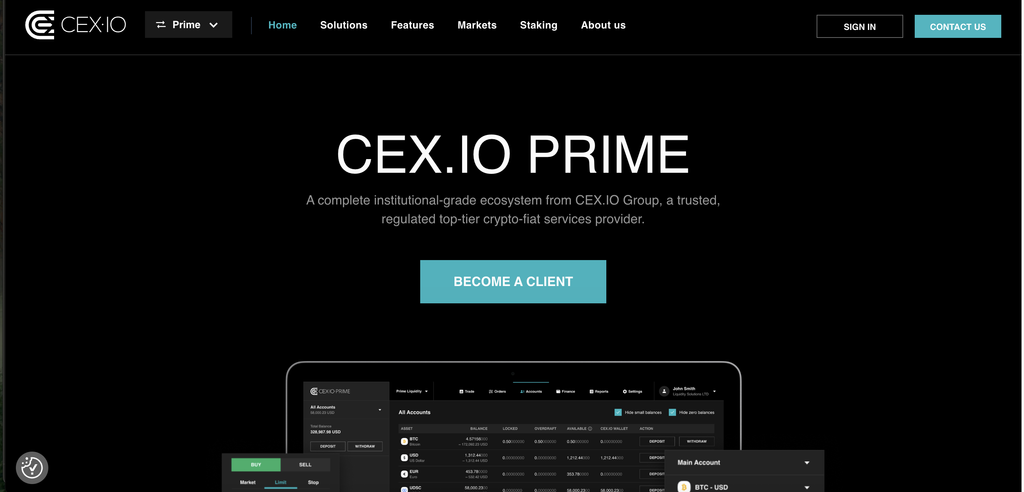
The workflow is written down and it does not change between trades. You send your account manager the asset, the side, the size and the settlement asset. The manager sources a price and presents a quote with a validity period. You confirm in writing inside that period, and the manager executes the block away from the public order book. The internal ledger then settles the balance on your account, and the trade appears in standard reporting next to everything else you run. That written exchange between you and the desk is the audit record, which is the part a compliance team actually needs.
Sub-accounts hold segregated balances, with mandatory address whitelisting and approval rules you configure. Every operation posts to one ledger with consistent identifiers, so you pull account-level and sub-account-level statements through the interface or the API and feed them into your own accounting. Connectivity covers FIX 4.4, REST and WebSocket, with a sandbox before production keys.
On the trust side, CEX.IO holds a PCI DSS Level 1 certification as a Level 1 Service Provider, assessed by Kyte Global, certificate 18815, issued on 23 March 2026. That is a dated third-party document you can request, which is a different class of evidence from a badge on a page.
Kraken OTC
Kraken publishes more of its OTC terms than anyone else on this list. The page offers deep liquidity for spot and derivatives trades over 50,000 US dollars, with a footnote limiting availability to OTC clients in certain jurisdictions. It states that clients settle trades within 24 hours using a Kraken account, a bank or an external wallet, and it names Payward Oceanic Ltd. as the entity offering OTC services.
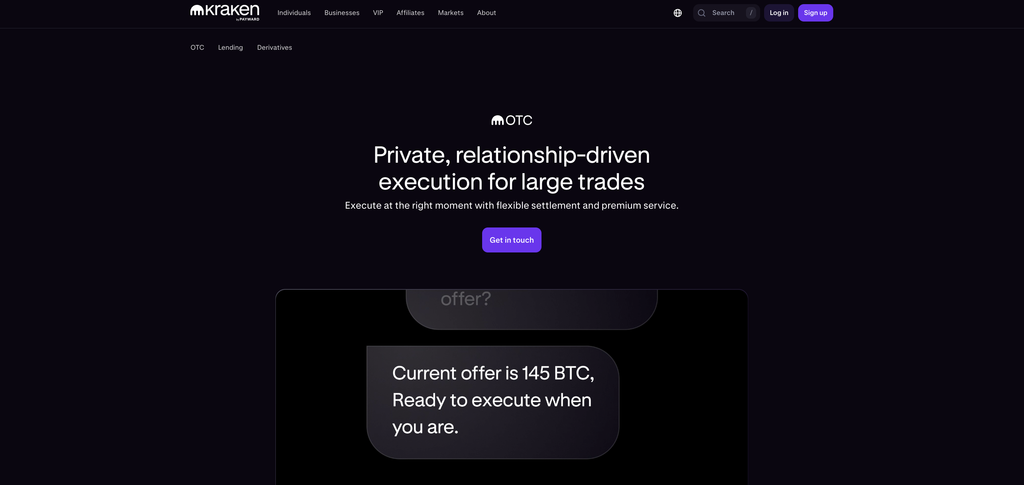
Two execution routes run side by side: a self-service RFQ through the OTC portal, and trading by chat with the desk. Kraken quotes 150 or more pairs through the portal, and the 550 asset figure on its institutional page covers trading and custody together across the whole institutional offering. Connectivity is API, WebSockets, REST and FIX 4.4. Kraken also runs OTC lending with a stated minimum loan size of 500,000 US dollars.
The published operational figures are 2.5 millisecond baseline round-trip latency and 99.9% uptime. Those measure the connection, so they say nothing about the price you get, and no other desk on this list publishes that either.
Coinbase Prime
Coinbase gives the fullest regulatory picture of the five. The pages name NYDFS qualified custodian status, a New York licence to engage in virtual currency business activity, a MiCA licence covering EU member states, and registration as a futures commission merchant with the CFTC. Custody sits with Coinbase Custody Trust Company, LLC, a limited purpose trust company chartered by NYDFS.
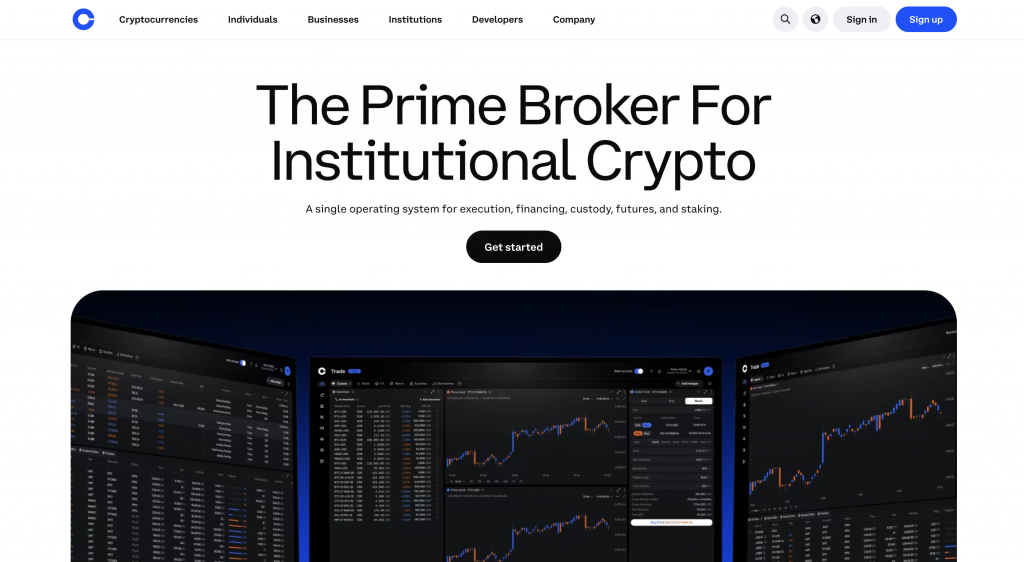
Execution runs through RFQ, a smart order router across venues, algorithmic order types including TWAP and iceberg, and Coinbase Execution Services, which the company describes as an agency-only trading desk. Agency-only is a meaningful detail, because an agency desk works your order in the market and does not take the other side of it.
What Coinbase does not publish is almost as notable. There is no minimum ticket anywhere, no settlement timing, and no named connectivity protocol on the institutional pages. Its own asset counts also disagree across pages, with 275 or more tradeable assets on the Prime page and 200 or more on the trading page, so cite whichever page you are quoting.
Binance OTC
Binance sets the highest published entry point here. Its FAQ states that the minimum trade size for manual Spot RFQ and IOI transactions is 200,000 US dollars or the equivalent, and it notes that the minimum for Options RFQ varies by symbol. The page describes settlement on RFQ as near-instant.
The service covers RFQ for spot and options, Indication of Interest, and high-touch execution with relationship managers. Contact routes include a named Telegram desk and an email address, which suits firms that already work that way and reads oddly to firms that expect a portal.
On the regulatory side the page names Binance ADGM entities regulated by the Financial Services Regulatory Authority of Abu Dhabi Global Market, and it lists the Nest entities covering exchange, clearing, custody and trading. It does not say which of those entities becomes your counterparty, so ask before you sign.
OKX Liquid Marketplace
OKX runs the lowest published threshold of the five. The minimum notional size for a block is 1,000 US dollars or the equivalent, subject to exceptions in volatile markets, and the FAQ answers the question about a minimum asset requirement with three words: no minimum requirement. That makes it the most accessible desk here for a firm testing the workflow before it commits size.
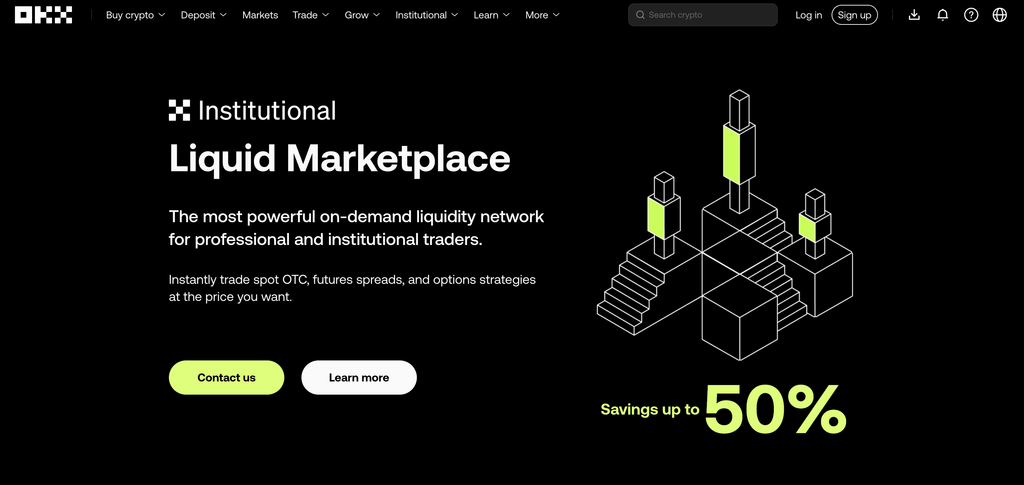
Execution covers RFQ, block trading and Nitro Spreads for one-click basis trades. Connectivity is REST and WebSocket, with no FIX version named. The European entity is OKX Europe Limited, licensed by the Malta Financial Services Authority as a crypto-asset service provider under MiCA, which is one of the clearest entity and licence pairings in this comparison.
The gap is settlement. Neither the Liquid Marketplace page nor the institutional page states how quickly a trade settles, and the institutional page publishes a 99.99% uptime record that describes the venue and not the desk.
Settlement and counterparty risk
Execution gets the attention and settlement is where the money goes missing. Three models cover almost every desk, and the difference between them decides how much of your balance sits with someone else and for how long.
Pre-funding
You send the full notional to the desk before it executes. Your capital sits with the counterparty for the whole window, and you carry that exposure until the asset comes back.
Post-trade settlement on credit
The desk extends a line, executes, and you settle afterwards. Your capital stays with you, and the desk takes credit risk on you, which is why this route needs due diligence on both sides.
Delivery against payment
Both legs move together, so neither side holds the other’s asset without cover. This removes most of the settlement exposure and it needs infrastructure that supports it.
Three questions answer most of it before the first trade. Which model does the desk use by default? Who holds the asset between the legs? What happens to your claim if the desk defaults after you have funded and before it has delivered?
What onboarding looks like
Onboarding at a real institutional desk takes days or weeks, and the document list is long. That friction is the product working, because the same checks that slow you down are the ones keeping the desk’s book clean.
STEP 01. Scope and agreement
You and the desk agree the products, assets, rails and limits, then sign a master agreement. Read which entity signs it.
STEP 02. KYB, KYC and source of funds
Expect a certificate of incorporation, beneficial ownership disclosure, sanctions screening and evidence of where the money comes from.
STEP 03. Access and a test trade
The desk configures accounts, issues production keys and assigns a contact. Run one minimum-size trade through the full cycle before you scale.

Frequently asked questions
Is every crypto OTC trading platform legit?
No. The label OTC carries no legal meaning on its own, and fraudulent operations use it freely. Legitimacy comes from a named legal entity you can find on a supervisor’s public register, real onboarding checks, written agreements and disclosed settlement mechanics. Verify those four before you send anything.
Is OTC crypto trading safe?
Trading through a licensed desk with segregated client assets and written confirmations carries the normal counterparty and market risk of any bilateral trade. Trading through an unverified desk carries the risk of losing the whole amount. The difference sits in the checks you run first, not in the trade itself.
Is OTC crypto trading legal?
Yes, in the jurisdictions where the desk holds the right registration and where your own entity can transact. Requirements vary, so the licence a desk needs in New York differs from the one it needs in Malta or the United Arab Emirates.
How do I check if a crypto OTC desk is regulated?
Take the legal entity name from the contract and search it on the supervisor’s register directly: FinCEN and the relevant state regulator or NYDFS in the United States, the FCA register in the United Kingdom, the MiCA CASP register in the European Union, FINTRAC in Canada, MFSA in Malta, VARA, FSRA or DFSA in the United Arab Emirates. A logo on a website is not evidence.
Is a FinCEN registration enough to run an OTC desk?
No. The FBI states that inclusion in the FinCEN registry is not a recommendation, certification of legitimacy or endorsement. Registration also does not replace a state money transmitter licence or a BitLicense where the state regime applies.
What is the difference between an OTC desk and an exchange?
An exchange matches your order against a public book, in pieces, at whatever prices the depth offers. A desk quotes one price for the whole size and settles bilaterally, so the order never reaches a public book.
How do crypto OTC desks make money?
Most earn on the spread between the price they source and the price they quote you, so the cost sits inside the number and never appears on a separate line. Ask whether the quote is all-in and whether any execution or settlement fee applies on top.
What is the minimum trade size for a crypto OTC desk?
It varies enormously. Among the desks compared here, OKX publishes a 1,000 US dollar minimum block notional, Kraken serves trades over 50,000 US dollars, and Binance sets 200,000 US dollars for manual Spot RFQ and IOI. Coinbase and CEX.IO Prime publish no figure, so you have to ask.
What happens if an OTC counterparty defaults?
That depends entirely on the settlement model and on whether your assets were segregated. If you pre-funded and the desk failed before delivering, you become a creditor. This is the reason to read the segregation policy and the settlement process before the first trade.
Is 24/7 OTC trading the same as 24/7 settlement?
No. Crypto rails run continuously and fiat rails follow banking hours and cut-off times. A desk can quote you at three in the morning and still settle the fiat leg on the next business day.
What is an RFQ in crypto trading?
A request for quote. You ask for a price on a defined size, the desk returns a firm number with a validity period, and you either accept inside that period or let it lapse. It suits execution that needs an internal approval before anyone trades.
What should I ask a desk before the first trade?
Six things: which entity signs the agreement, which register shows it, what the minimum and the quote validity period are, how settlement works and who holds the asset between the legs, whether client assets are segregated, and whether they will run a test trade.