
Atomic Wallet is a self-custody crypto wallet that runs without accounts, identity checks, or centralized control over user funds. Private keys stay on the user’s device, and access relies entirely on a backup phrase. The wallet supports 1,500+ assets, includes built-in swaps and staking across multiple networks, and allows fiat purchases through external providers.
That setup defines how everything works. Storage and access remain under user control, while transactions such as swaps, purchases, and some trading features depend on third-party infrastructure. Fees, execution speed, and availability vary depending on those integrations.
This review explains how Atomic Wallet handles custody, transactions, staking, and trading tools, and where its design introduces clear limitations alongside its core functionality.
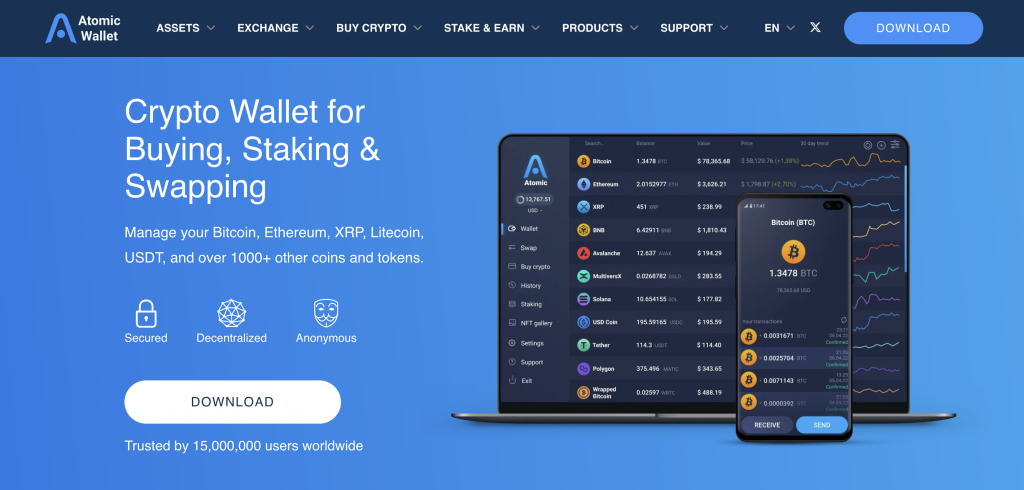
Atomic Wallet at a Glance
Atomic Wallet combines self-custody storage with built-in tools for staking, swaps, and crypto purchases. The table below outlines the core facts that define how the wallet operates.
| Feature | Details |
| Wallet Type | Self-custody (private keys stored locally) |
| Supported Assets | 1,500+ cryptocurrencies |
| Blockchain Coverage | 50+ blockchains |
| Platforms | Desktop (Windows, macOS, Linux), Mobile, Browser extension |
| Account Requirement | No account or KYC for core wallet use |
| Staking Support | 20+ assets with variable APY |
| Trading Features | Built-in swaps, fiat on-ramp via third-party providers |
What Is Atomic Wallet?
Atomic Wallet is a self-custody cryptocurrency wallet that stores private keys on the user’s device rather than on a centralized server. It supports 1,500+ digital assets across multiple blockchains and allows users to manage, send, receive, and swap crypto within a single interface.
The wallet does not require account registration or identity verification for basic use. Access depends on a backup phrase generated during setup. Alongside storage, Atomic Wallet includes staking for selected assets and fiat purchase services provided through external partners, which handle payment processing and execution.
How Atomic Wallet Works
Atomic Wallet generates and stores private keys locally, giving users direct access to their funds through a non-custodial model. Transactions such as sending or receiving crypto occur directly on the blockchain, with network fees determined by each protocol.
Built-in swaps and fiat purchases rely on third-party service providers. These providers process transactions, set exchange rates, and apply service fees. Staking operates through blockchain validators, where supported assets can earn rewards over time. The wallet also integrates multiple blockchains in one interface, allowing users to manage different assets without switching between separate applications.
Key Features of Atomic Wallet
Atomic Wallet combines storage with built-in tools that extend beyond basic transfers. The features below define how users interact with assets inside the wallet.
Self-Custody Storage
Private keys remain on the user’s device and are never shared with Atomic Wallet servers. Access depends entirely on the backup phrase, which restores the wallet on another device if needed. The platform does not store keys, passwords, or recovery phrases, and does not process transactions on behalf of users.
Multi-Asset Support and Built-In Swaps
Atomic Wallet supports 1,500+ assets across 50+ blockchains, allowing users to manage a wide range of cryptocurrencies in one place.
The wallet includes a built-in swap function that connects to external liquidity providers. Exchange rates and fees vary among providers, and transactions complete without transferring custody of funds to a centralized account.
Staking and Reward Mechanisms
The wallet supports staking for 20+ assets, including networks such as Ethereum, Solana, Cosmos, and Cardano. Estimated annual yields vary by asset, with some networks offering higher rates depending on validator conditions.
Rewards distribution depends on the blockchain. Some assets add rewards automatically, while others require manual claiming. Lock-up and unstaking periods may apply, depending on the network rules.
Atomic Wallet Fees Explained
Atomic Wallet uses several fee layers, and not all of them come from the wallet itself. Standard send and receive transactions only require the blockchain network fee, which goes to miners or validators, not to Atomic Wallet.
For swaps, Atomic Wallet says it charges 0.5% plus its swap partners’ commission, with the quoted amount already reflecting network and related costs. For card-based crypto purchases, Atomic Wallet lists a flat 5% fee with a $10 minimum per transaction, while the issuing bank may add roughly another 5% processing fee.
Network fees also apply to the transfer of the purchased asset. This makes the fee structure broader than that of many wallets, which charge only blockchain fees.
How to Use Atomic Wallet
Atomic Wallet combines wallet setup, asset management, swaps, staking, and crypto purchases in one app. The steps below show how the wallet works from setup to everyday use.
Step 1: Download and install the wallet
Install Atomic Wallet on a supported device. The platform offers desktop versions for Windows, macOS, Ubuntu, Debian, and Fedora, along with mobile access.
Step 2: Create a wallet and save the backup phrase
Open the app, create a new wallet, and write down the 12-word backup phrase. Store it offline in more than one secure place. Atomic Wallet does not store recovery phrases, private keys, or passwords, so wallet recovery depends entirely on that phrase.
Step 3: Add crypto to the wallet
Transfer crypto from another wallet or exchange by selecting the asset and copying the receiving address. You can also buy crypto in the app through Simplex, which handles card payments and conversion. Purchase fees and network costs appear before confirmation.
Step 4: Send crypto
Choose the asset, enter the receiving address, add the amount, and review the network fee. Atomic Wallet says it does not charge extra for regular send and receive transactions. The blockchain fee changes with network demand, and for BTC-like assets, it also depends on transaction inputs.
Step 5: Adjust the network fee when supported
For BTC, LTC, ETH, and BSC, along with ERC-20 and BSC tokens, Atomic Wallet allows manual fee adjustment. The wallet shows a slider that lets you choose slower to faster confirmation speeds. Atomic says the default fee aims for confirmation within the next one to two blocks, while lower custom fees can leave a transaction pending for hours or days.
Step 6: Track balances and transaction history
Atomic Wallet pulls balance data and transaction history from public blockchains. That means the app works as an interface for blockchain data, while the blockchain itself remains the final record of ownership and transfers.
Supported Cryptocurrencies and Networks
Atomic Wallet supports 1,500+ cryptocurrencies across 50+ blockchains, covering major networks such as Bitcoin, Ethereum, Solana, Tron, and Cosmos, along with a wide range of tokens.
The wallet integrates multiple ecosystems into a single interface, allowing users to manage assets without switching between separate applications. It also added new networks and Layer 2 integrations, including Optimism and other emerging chains, expanding asset coverage further. Support includes standard tokens such as ERC-20 and TRC-20, along with staking-enabled assets. Availability of specific tokens depends on network compatibility and ongoing integrations.
Pros and Cons of Atomic Wallet
Atomic Wallet delivers a wide feature set within a self-custody structure, but that design introduces clear trade-offs. The points below highlight where the wallet performs well and where limitations appear.
Pros
- Self-custody, private keys stored locally
- 1,500+ assets across 50+ blockchains
- Staking available for 20+ assets
- Built-in swaps and crypto purchases
- No account or KYC required for core use
Cons
- Relies on third-party providers for swaps and purchases
- Multiple fee layers (network, swap, provider fees)
- Limited control over exchange rates and execution
Atomic Wallet vs Other Wallets
Atomic Wallet, CEX.IO Wallet, and KuCoin Wallet serve different roles. One gives full self-custody, while the others operate within regulated or exchange-based environments. The differences affect access, recovery, fees, and how transactions are handled.
Atomic Wallet vs CEX.IO
Atomic Wallet operates without account registration. Users create a wallet, receive a 12-word backup phrase, and manage assets directly on-chain. Transactions, swaps, and staking happen without identity checks, but crypto purchases and swaps depend on third-party providers that set pricing and fees.
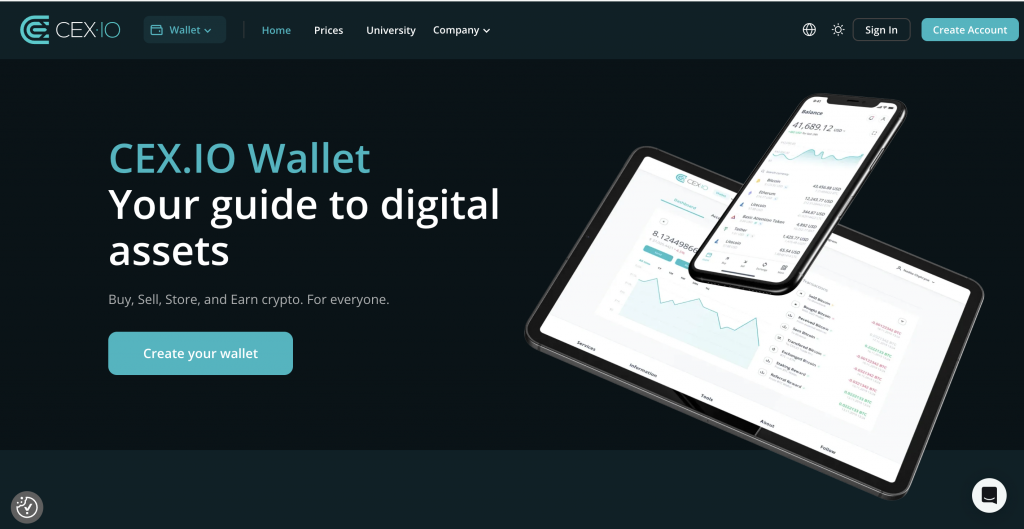
CEX.IO follows a different structure. It requires identity verification because it operates under regulatory frameworks in supported jurisdictions. That process enables direct access to fiat services, such as bank transfers, card purchases, and withdrawals, all on one platform. Transactions execute within the platform environment, and the final price is displayed before confirmation.
Recovery also differs. Atomic Wallet cannot restore access without the backup phrase. CEX.IO allows account recovery through verification, which can help users who lose credentials.
Atomic Wallet suits users who want direct key control. CEX.IO may suit users who need fiat access, clearer pricing, and account recovery within a regulated service.
Atomic Wallet vs KuCoin Wallet
Atomic Wallet and KuCoin Wallet both support self-custody, but their scopes differ. Atomic Wallet supports 1,500+ assets across multiple blockchains and includes staking, swaps, and fiat purchases through partners.
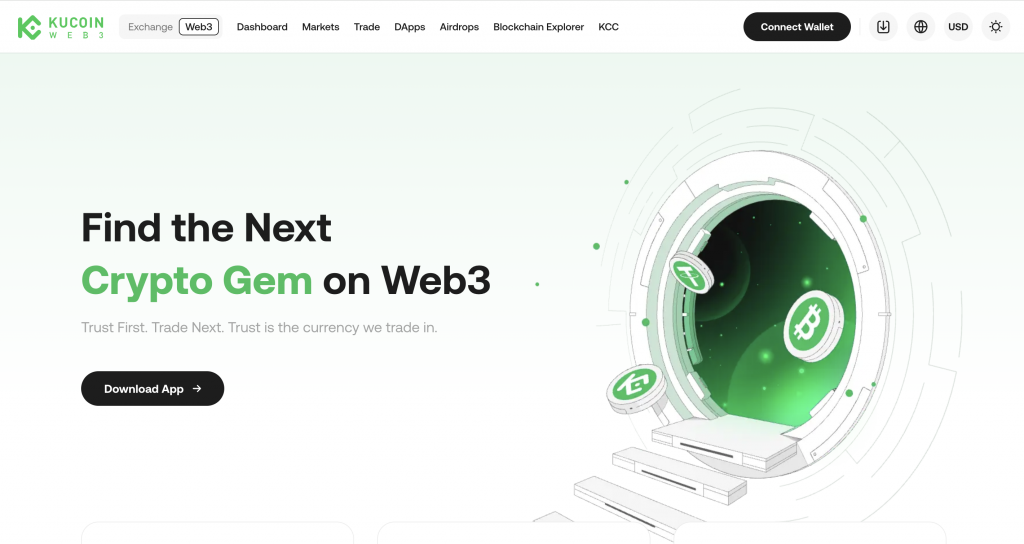
KuCoin Wallet connects closely with the KuCoin exchange ecosystem and Web3 services. It supports dApps, NFTs, and cross-chain activity, with tighter integration into trading infrastructure.
Atomic Wallet keeps everything in one application with staking and swaps built in. KuCoin Wallet leans toward users who interact with exchange-linked services and Web3 applications more frequently.
Wallet Comparison Overview
Each wallet follows a different structure. The table below highlights how they differ across key areas.
| Feature | Atomic Wallet | CEX.IO Wallet | KuCoin Wallet |
| Wallet Type | Self-custody | Custodial | Self-custody |
| Key Control | User holds keys locally | Platform manages access | User holds keys |
| Ease of Use | Moderate, requires understanding of fees and networks | High, guided flows and clear prompts | Moderate, Web3-focused interface |
| Transaction Flow | On-chain execution, external providers for swaps | Platform-based execution | On-chain with exchange integrations |
| Fee Visibility | Varies by provider and network | Final price shown upfront | Varies by network and service |
| Recovery Access | Backup phrase only | Account recovery via verification | Backup phrase required |
| Fiat Access | Through third-party providers | Built-in buy, sell, and withdrawal | Limited, depends on integrations |
(H3) Which Wallet Is Better for Beginners?
CEX.IO Wallet may suit beginners who want a guided environment. Identity verification enables access to fiat deposits, withdrawals, and account recovery, which reduces the risk of losing access due to a missing backup phrase. The platform also shows final pricing before confirming transactions.
Atomic Wallet requires managing a backup phrase and understanding network fees, staking rules, and third-party pricing. KuCoin Wallet introduces additional complexity through Web3 tools and dApp connections.
For users starting out, a structured platform with recovery support and integrated fiat access can make the onboarding process more manageable.
(H2) FAQs
(H3) Is Atomic a safe wallet?
Atomic Wallet uses a self-custody model, where private keys remain on the user’s device and are not stored by the platform. Access depends on a 12-word backup phrase. Security, therefore, relies heavily on how well that phrase is stored. The wallet also includes alerts for suspicious tokens, but it does not provide account recovery, as you do on CEX.IO and other regulated exchanges.
(H3) Can I cash out of an Atomic Wallet?
Atomic Wallet does not process fiat withdrawals directly. To convert crypto into cash, users usually send funds to an exchange that supports bank withdrawals. The wallet includes fiat purchase features, but off-ramping typically requires moving assets to a platform that handles withdrawals to bank accounts.
(H3) Who is the Atomic Wallet?
Atomic Wallet is a non-custodial wallet provider that develops software for storing and managing cryptocurrencies. It does not hold user funds or control transactions. The platform operates as a software interface that connects users to blockchain networks and third-party service providers for certain functions.
(H3) How do I access my Atomic Wallet?
Access depends on the password set during installation and the 12-word backup phrase. The wallet can be restored on another device using that phrase. If both the password and backup phrase are lost, access to the funds cannot be восстановed, since Atomic Wallet does not store recovery data.
(H3) Can I withdraw from an Atomic Wallet to a bank account?
Atomic Wallet does not support direct withdrawals to bank accounts. Users typically transfer crypto to an exchange that offers fiat withdrawal methods such as bank transfer or card payout. The wallet itself acts as a storage and transaction interface rather than a fiat off-ramp service.
(H3) Does Atomic Wallet charge a fee?
Atomic Wallet does not charge fees for standard send or receive transactions. Users pay blockchain network fees instead. For swaps, the wallet applies around 0.5% plus partner commissions. Card purchases include a base fee and additional processing charges from payment providers and issuing banks.
(H3) Is Atomic Wallet safer than Coinbase?
Atomic Wallet and Coinbase follow different models. Atomic Wallet stores keys locally, so users manage their own security. Coinbase operates as a custodial platform with account-based access, recovery processes, and compliance requirements. Each model introduces different risks, depending on whether users prefer self-custody or platform-managed access.
(H3) Does Atomic Wallet report to the IRS?
Atomic Wallet does not require identity verification for core wallet use, and it does not act as a reporting entity. However, transactions recorded on public blockchains remain visible. Users may still have tax obligations depending on their jurisdiction and should review local reporting requirements.