
Choosing the best crypto wallet in Australia in 2026 is one of the most important decisions a user makes when managing digital assets. Custodial wallet providers must register with AUSTRAC under Australia’s AML/CTF framework, and the Corporations Amendment (Digital Assets Framework) Act — passed April 2026 — now requires platforms that hold digital assets on behalf of customers to obtain an Australian Financial Services Licence (AFSL) from ASIC. Self-custody wallets, where users hold their own private keys, fall outside AUSTRAC scope entirely. This guide reviews five leading wallets — CoinSpot, CEX.IO, Kraken Wallet, Binance, and Swyftx — covering wallet type, AUD funding, fees, and features for Australian users.
Best Crypto Wallet Comparison
| Wallet | Wallet Type | Key Characteristics | AUD Funding | Fees |
|---|---|---|---|---|
| CoinSpot | Custodial (Hot) | 480+ coins; PayID; free AUD withdrawals; AUSTRAC | PayID, bank transfer, card | 0.10% market; 1% instant buy |
| CEX.IO | Custodial (Hot) | AUSTRAC compliant; 310+ coins; card deposits; Earn | Visa/Mastercard card | 0.25% entry (≤$10K) |
| Kraken Wallet | Non-Custodial (Hot) | Self-custody; BTC/ETH/SOL/Polygon/Base/DOGE; free | No direct AUD gateway | Free to hold; network fees apply |
| Binance | Custodial + Web3 (Hot) | 500+ coins; Web3 Wallet MPC (130+ chains); 0.10% fee | PayID, bank transfer, card | 0.10% spot trading |
| Swyftx | Custodial (Hot) | AU-born; 320+ coins; PayID instant; SMSF accounts | PayID, Osko, bank transfer, card | 0.10%–0.60% by tier |
CoinSpot
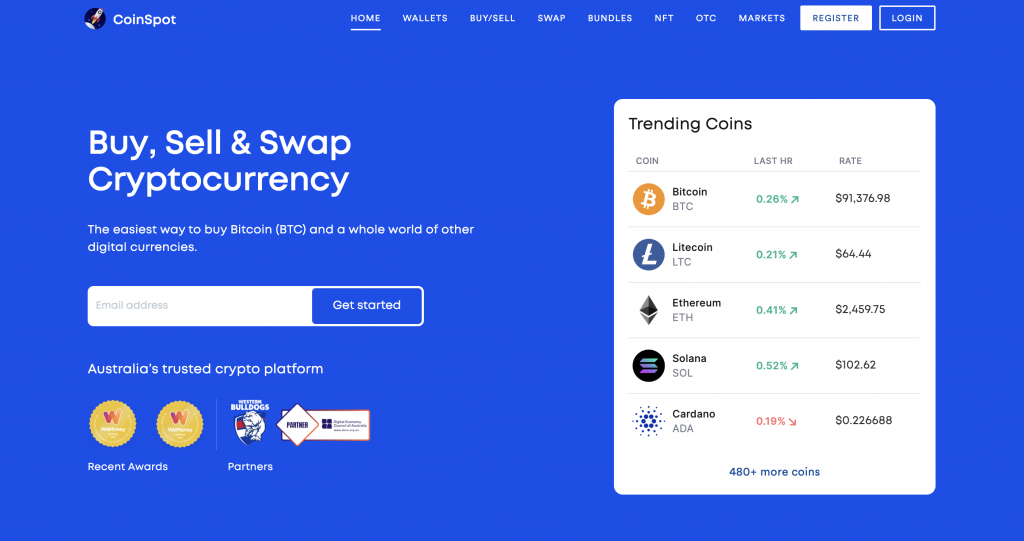
CoinSpot is Australia’s largest domestic crypto exchange, founded in Melbourne in 2013, holding AUSTRAC registration and ISO 27001 security certification. With more than 2.5 million registered users, CoinSpot operates a custodial wallet embedded in its platform — users hold crypto in their account without managing private keys. The platform supports over 480 cryptocurrencies and is built entirely around AUD, with PayID deposits, bank transfers, and free AUD withdrawals as standard features for every account.
Key Features
CoinSpot delivers the most complete AUD-native experience of any wallet reviewed here. PayID deposits settle instantly, and AUD bank withdrawals carry no fee regardless of amount — a clear advantage over global platforms that charge fiat exit fees. Market orders carry a 0.10% fee, matching Binance and competitive with any AUSTRAC-registered exchange. Instant buy — the one-click purchase at the best available price — carries a 1% fee, which is higher than Binance’s 0.10% spot rate but faster for users who do not want to place limit orders. CoinSpot stores the majority of customer assets in cold storage, with a smaller portion in hot wallets to support daily trading and withdrawals.
Compared to CEX.IO, CoinSpot offers direct AUD bank infrastructure and a wider coin catalogue of 480+ assets, but without a global regulatory footprint beyond Australia. Compared to Swyftx, CoinSpot lists more coins (480+ vs 320+) at the same 0.10% market order rate, while Swyftx provides a more modern interface and dedicated SMSF account structures.
Why Choose CoinSpot
Australian users who want to buy, sell, and hold crypto using Australian dollars — without currency conversion or reliance on international payment infrastructure — will find CoinSpot the most complete domestic option on this list. PayID deposits arrive instantly, AUD withdrawals are free, and the 480+ coin catalogue covers every major asset alongside hundreds of altcoins unavailable on global platforms like CEX.IO. For Australians whose primary goal is AUD-to-crypto and back, CoinSpot removes every friction point that international platforms introduce.
CEX.IO
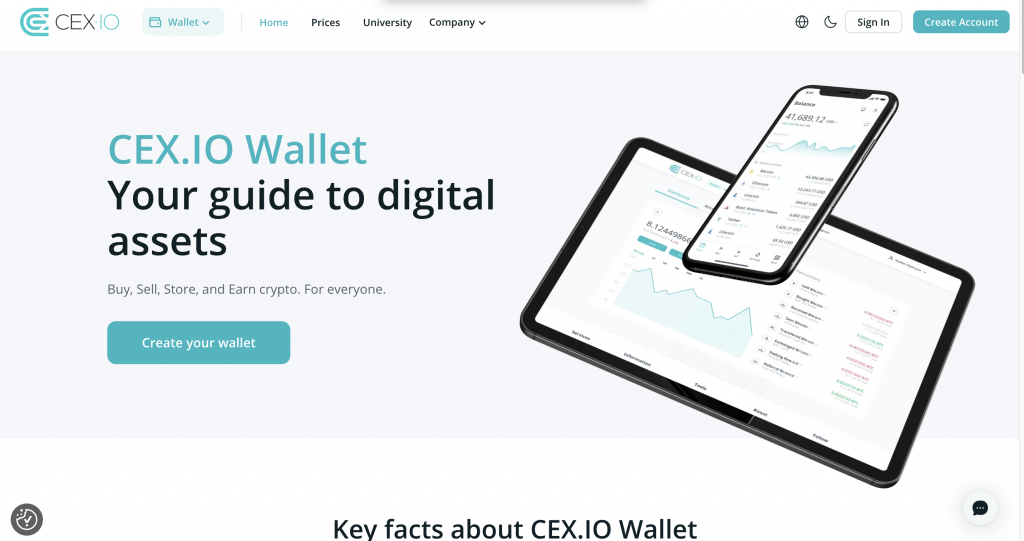
CEX.IO is a global exchange with a growing presence in the Australian market, offering a secure, AUSTRAC-compliant, and easy-to-use custodial wallet. The CEX.IO Wallet is designed for both beginners and experienced traders who want a globally licensed platform with direct card funding from Australia. CEX.IO is a custodial wallet — CEX.IO holds private keys on behalf of users, delivering an account-based experience without the need to manage seed phrases or hardware devices. The platform has operated since 2013 and holds over 40 regulatory licences globally alongside AUSTRAC compliance for Australian users.
Key Features
CEX.IO Wallet is often regarded as a strong choice for Australian users who want a globally regulated custodial platform with direct card deposit access. It stores Bitcoin, Ethereum, and over 310 other cryptocurrencies, integrating directly with CEX.IO’s Spot Trading and Instant Buy for fast card-funded purchases. Australian users fund accounts via Visa or Mastercard — deposits arrive quickly without requiring a local bank transfer through a secondary platform. Entry-level spot trading fees sit at 0.25% for volumes up to $10,000, dropping further at higher volumes. CEX.IO Earn is available for eligible Australian users, letting holdings generate rewards on supported assets — a feature Kraken Wallet and CoinSpot do not offer in an equivalent form.
Compared to CoinSpot, CEX.IO does not offer AUD bank transfers or AUD trading pairs, but its gives users global account access that AU-only platforms cannot match.
Australian users should note that CEX.IO offers spot trading only in Australia — derivatives and margin trading require a separate ASIC licence that CEX.IO does not hold for the Australian market. The crypto debit card is available in EEA countries only and is not available to Australian users. PayPal deposits are US-only and not available in Australia. AUD bank transfers and AUD trading pairs are not currently available.
Why Choose CEX.IO
Australian users who want a globally regulated custodial wallet with direct card funding will find CEX.IO a strong choice. Card deposits from Australian-issued Visa and Mastercard cards provide fast funding without requiring a secondary AUD exchange step. The AUSTRAC compliance and 40+ global licences give Australian account holders the same regulatory backing as users in the US and Europe. CEX.IO Earn adds a passive layer for eligible users holding crypto on the platform.
Kraken Wallet
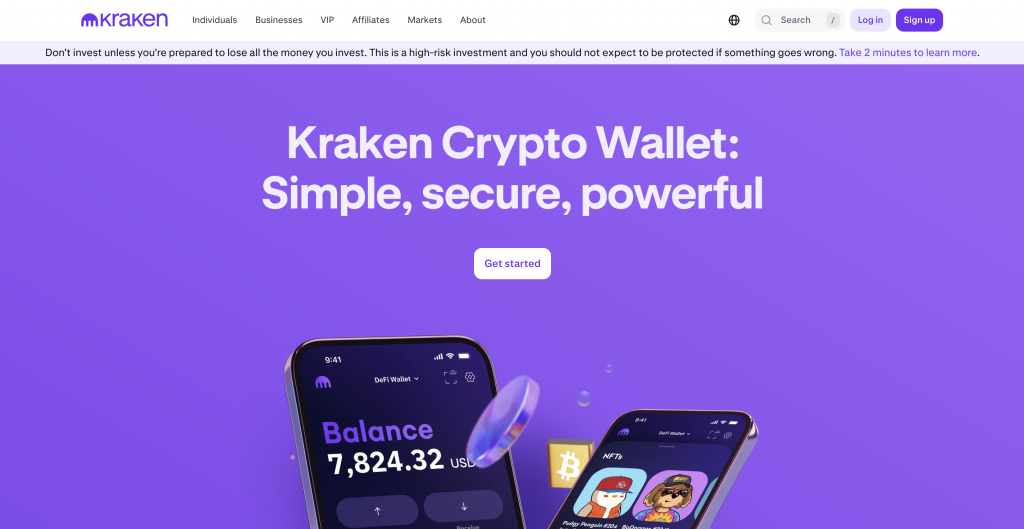
Kraken Wallet is a self-custody mobile wallet developed by Kraken, one of the most established AUSTRAC-registered crypto exchanges operating in Australia. Users hold their own private keys through a locally generated seed phrase — Kraken has no access to wallet funds at any point. As a non-custodial wallet, Kraken Wallet is not subject to AUSTRAC registration requirements. From March 31, 2026, Australian users moving crypto between Kraken Wallet and the Kraken exchange must complete additional verification steps under Australia’s updated Travel Rule obligations.
Key Features
Kraken Wallet supports Bitcoin, Ethereum, Solana, Dogecoin, Polygon, Arbitrum, Optimism, Base, and Blast — covering the major chains Australian DeFi and Web3 users access. NFT support is available on Ethereum, Arbitrum, Base, Optimism, Polygon, and Solana, giving users a built-in way to view and manage digital collectibles without a separate application. WalletConnect integration connects the wallet to decentralised applications directly from the mobile interface. The wallet links to the Kraken exchange, simplifying transfers between the custodial exchange account and the self-custody wallet while keeping keys with the user at all times.
Compared to Binance Web3 Wallet, Kraken Wallet covers fewer chains (9 vs 130+) but carries the brand trust of an AUSTRAC-registered exchange with a long compliance track record. Compared to CEX.IO, Kraken Wallet gives users full key control and DeFi access, while CEX.IO provides AUD card funding and Earn features that a self-custody wallet cannot replicate natively.
Why Choose Kraken Wallet
Australian users who want DeFi and Web3 access under a self-custody model, backed by the compliance standing of a well-established exchange, will find Kraken Wallet a compelling option. The WalletConnect integration connects to dApps directly from mobile, and the link to the Kraken exchange makes it straightforward to move assets from a custodial trading account into self-custody. For Australians who already use Kraken exchange and want to step into self-custody without adopting a completely separate product ecosystem, Kraken Wallet is the most direct path.
Binance
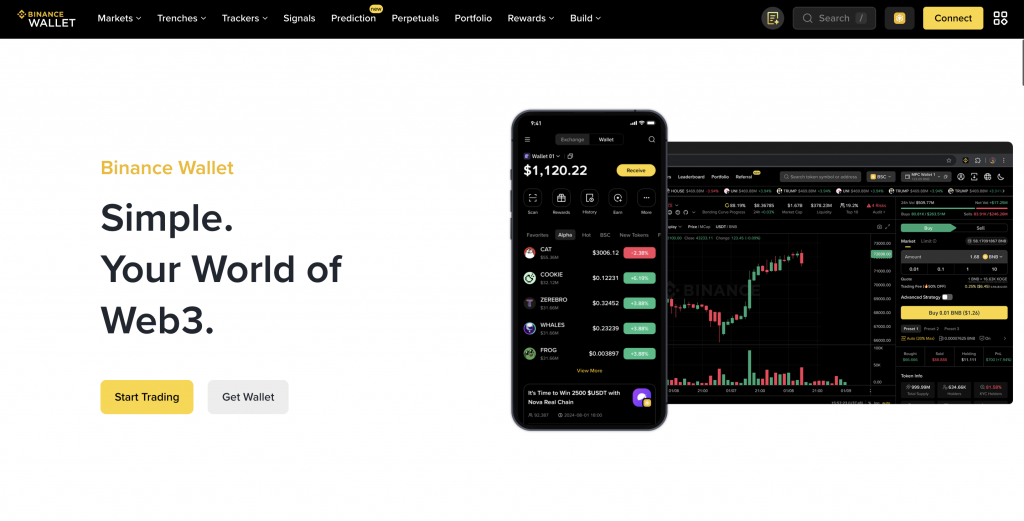
Binance operates in Australia in 2026 through InvestbyBit Pty Ltd, an entity registered with AUSTRAC as a Digital Currency Exchange. The platform gives Australian users access to both a custodial exchange wallet — holding 500+ cryptocurrencies within a Binance account — and the Binance Web3 Wallet, a self-custody product built into the app using multi-party computation (MPC) key management. Binance’s spot trading fee of 0.10% is the lowest entry-level rate on this list. AUD deposits are available via PayID, bank transfer, and card.
Key Features
Binance covers two distinct wallet models within the same application. The custodial exchange wallet holds user funds on Binance’s servers, linked to a full KYC account — the standard exchange custody model. The Binance Web3 Wallet uses MPC key management: access is split across multiple encrypted key shares, removing dependence on a single private key and reducing single-point-of-failure risk. The Web3 Wallet supports 130+ blockchains — Ethereum, BNB Chain, Polygon, Arbitrum, Solana, and many more — giving it the widest multi-chain DeFi coverage of any wallet reviewed here. Binance Australia provides PayID deposits for instant AUD funding. From July 1, 2026, all crypto transfers require full sender and beneficiary details under Australia’s Travel Rule.
Compared to CoinSpot and Swyftx, Binance offers a lower spot trading fee (0.10%) and a global platform with 500+ coins, but with a more complex interface less suited to beginners. Compared to Kraken Wallet, Binance Web3 Wallet covers 130+ chains vs 9, giving it substantially broader DeFi reach.
Why Choose Binance
Australian users who want the lowest spot trading fees on this list combined with the widest multi-chain self-custody coverage through the Web3 Wallet will find Binance the strongest option for those two criteria. The 0.10% spot fee means active traders pay less per transaction than on any other platform reviewed here, and the 500+ coin catalogue reaches assets beyond the scope of AU-only platforms. The Web3 Wallet’s 130+ chain support far exceeds Kraken Wallet’s 9 supported networks, giving DeFi users access to a larger on-chain ecosystem from the same app. For Australian users comfortable with a feature-dense interface who want both exchange access and broad DeFi tools in one place, Binance covers both.
Swyftx
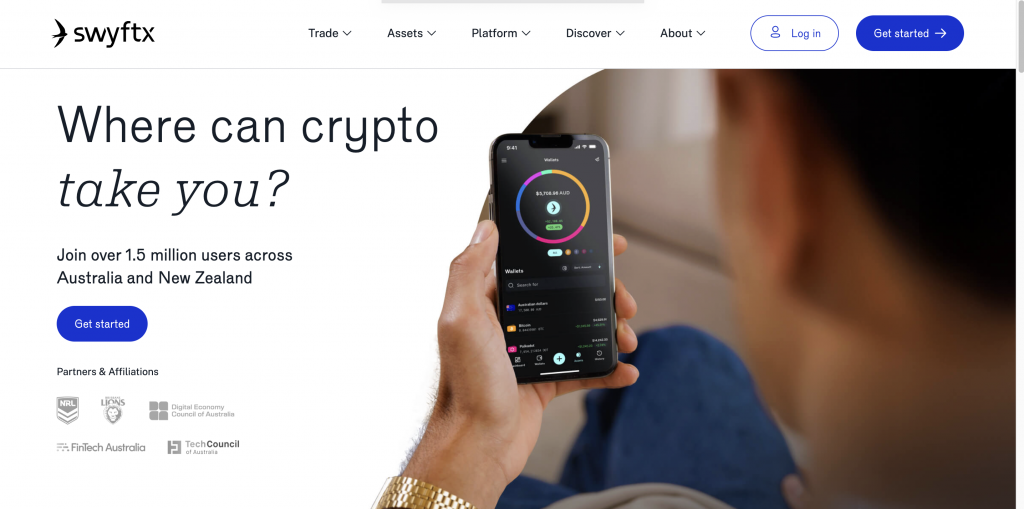
Swyftx is an Australian-born crypto exchange founded in Brisbane, holding AUSTRAC registration and ISO 27001 security certification. The platform serves over 1.5 million users across Australia and New Zealand with AUD-native deposits via PayID, Osko, and bank transfer, with PayID payments arriving instantly. Swyftx operates a custodial wallet model — users hold assets in their Swyftx account without managing private keys. The platform offers SMSF account structures, making it one of the few Australian platforms with dedicated infrastructure for self-managed superannuation fund investors.
Key Features
Swyftx supports 420+ cryptocurrencies with direct AUD trading pairs covering Bitcoin, Ethereum, Solana, and a wide range of altcoins. Trading fees range from 0.10% to 0.60% depending on volume tier, with 0.60% at the standard level. AUD withdrawals via bank transfer are free and typically process within one business day. Swyftx holds all customer funds 1:1 in full reserve, with independent audits published to verify solvency — a transparency standard not matched by all AUSTRAC-registered platforms. Card deposits via Stripe carry a third-party fee of 1.875%.
Compared to CoinSpot, Swyftx offers a more modern interface and SMSF support, but lists fewer coins (420+ vs 480+) and carries a higher standard trading fee (0.60% vs 0.10% market rate). Compared to CEX.IO, Swyftx provides direct AUD PayID deposits and local AU customer support, while CEX.IO offers a wider global regulatory footprint and international availability.
Why Choose Swyftx
Australian users who want a locally built custodial wallet with instant AUD deposits, full-reserve transparency, and SMSF support will find Swyftx a strong domestic option. The clean modern interface reduces the learning curve for users moving from banking apps into crypto, and the 1:1 reserve policy with published audits provides documented confirmation that assets are held in full. For Australians with a self-managed super fund looking to include crypto exposure through a purpose-built account structure, Swyftx is the only platform on this list with that specific product available.
FAQ
What is a crypto wallet?
A crypto wallet is a tool that stores private keys used to access cryptocurrency holdings on a blockchain. Custodial wallets — like CoinSpot, CEX.IO, Binance, and Swyftx — hold private keys on behalf of users, providing an account-based experience with customer support and AUD banking. Non-custodial wallets — like Kraken Wallet and Binance Web3 Wallet — give users direct control of their own keys through a seed phrase or MPC key shares. Users who hold their own keys bear full responsibility for key security and have no recovery option if keys are lost.
What is the best crypto wallet in Australia?
The best crypto wallet for an Australian user depends on what they need. CoinSpot suits users who want AUD-native deposits, 480+ coins, and free bank withdrawals from Australia’s largest domestic platform. CEX.IO suits users who want a globally regulated custodial wallet with card deposit funding and international reach. Kraken Wallet suits users who want self-custody backed by an established AUSTRAC-registered exchange. Binance suits active traders who want the lowest fees and widest DeFi chain coverage through the Web3 Wallet. Swyftx suits users who want a modern Australian platform with instant PayID deposits, full-reserve transparency, and SMSF support.
Which crypto wallets are AUSTRAC registered in Australia?
Custodial wallet providers operating as digital currency exchanges must register with AUSTRAC. CoinSpot, CEX.IO, Binance (through InvestbyBit Pty Ltd), and Swyftx are each AUSTRAC registered. Kraken Wallet is not subject to AUSTRAC registration as a non-custodial tool. The Corporations Amendment (Digital Assets Framework) Act passed April 2026 adds an AFSL requirement for platforms holding digital assets on behalf of customers — this is separate from AUSTRAC registration, and not all platforms reviewed here currently hold an AFSL.
Is Binance available in Australia?
Yes. Binance operates in Australia in 2026 through InvestbyBit Pty Ltd, an entity registered with AUSTRAC as a Digital Currency Exchange. Australian users access Binance with AUD deposits via PayID and bank transfer available. Binance does not currently hold an AFSL from ASIC. From July 1, 2026, all crypto transfers on Binance Australia require sender and beneficiary details under Australia’s Travel Rule.
Can I buy crypto with AUD?
Yes, for custodial wallets with AUD banking. CoinSpot and Swyftx accept AUD via PayID and bank transfer with instant settlement. Binance Australia accepts AUD via PayID, bank transfer, and card. CEX.IO accepts card deposits from Australian-issued Visa and Mastercard, but does not support AUD bank transfers. Kraken Wallet is non-custodial with no direct AUD deposit gateway — Australian users fund it by buying crypto on a separate AUSTRAC-registered exchange and transferring assets to the wallet.
Is CEX.IO Wallet available in Australia?
Yes. CEX.IO holds AUSTRAC compliance and over 40 global regulatory licences. Card deposits via Visa or Mastercard work from Australia, and CEX.IO Earn is available for eligible Australian users. Spot trading is available; derivatives and margin trading are not available in Australia as they require a separate ASIC licence. The crypto debit card is EEA-only and not available in Australia. AUD bank transfers are not available.
What is the safest crypto wallet in Australia?
Safety depends on the use case. For regulated custodial storage, CoinSpot (ISO 27001, cold storage majority), Swyftx (ISO 27001, 1:1 full reserve audits), and CEX.IO (40+ global licences, AUSTRAC) each provide institutional-grade infrastructure. For self-custody, Kraken Wallet and Binance Web3 Wallet keep private keys out of any third-party server — users bear full seed phrase or MPC backup responsibility. Coinbase obtained an AFSL from ASIC in April 2026, giving it the strongest Australian financial services credential among global exchanges, though it is not reviewed here. No wallet eliminates all risk.
Do I pay tax on crypto in Australia?
The Australian Taxation Office (ATO) treats cryptocurrency as a capital asset. Capital Gains Tax applies when you dispose of crypto — by selling, trading, or spending it. Holding crypto in a wallet, or transferring it between your own wallets, is not a disposal and does not trigger a CGT event. Australian residents who hold a crypto asset for 12 months or more before disposal may qualify for the 50% CGT discount. The ATO requires records of acquisition dates, costs, and disposal proceeds. This article provides general information only and does not constitute tax advice — consult a registered tax professional for your specific situation.