
The digital asset market in 2026 reflects increased regulatory scrutiny and a growing demand for transparent fiat entry points. Users who want to convert traditional currency into cryptocurrency without navigating a full trading interface can find a category of specialized buy-and-sell platforms alongside conventional exchanges. Paybis operates in this segment — a fiat-to-crypto gateway, not a comprehensive trading infrastructure.
This analysis provides an objective assessment of Paybis’s operational structure, fee framework, and security posture, outlining where the platform delivers on its design intent and where it carries structural limitations.
Platform Overview and Positioning
Paybis was established in 2014 and is headquartered in Warsaw, Poland, with its head office registered in Riga, Latvia. The platform operates under three registered legal entities: PAYBIS POLAND Sp. z o.o. (Poland, Registration No. 0001041711), Paybis LTD (Glasgow, UK, Registration No. SC533961), and PAYBIS USA LTD (Tulsa, Oklahoma, Registration No. 87-1891757).
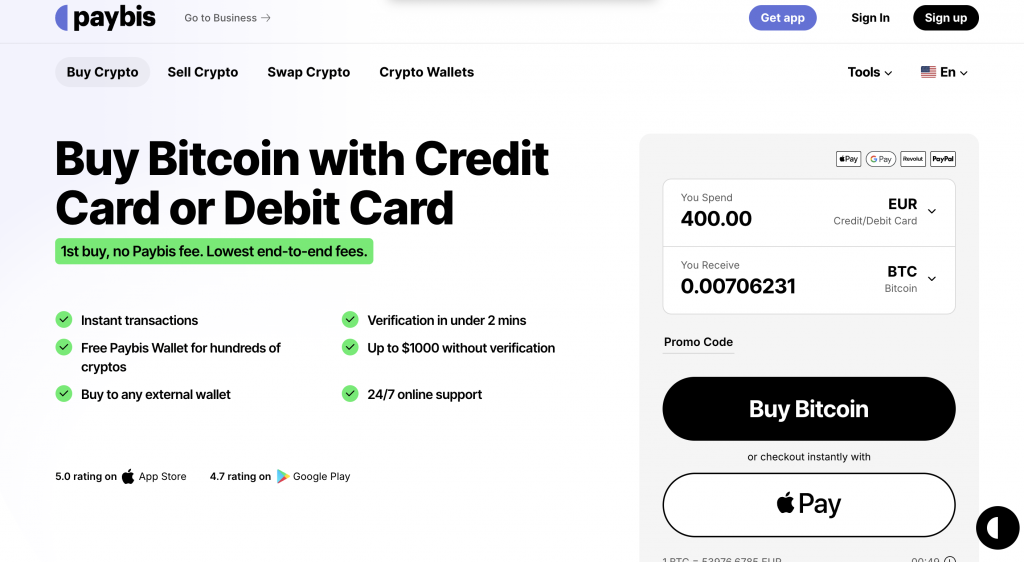
The platform’s core function is fiat-to-crypto conversion. It does not operate as a trading exchange — there are no order books, no price charts, and no margin or derivatives infrastructure. Paybis accepts fiat payments through multiple methods and delivers crypto directly to a user-specified wallet address or to the Paybis custodial wallet.
Current Market Statistics (Q2 2026):
- Transaction Volume: $2 billion+ processed since launch
- Geographic Reach: 180+ countries supported
- Supported Fiat Currencies: 48
- Trustpilot Rating: 4.1/5, 31,000+ reviews
- Registered Entities: EU (MiCA CASP + PSD2 PI), US (FinCEN), Canada (FINTRAC)
Key Features & Services
The Paybis product set is deliberately narrow. The platform positions itself as an accessible entry point for users acquiring crypto for the first time, not a destination for active trading or portfolio management.
Buy and Sell Interface
The primary transaction flow guides users through a step-by-step purchase sequence: select a cryptocurrency, enter an amount, choose a payment method, complete identity verification, and receive delivery to a wallet address. The interface requires no prior trading knowledge and completes transactions within a single session.
The sell (cash-out) function follows the same design logic. Users select a supported cryptocurrency, enter the amount, and receive fiat via Visa/Mastercard, SWIFT, SEPA bank transfer, Skrill, or Neteller — depending on the asset and region. The sell-side asset catalogue is intentionally limited to ensure liquidity across available settlement channels.
Paybis Wallet
Paybis provides a custodial wallet that consolidates holdings across supported assets under a single account login. The wallet is accessible via web and mobile. Users access assets through their Paybis account credentials — private key and seed phrase management sits with the platform, not the user.
The wallet employs Multi-Party Computation (MPC) technology for key management. Under this architecture, private key access is distributed across multiple encrypted computation nodes, removing the single-point-of-failure risk common in traditional hot wallet configurations.
Key wallet functions:
- Unified multi-asset management across 80+ supported cryptocurrencies
- Quick Buy from within the wallet interface
- Real-time price tracking in USD
- Dedicated on-chain addresses per asset, verifiable through public blockchain explorers
- iOS and Android mobile access
Supported Payment Methods
Paybis supports a broader range of regional payment options than most comparable platforms. In addition to international card and bank transfer channels, the platform integrates local payment systems across Latin America, Poland, Africa, and other markets.
Available payment methods by region:
| Payment Method | Coverage |
|---|---|
| Credit / Debit Card (Visa, Mastercard) | Global |
| Bank Transfer (SEPA) | Europe |
| Skrill | Global |
| Neteller | Global |
| Revolut Pay | Selected markets |
| Astropay | Selected markets |
| PIX | Brazil |
| PSE | Colombia |
| SPEI | Mexico |
| BLIK | Poland |
| SWIFT Bank Transfer | Global |
| M-PESA | Kenya |
Certain banks in the US, Canada, and UK do not process payments to Paybis due to internal policies at the institution level.
Affiliate and Referral Program
Paybis operates a revenue-share affiliate program administered through the Affise platform. Affiliates receive 20% of the platform’s commission on all purchases made by referred users, with no upper limit on earnings and no expiration on the referral relationship.
Program structure:
- Commission model: 20% lifetime revenue share per referral
- Tiered referral layer: 5% from transactions made by webmasters that an affiliate has recruited
- Cookie duration: 12 months
- Payout schedule: Monthly, minimum threshold of $50 USD
- Payment methods: SEPA bank transfer or Bitcoin
User Interface Design
The Paybis interface applies a single-column purchase flow that minimizes decision points. The design places accessibility above configurability, with no order type selection or market analysis tools present in the standard interface.
Account creation requires only an email address and phone number at registration. Identity verification is triggered at the point of the first transaction and accepts over 6,500 document types from 220+ countries. The KYC process completes in under 2 minutes for most users according to Paybis. Transactions up to $1,000 can proceed without full identity verification.
Navigation structure:
- Purchase flow: cryptocurrency selection → fiat amount entry → payment method selection → identity check → transaction confirmation
- Wallet dashboard: asset balances, price data, transaction history, quick buy entry point
- Support access: live chat widget available from all pages
Fee Structure and Pricing Analysis
Service Fee Model
Paybis applies a zero-fee structure to a user’s first transaction. From the second transaction onward, a service fee applies. The fee amount varies based on three factors: the payment method selected, the transaction amount, and the currency of the transaction.
Paybis does not publish a single fixed percentage for card transactions — the service fee varies by payment method, transaction amount, and currency. The platform imposes a minimum service fee of $2 USD per transaction. Users see the exact fee in the order confirmation screen before finalising any purchase.
Fee structure parameters:
- First transaction: 0% service fee
- Card transactions: fee varies; $2 USD minimum service fee applies
- Payment method variance: bank transfers carry lower processing costs than card networks
- Transaction amount effect: the $2 minimum service fee means smaller transactions carry a proportionally higher effective fee rate
- Currency effect: common currencies (USD, EUR, GBP) typically carry lower fees than regional alternatives
All fee components — service fee and network fee — are displayed in the order confirmation screen before a transaction is finalized.
Transaction Limits by Payment Method
| Payment Method | Minimum Amount | Maximum per Transaction | Daily / Monthly Cap |
|---|---|---|---|
| Credit / Debit Card | $4 | $20,000 | No stated cap |
| Skrill / Neteller | $20 | $200,000 | $200,000 daily |
| Bank Transfer | $200 | $1,000,000 | $1,000,000 monthly |
Network fees apply to all transactions regardless of payment method. These are market-determined and vary based on blockchain congestion at the time of confirmation.
Payment Infrastructure and Fiat Connectivity
Paybis covers both purchase and liquidation (sell) pathways, though the supported channels for each direction differ.
Purchase (fiat to crypto): Accepts card payments, bank transfers (including SEPA), Skrill, Neteller, and regional payment methods depending on the user’s country. This makes Paybis accessible to users without a card-compatible bank relationship in certain markets.
Liquidation (crypto to fiat): Bitcoin can be sold via Visa/Mastercard (min $20, max $20,000 per transaction), SWIFT bank transfer (min $1,000), SEPA bank transfer in EUR (min $240, max $100,000), and Skrill/Neteller (min $50, max $25,000). USDT (ERC-20) supports Visa/Mastercard, bank transfer, and Skrill/Neteller. Revolut accounts are excluded from fiat payouts.
Supported fiat currencies for purchase: 48 currencies, covering major and regional markets across Europe, the Americas, Asia, and Africa. Note: SEPA outgoing bank transfers for sell transactions are denominated in EUR only.
Security Framework and Compliance
Regulatory Registrations:
Paybis holds four regulatory registrations:
- MiCA CASP (EU): Crypto Asset Service Provider authorisation, Licence No. 27-55/2026/6.
- PSD2 Payment Institution (EU): Payment Institution licence, Licence No. 27-55/2026/7.
- FinCEN (United States): Registered as a Money Services Business, Registration No. 31000272911973. The platform operates in 48 U.S. states.
- FINTRAC (Canada): Registered as a Money Services Business, Registration No. C100000816.
The UK entity (Paybis LTD) operates under a company registration in Scotland. The platform’s own footer states it is not regulated by the Financial Conduct Authority, and digital assets held on Paybis are not covered by the Financial Ombudsman Service or FSCS.
Wallet Security Architecture:
The Paybis custodial wallet uses Multi-Party Computation (MPC) for private key management. Under this model, key access is split into multiple encrypted shares distributed across separate computation parties. No single party holds a complete key. This eliminates the single-point-of-failure risk that standard hot wallet configurations carry.
Paybis operates a bug bounty program for security researchers and has not reported a confirmed security exploit of its wallet infrastructure.
KYC and AML:
The platform requires identity verification for all transacting users. It accepts over 6,500 identity document types from 220+ countries. Documents accepted include national ID cards, driving licences, passports, residence permits, and several region-specific formats (PAN card, voter card, health ID card, military ID card).
Asset Availability and Regional Restrictions
Purchase catalogue: 80+ cryptocurrencies, including Bitcoin (BTC), Ethereum (ETH), Solana (SOL), Cardano (ADA), Tether (USDT), USD Coin (USDC), Dogecoin (DOGE), Polygon (MATIC), Litecoin (LTC), Chainlink (LINK), Uniswap (UNI), Aave (AAVE), and others.
Sell catalogue: 9 assets. Users can only liquidate BTC, ETH, USDC, USDT (ERC-20 and TRC-20), ADA, DOGE, SOL, MATIC, and LTC through the platform.
U.S. State Restrictions:
| Restriction Level | States |
|---|---|
| No service | New York, Hawaii, Louisiana |
| Limited service (selected assets excluded) | Alaska, Nevada, New Mexico, North Dakota, Puerto Rico, Vermont, Washington |
| Stablecoin restriction | Texas |
Mobile Application Performance
The Paybis mobile application is available on iOS (App Store) and Android (Google Play). The mobile interface mirrors the web platform’s transaction flow and provides access to the custodial wallet, order history, and live chat support. The Android application holds a 4.7-star rating on Google Play; the iOS application holds a 5.0-star rating on the App Store.
Security features at the mobile level include standard device authentication. The application does not require an additional hardware key or dedicated authenticator app for standard transactions — access is controlled through account login credentials.
Support Infrastructure and System Reliability
Paybis provides 24/7 customer support through live chat and email. Phone support is not available. The support team operates in nine languages: English, French, Arabic, Italian, Korean, Spanish, German, Portuguese, and Russian.
A structured support portal consolidates frequently asked questions and process guides for common user actions, including identity verification, payment troubleshooting, and sell-side settlement.
Account suspension decisions — applied when the platform’s compliance checks flag account activity — are handled by the security team and stated as final once executed. User feedback on Trustpilot confirms this pattern, with the majority of negative reviews citing account suspension immediately following registration. Paybis has consistently acknowledged these decisions as compliance-based and irreversible.
System uptime data is not publicly published through a dedicated status page. Market volatility conditions may affect transaction processing times, particularly for first-time user verification queues.
Platform Comparison: Paybis vs CEX.IO
Paybis and CEX.IO serve different segments of the digital asset user base. Paybis is a fiat-to-crypto conversion platform — it does not offer order books, spot trading tools, or margin infrastructure. CEX.IO operates as a full-service exchange with trading, Earn programs, and API access for advanced users.
| Category | Paybis | CEX.IO |
|---|---|---|
| Platform Type | Fiat-to-crypto gateway | Full exchange + wallet |
| Spot Trading | Not available | Available (0.25% entry fee) |
| Supported Buy Assets | 80+ | 310+ |
| Supported Sell Assets | 9 | 310+ |
| Fee Model | Variable service fee (displayed at checkout); $2 minimum | 0.25% entry spot fee (≤$10K volume) |
| Margin Trading | Not available | Available in supported regions |
| Earn / Staking | Not available | CEX.IO Earn (Savings + Staking) |
| Payment Methods | Card, SEPA, Skrill, Neteller, regional options | Card, SEPA, Faster Payments, Online Banking, PayPal (US only) |
| Fiat Sell Channels | Visa/Mastercard, SWIFT, SEPA EUR, Skrill, Neteller | Multiple withdrawal options |
| EU Regulatory Status | MiCA CASP (No. 27-55/2026/6); PSD2 PI (No. 27-55/2026/7) | VASP registered (Bank of Spain) |
| US Regulatory Status | FinCEN registered (48 states) | FinCEN registered, 30+ state MTLs |
| API Access | Not available | Full trading API |
| Mobile App | iOS / Android | iOS / Android |
For participants whose primary requirement is buying crypto with a card or regional payment method, Paybis provides a functional onboarding layer. For participants who require full exchange capability — spot trading, broader asset selection, deeper sell-side liquidity, or access to Earn products — CEX.IO provides a more complete infrastructure. CEX.IO’s entry-level spot fee of 0.25% provides a transparent fixed rate, while Paybis’s service fee varies by payment method and is only disclosed at checkout.
Final Verdict
Paybis executes its defined function reliably: it converts fiat currency into cryptocurrency through a guided, low-friction interface. The platform holds a MiCA Crypto Asset Service Provider (CASP) authorisation and PSD2 Payment Institution licence in the EU, FinCEN registration in the US, and FINTRAC registration in Canada — a four-jurisdiction regulatory footprint that covers most of its core markets. It processes transactions in 180+ countries and provides 24/7 multilingual support. The MPC-based wallet architecture addresses single-point-of-failure risk at the key management level.
At the same time, the platform carries structural limitations that define its user ceiling. Service fees vary by payment method and transaction size, with a $2 minimum — the exact cost is only visible at checkout, not published as a fixed rate. The sell-side asset catalogue covers a limited set of coins. Spot trading, margin, Earn products, and API access do not exist within the platform. The UK entity carries no FCA regulation.
For users who require a guided, one-time or occasional crypto purchase experience, Paybis serves that function. For users who want to trade, earn on holdings, access a full asset catalogue, or manage crypto at a lower cost structure, a full-service exchange provides the necessary toolset that Paybis does not.
FAQ
Is Paybis legit?
Paybis is a legitimate cryptocurrency buying and selling platform registered with the Financial Crimes Enforcement Network (FinCEN) in the United States and FINTRAC in Canada. The platform has operated since 2014, processed over $2 billion in transaction volume, and holds a 4.1/5 Trustpilot rating across 31,000+ reviews. Negative reviews primarily involve account suspension decisions made by the compliance team, which Paybis states are final. The platform’s regulatory registrations are publicly verifiable through the FinCEN and FINTRAC official registers.
Is Paybis safe?
Paybis employs Multi-Party Computation (MPC) for wallet key management, distributing encrypted key shares across multiple parties so no single point of failure exists. The platform requires KYC verification for all transacting users and operates a bug bounty program. No confirmed security exploit of Paybis wallet infrastructure has been publicly reported. Users should note that the platform is not regulated by the FCA in the UK and that digital assets held on Paybis are not covered by FSCS or equivalent deposit protection schemes.
What cryptocurrencies can you buy on Paybis?
Paybis supports purchases of 80+ cryptocurrencies, including Bitcoin (BTC), Ethereum (ETH), Solana (SOL), Cardano (ADA), Tether (USDT), USD Coin (USDC), Dogecoin (DOGE), Polygon (MATIC), Litecoin (LTC), Chainlink (LINK), Uniswap (UNI), and others. The sell (cash-out) catalogue is limited to selected assets including BTC and USDT (ERC-20), with settlement via Visa/Mastercard, SWIFT, SEPA bank transfer, Skrill, or Neteller depending on the asset and region.
Is Paybis available in the US?
Paybis operates in 48 U.S. states through its FinCEN registration. Residents of New York, Hawaii, and Louisiana cannot access the platform. Users in Alaska, Nevada, New Mexico, North Dakota, Puerto Rico, Vermont, and Washington face restrictions on selected assets. Texas residents cannot purchase stablecoins through Paybis. For a full list of state-specific limitations, Paybis’s terms of service document the applicable restrictions.
Does Paybis support crypto trading?
Paybis does not support cryptocurrency trading. The platform functions as a fiat-to-crypto conversion service — it does not provide order books, price charts, limit orders, margin trading, or futures contracts. Users can buy and sell a defined set of cryptocurrencies but cannot trade crypto-to-crypto pairs through the platform’s interface. Users requiring full exchange functionality should evaluate platforms built for active trading.
What is the Paybis affiliate program?
The Paybis affiliate program pays participants 20% of the platform’s commission on all purchases made by their referrals, with no expiration on the referral relationship. An additional 5% applies from transactions made by webmasters recruited into the program. Payouts are processed monthly with a $50 minimum threshold, delivered via SEPA bank transfer or Bitcoin. The program is administered through the Affise platform. Enterprise partners can negotiate custom commission structures above the standard 20% rate.