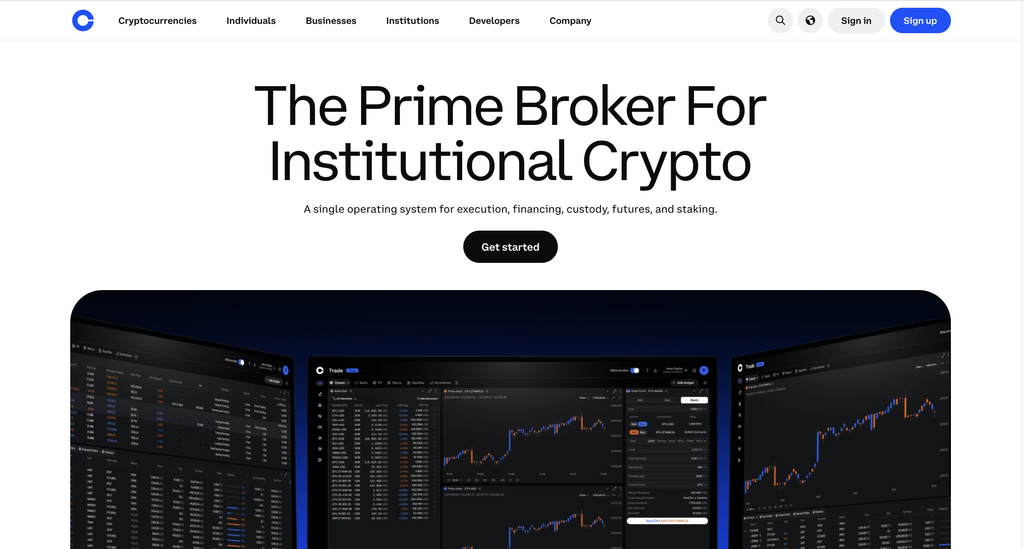
Coinbase Prime is the institutional arm of Coinbase, and it brings execution, financing, custody, futures and staking into one platform. Funds and large investors value it for qualified custody in New York and a deep derivatives offer. Another group of companies reaches the edges of that model sooner. European payment firms, brokers, fintechs and treasury teams often need euro and sterling rails, firm OTC quotes and a separate sub-account for every client they serve. Those needs lead them to look for a Coinbase Prime alternative.
Below we set Coinbase Prime against CEX.IO Prime point by point, from order routing and fiat rails to custody, API access and licences. The aim is to help you match each platform to the way your business moves money.
What is Coinbase Prime, and how does it work?
Coinbase Prime is a prime brokerage platform that serves institutions and crypto private wealth clients. It sits inside Coinbase, a company with more than 13 years in crypto, and Coinbase lists more than 275 tradeable assets for Prime clients.
Prime groups its services into six areas:
- Spot and derivatives trading with a smart order router, execution algorithms and RFQ.
- Margin loans and portfolio margining across spot and derivatives positions.
- Custody at Coinbase Custody Trust Company, LLC, a qualified custodian.
- Futures and cleared swaps through Coinbase Financial Markets, Inc.
- Staking and earn on eligible assets.
- USDC tools, with conversion between USDC and USD.
Execution at Coinbase Prime follows an agency model, so Coinbase acts as an agent and routes client orders to outside venues. The router reaches exchanges, OTC desks and market makers and sends each order where the price is best. Clients choose market, limit, iceberg or TWAP orders, or run VWAP, basis and adaptive algorithms. Post-trade reports break each order down by venue and by fill.
Coinbase also sells its infrastructure to other companies through Crypto as a Service. The company names more than 240 banks, brokers, fintechs and payment firms as partners in that business.
All of this makes Coinbase Prime a good match for funds that want custody, trading and derivatives inside one US group. Companies with heavy euro or sterling flows, or with many end clients to keep apart, tend to compare it with other providers before they commit.
Why look for a Coinbase Prime alternative?
A Coinbase Prime alternative is any institutional provider that gives a business crypto execution with a different mix of products or regions. These are the most common triggers for the search:
- The business takes payments in euros or pounds and wants SEPA, SEPA Instant or Faster Payments next to its crypto.
- It runs a trading venue, broker or app and needs spot liquidity it can pass on to its own users.
- It manages money for several mandates or end clients and must keep each one apart.
- It moves large blocks and prefers a single firm quote from an account manager.
- It wants a second provider as a backup for execution and settlement.
The trigger depends on how the business earns money. A US fund and a European payment institution may trade the same coins and still expect very different service from a provider.
CEX.IO Prime vs Coinbase Prime Summary
The comparison table gathers the main facts from each company’s website and product materials. Terms can change by country and client type, so check them with each provider during onboarding.
| CEX.IO Prime | Coinbase Prime | |
|---|---|---|
| Operating since | CEX.IO exchange since 2013 | Coinbase, 13+ years |
| Main use | Liquidity, OTC, payments and account infrastructure for operating businesses | Prime brokerage for execution, financing, custody, derivatives and staking |
| Assets | 500+ assets across 60+ networks | 275+ tradeable assets, 470+ assets in custody |
| Execution | Smart order routing, order slicing, RFQ, Instant Convert, assisted OTC | Smart order router, RFQ, TWAP, VWAP, iceberg, basis and adaptive algorithms, agency desk |
| Fiat settlement | USD, EUR and GBP over SWIFT, SEPA, SEPA Instant and Faster Payments, same day | USD and USDC conversion, the Prime page names no other fiat rails |
| Connectivity | FIX 4.4, REST, WebSocket, webhooks, sandbox, web portal | REST, FIX, WebSocket, web platform |
| Derivatives | No options or futures desk | Futures and cleared swaps through a CFTC-registered FCM |
| Financing | Per-client credit lines and collateralised loans | Margin loans, portfolio margining, cross-margining on 90+ assets |
| Custody | MPC custody, segregated sub-accounts, mandatory whitelisting | Qualified custodian with a New York trust charter, cold storage, SOC 1 and SOC 2 Type II audits |
| Public limits | Minimum and maximum order size for every pair on prime.cex.io/markets | No minimums on the Prime website |
| Key regulation | FinCEN MSB, US state money transmitter licences, FCA registration, VASP registration in Spain, FINTRAC MSB, Bermuda DABL licence | NYDFS virtual currency licence, NYDFS trust charter, MiCA licence, CFTC-registered FCM and NFA member |
CEX.IO Prime
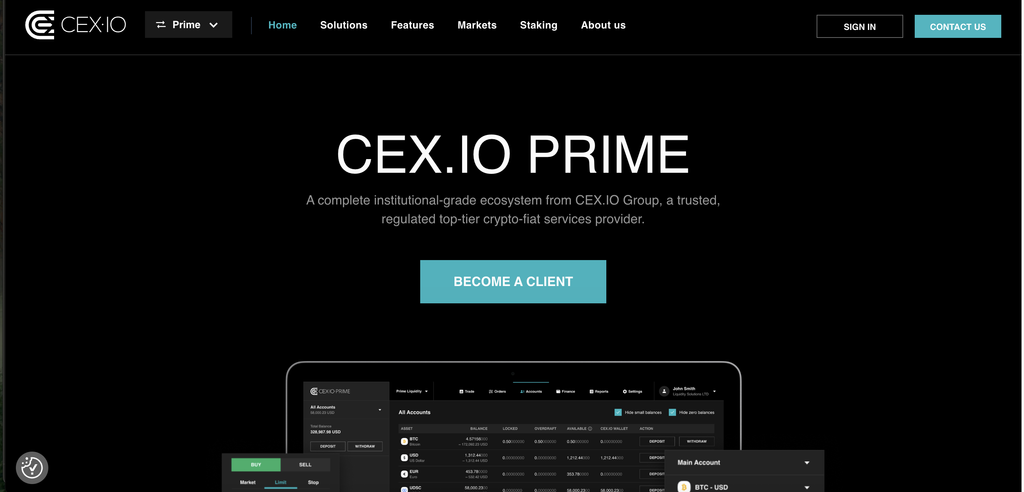
CEX.IO Prime is the business platform of CEX.IO Group, the company behind the CEX.IO exchange, which opened in 2013. Prime takes the liquidity, custody and payment infrastructure of that exchange and packages it for institutions. A client gets one account that covers trading, OTC, settlement, custody and reporting.
Aggregated liquidity
Prime connects to more than 15 trading venues, among them major exchanges and top-tier liquidity desks, and shows their depth as one order book. When a large order arrives, the engine splits it, sends each part to the venue with the best price and returns one fill at one price. For pairs with no direct market, Prime trades through an intermediate asset. That lets a fintech offer conversions between assets that rarely trade against each other.
Each trade can follow its own route. A team can place orders on the live book, fix a price for a short window with Instant Convert, ask for a quote on size through RFQ, or pass a block to the desk for assisted OTC execution. All four routes post to the same account and the same ledger.
OTC desk
The OTC desk is the Prime service for blocks that a client wants to trade at one agreed price, outside the visible order book. Prime switches on OTC access client by client. Each OTC trade runs through the account manager:
- The client names the asset, the side, the size and the asset it wants to settle in.
- The account manager collects a price from a liquidity provider or the in-house trading desk.
- The client receives the quote together with its validity period.
- The client accepts the quote in writing before the period ends.
- The account manager fills the block off the order book.
- The internal ledger books the block to the client’s account, and it shows up in the regular reports.
Every block starts with a written quote and a written confirmation. The client therefore keeps a full audit trail for each OTC trade, which makes internal sign-off and later audits easier.
Fiat and crypto settlement
Prime runs fiat and crypto through the same account, with USD, EUR and GBP as account currencies. Payments move over SEPA, SEPA Instant, Faster Payments and SWIFT, and Prime also sends and receives domestic and cross-border wires. On-chain, the platform moves stablecoins, bitcoin, ether and hundreds of other tokens across more than 60 networks. Fiat and crypto both settle the same day.
This opens a few practical routes for corporate money. A company with suppliers in several regions can keep part of its working capital in USDC on Prime and convert from EUR when a payment falls due. A settlement platform that receives stablecoins from corporate clients can off-ramp them to euros and receive the money in its own bank account. A group that moves working capital from its EU entity to a sister company can convert EUR to USDC and send it through CEX.IO Pay when both entities hold Prime accounts. CEX.IO Pay moves funds between Prime clients instantly and free of charge.
Accounts, custody and control
Prime holds client assets in MPC custody, where a quorum of key holders signs each transaction. Sub-accounts let a client split its activity by mandate, strategy, business line or end user, and Prime segregates the holdings of each one. A fund manager can run three strategies as three sub-accounts, trade each one on its own and send investors a separate statement for each strategy. Outbound transfers reach only addresses on the client’s whitelist, and the client sets single, dual or threshold approval for withdrawals. Access roles, single sign-on and two-factor authentication limit what each team member can do.
Reporting runs from one ledger with consistent identifiers across every product. Finance teams download account and sub-account statements in the interface or pull them through the API straight into their accounting software. Payment businesses can give each merchant or payer its own deposit addresses, receive a webhook when funds arrive and send payouts in batches of up to 10,000 rows.
Financing
Prime sets up financing for each client separately, after due diligence and a risk review. It offers two formats. A credit line at account level lets the client trade larger sizes with same-day settlement. A collateralised loan credits an agreed amount against fiat, stablecoins, BTC or ETH, and Prime values the collateral in real time. A fintech can use such a loan to fund crypto-backed loans for its own users under its own terms.
Connectivity, security and licences
Developers integrate over FIX 4.4, REST or WebSocket and test the setup in a sandbox before they move to production keys. Webhooks report every state change, so a platform can automate deposits, conversions and withdrawals from start to finish. Operations teams can run the same account from the web portal. Every Prime client has its own account manager, and the institutional desk covers the market 24/7.
Prime also shows its trading rules in public. The page prime.cex.io/markets shows, for each pair, the smallest and largest order Prime accepts, the lot step and the number of decimals in the price. A prospective client can read all of it before the first call.
On security, CEX.io LTD passed a PCI DSS Level 1 assessment for service providers and received its certificate in March 2026. On regulation, the group works through local companies. In the United States they hold a FinCEN registration as a money services business and state money transmitter licences. In the UK the FCA has a CEX.IO registration on file, and in Spain the group holds a VASP registration. Canada adds a FINTRAC registration, and Bermuda adds a licence under the Digital Asset Business Act. Each legal entity appears on the CEX.IO Licenses and Registrations page.
CEX.IO Prime Pros and Cons
Prime fits companies that use crypto as an everyday operating tool, and it stands out on European and UK payment rails. It has less to offer funds that need US qualified custody or a derivatives book, two areas where Coinbase Prime has years of experience.
Pros:
- Trading, OTC, payments, custody and reporting on a single account.
- EUR, GBP and USD settlement on the same day, with SEPA Instant and Faster Payments.
- Firm OTC quotes with a written audit trail.
- A separate sub-account for each mandate, merchant or end user.
- Order limits per pair on a public page.
- PCI DSS Level 1 and more than a decade of exchange operations.
Cons:
- No futures, options or swaps desk.
- No published minimum for OTC blocks.
- OTC and financing open only after a separate approval.
Why do businesses choose CEX.IO Prime?
The business models in the Prime catalogue share one pattern. A company connects to Prime once and then runs several flows through that connection. A budgeting app can add a Buy USDC button and let Prime handle the deposit, the conversion and the credit to the user in one action. A marketplace can collect crypto from buyers on per-merchant addresses and pay merchants out in bulk at the end of the day. A regional exchange can refill its own order book from Prime liquidity over FIX. All of these flows share one ledger, one reporting set and one account manager.

Coinbase Prime
Coinbase Prime is a full-service crypto prime broker for institutions. It brings execution, financing, custody, derivatives and staking under one platform and one group of regulated entities.
Custody sits at the centre of the offer. Coinbase Custody Trust Company, LLC holds a limited purpose trust charter from the New York State Department of Financial Services and acts as a fiduciary and qualified custodian under New York banking law. Deloitte & Touche audits it for SOC 1 Type II and SOC 2 Type II. Coinbase Vault cold storage runs on key generation and cold-storage technology that Coinbase has built in house for more than 12 years. Clients can stake and vote on governance without moving assets out of cold storage. Coinbase says its custody holds 11% of the global crypto market cap.
On trading, the smart order router reaches regulated exchanges, OTC desks and professional market makers. Prime acts as a single entity on each venue, so the market cannot trace individual client orders. Coinbase Execution Services, an agency trading desk, helps clients plan and execute larger trades. Clients can also trade one block and allocate it to several portfolios afterwards at a single cost basis.
Derivatives and financing extend the platform. Coinbase Financial Markets, Inc. is a CFTC-registered futures commission merchant and NFA member that offers futures and cleared swaps. Prime clients get margin loans and portfolio margining across spot and derivatives. In August 2025 Coinbase completed its acquisition of Deribit, a crypto options and futures exchange.
Coinbase, Inc. holds a licence from the NYDFS for virtual currency business activity, and Coinbase holds a MiCA licence that covers all 27 EU member states. Developers connect through the Prime REST API, a FIX API for high-volume orders and a WebSocket feed for real-time market data.
Coinbase Prime Pros and Cons
Coinbase Prime suits institutions that want custody, trading and derivatives from one regulated group, with US custody under a New York trust charter. A company that mostly buys, sells and pays out crypto will touch only a small slice of the platform.
Pros:
- Qualified custody with a New York trust charter and SOC 1 and SOC 2 Type II audits.
- A wide set of execution algorithms and an agency trading desk.
- Futures, cleared swaps and portfolio margining in one platform.
- Staking from cold storage.
- MiCA licence for all EU member states.
Cons:
- No minimums or fee tables appear on the Coinbase Prime website.
- The Prime page names USD and USDC services and no specific EUR or GBP rails.
- Its derivatives and wealth features may go beyond what a payments or brokerage business needs.
CEX.IO Prime vs Coinbase Prime Head to Head
Liquidity and execution
Both providers pull prices from many venues and route each order to the best one. Coinbase Prime gives traders a deeper algorithm menu, with TWAP, VWAP, basis and adaptive strategies, plus a separate agency desk. CEX.IO Prime answers with fixed-price conversions and a desk that prices the whole block in one quote. Teams that run algorithms will prefer Coinbase Prime. Teams that want one agreed price for a block will prefer CEX.IO Prime.
Fiat settlement
CEX.IO Prime publishes every rail it uses, and dollar, euro and sterling payments clear the same day. Coinbase Prime describes USD and USDC services on its Prime page and lists no euro or sterling rails there. For daily euro and sterling flows, the edge goes to CEX.IO Prime.
Derivatives and financing
Coinbase Prime is stronger in this area. It offers futures and cleared swaps through its own FCM, nets positions through portfolio margining and has owned Deribit since August 2025. CEX.IO Prime lends through per-client credit facilities and runs no derivatives desk, so this round goes to Coinbase Prime.
Custody and operations
Coinbase Prime keeps client assets with a New York qualified custodian that Deloitte audits for SOC 1 and SOC 2 Type II. Regulated funds that must use a US qualified custodian will pick Coinbase Prime. CEX.IO Prime treats custody as an everyday operating tool, with MPC, sub-accounts, whitelists, approval rules and bulk payouts. Companies that manage many end users from one account will get more from CEX.IO Prime.
Transparency of terms
Anyone can open prime.cex.io/markets and read the order limits for each pair. The Coinbase Prime site shows no minimums or fees. On public terms, CEX.IO Prime gives more detail before the first meeting.
How to choose between CEX.IO Prime and Coinbase Prime
The right platform follows from your daily workload. Use the two lists below as a quick filter.
Choose CEX.IO Prime if:
- Your company is a payment institution, broker, exchange, fintech or OTC desk.
- Your money moves in EUR or GBP and you want same-day settlement.
- You need one sub-account per client, merchant or mandate.
- You want written OTC quotes and public order limits.
Choose Coinbase Prime if:
- Your fund must hold assets with a US qualified custodian.
- Futures, swaps and portfolio margining drive your returns.
- Your desk trades through algorithms and wants agency-only execution.
Plenty of firms keep both accounts. A second provider gives a backup route and spreads counterparty risk.
FAQ
What is the best Coinbase Prime alternative?
For companies that need spot liquidity, block trading and same-day dollar, euro and sterling payments from one account, CEX.IO Prime is a strong Coinbase Prime alternative. Funds that need a US qualified custodian or a broad derivatives offer will likely stay with Coinbase Prime.
Who are Coinbase Prime’s main competitors?
Coinbase Prime’s main competitors include FalconX, Galaxy, B2C2 and CEX.IO Prime. They differ in custody models, derivatives coverage and fiat rails, so the best choice depends on the flows you run.
Is Coinbase Prime regulated?
Yes. Coinbase, Inc. holds an NYDFS licence for virtual currency business activity, and Coinbase Custody Trust Company, LLC holds an NYDFS limited purpose trust charter. Coinbase Financial Markets, Inc. is a CFTC-registered futures commission merchant and NFA member. In the EU, Coinbase holds a MiCA licence.
Is CEX.IO Prime regulated?
CEX.IO operates through group entities with registrations and licences in the US, the UK, the EU, Canada and Bermuda. The list covers a FinCEN money services business registration and state money transmitter licences in the US, an FCA registration in the UK, a Bank of Spain VASP registration, a FINTRAC registration in Canada and a Bermuda digital asset business licence. On data security, CEX.io LTD carries PCI DSS Level 1 certification.
Does Coinbase Prime have a minimum account size?
Coinbase does not show a minimum account size or a fee table on its Prime pages. Ask the Coinbase Prime sales team for the terms that apply to your firm and jurisdiction.
Can I settle in EUR and GBP with CEX.IO Prime?
Yes. Prime accounts hold EUR, GBP and USD, and payments move over SEPA, SEPA Instant, Faster Payments, SWIFT and wires. Fiat and crypto both settle the same day.
Can I use both CEX.IO Prime and Coinbase Prime?
Yes. Large firms often spread their flow across two or more providers. A second account keeps execution running if one provider has an outage and lowers exposure to a single counterparty.
Final thoughts
Coinbase Prime gives funds qualified custody in New York, a wide algorithm menu and a full derivatives stack under one US group. CEX.IO Prime gives operating businesses aggregated liquidity, firm OTC quotes, same-day settlement in dollars, euros and pounds, and a sub-account for every client. Companies in the second group will find in CEX.IO Prime the Coinbase Prime alternative that fits the way they work.