
Intraday trading is a trading style in which a trader opens and closes positions within the same day, so no position stays open overnight. The trader tries to act on small price moves that develop over minutes or hours. Crypto markets run around the clock, so “the same day” in crypto means a time window that the trader chooses. This guide explains what intraday trading means, how it works in crypto, which rules and costs apply, and which risk controls traders use.
The guide is educational and does not offer financial advice. Intraday trading is a high-risk activity. Regulators warn that frequent short-term trading can lose some or all of the money a person puts in, and costs can erode results even when individual trades win.
What is intraday trading?
Intraday trading means buying and selling the same asset within one trading day. The trader closes the position before the day ends, so the result depends only on price moves that happen during that day. The word intraday literally means within the day. Many sources use the terms intraday trading and day trading for the same activity, and this guide does too.
Intraday trading differs from swing trading and long-term holding in the length of time a position stays open. A swing trader holds a position for days or weeks, and a long-term holder keeps it for months or years. An intraday trader closes within hours, so the trader makes many more trades. More trades mean more fees, so each small price move must be large enough to cover its costs before it produces any gain.
What does intraday mean in crypto trading?
In crypto, intraday means any trade that the trader opens and closes inside a self-chosen day. Stock markets close each evening, which gives the trading day a natural end. Crypto exchanges stay open 24 hours a day, seven days a week, so no closing bell marks the end of a session. Many traders solve this with a fixed time such as midnight UTC, and others define a session of a few hours and close all positions before it ends.
A fixed session limits exposure and screen fatigue. Without one, a trader can keep watching charts through the night and make rushed decisions. A position that stays open overnight in crypto keeps moving with the market while the trader sleeps, so many intraday traders close their positions or protect them with stop orders before they step away.
How does intraday trading work?
An intraday trade follows a repeatable sequence. The trader picks a liquid market where many orders sit close to the current price, because liquidity keeps the gap between the buy price and the sell price small. The trader reads short-term charts, often with one-minute to one-hour candles, and writes a plan that states the entry price, the stop level, the target and the amount at risk. The trader then places the order, watches the position and closes it according to the plan. Writing the plan first reduces emotional decisions, because the trader already knows the exit when the price starts to move.
Three order types cover most intraday trading. A market order executes at once at the best available price, which gives speed but can fill at a worse price when the market moves fast. A limit order sets the price at which the trader will buy or sell, so it fills only at that price or better. A stop limit order waits until the price reaches a trigger level and then turns into a limit order, which traders use to exit a losing position.
Does the Pattern Day Trader rule apply to crypto?
No, the Pattern Day Trader rule does not apply to buying and selling spot crypto. The rule was a US securities margin rule. It required a margin account that made four or more day trades within five business days to hold at least $25,000 in equity. The rule covered brokerage accounts that trade securities such as stocks and options.
The rule no longer exists in its old form. The SEC approved FINRA’s amendments to Rule 4210 on April 14, 2026, and the new intraday margin standards took effect on June 4, 2026. The amendments remove the “pattern day trader” designation and the $25,000 minimum. FINRA’s Regulatory Notice 26-10 sets a phase-in period that ends on October 20, 2027, so each broker adopts the new standard on its own schedule. Many older guides still describe the $25,000 requirement, so readers who see it should check the date of the article.
Common intraday trading strategies
Intraday traders use many strategies, and each one tries to describe a repeatable price pattern. The four below appear most often in educational material. Each carries risk, and each needs a stop level that limits the loss when the pattern fails.
- Trend following. The trader buys when the price makes higher highs and higher lows, and sells when it makes lower highs and lower lows. The approach works while the trend continues and loses money when the trend reverses suddenly.
- Range trading. The trader buys near the lower edge of a sideways range and sells near the upper edge. A breakout through either edge turns the trade into a loss, so the stop sits just outside the range.
- Breakout and retest. The trader enters when the price moves beyond a level that held it back before, or waits for the price to return and test that level. Waiting reduces the risk of a false breakout but can miss the move if the price never returns.
- Scalping. The trader holds each position for seconds or minutes and aims for very small gains many times a day. Fees and spreads take a large share of each small gain, so scalping needs fast execution and tight cost control.
Which indicators do intraday traders use?
Indicators are calculations drawn on a chart from price and volume data. Moving averages smooth recent prices into a line. The relative strength index (RSI) measures the speed of recent price changes on a scale from 0 to 100, and traders read very high or very low values as a sign of a stretched move. The volume-weighted average price (VWAP) shows the average price paid during the session, weighted by trading volume, and many intraday traders use it as a reference line for the day. The average true range (ATR) measures the typical size of recent price swings and helps traders set stop distances. All of these tools use past data, so they lag the price.
What costs affect intraday trading results?
Trading fees apply to every order, and an intraday trader places many orders. A completed trade has two sides, one to open and one to close, so the trader pays the fee twice. At a fee of 0.25% per order, a round trip costs about 0.50% of the position size, and a price move smaller than that loses money before any other cost enters the picture. Spreads and slippage add to the fee. The spread is the gap between the best buy price and the best sell price, and slippage is the difference between the expected price and the price at which the order fills.
Taxes add a further cost. The IRS treats digital assets as property. Selling digital assets for US dollars produces a capital gain or loss, and exchanging one digital asset for another also produces a capital gain or loss. A holding period of one year or less makes the result short-term, so every intraday trade falls into that category. Taxpayers report these transactions on Form 8949 and Schedule D. A trader who makes many trades creates many taxable events, so a complete record of each trade saves time at filing. Tax rules differ by country, and a tax professional can answer questions about a specific situation.
Intraday trading risk management
Risk management limits how much one trade can lose, and it decides how long a trader can keep trading after a losing streak. The most common guideline is the 1% rule. It says a trader risks no more than 1% of trading capital on a single trade, and some traders use a limit between 0.5% and 2%. On a $5,000 account, 1% equals $50.
The risk limit and the stop distance together set the position size. Suppose a trader buys at $100 and places a stop at $98. The stop sits 2% below the entry. To keep the maximum loss at $50, the trader divides $50 by 0.02 and opens a position of $2,500. If the price hits the stop, the loss equals about $50 before fees and slippage, which is 1% of the account.
Other habits support the risk limit, and some traders add the “3-5-7 rule” described in the FAQ below. A daily loss limit tells the trader to stop for the day after a set amount of losses, and a trade journal records each entry, exit and reason for later review. Leverage multiplies gains and losses by the same factor, and regulators warn that margin in securities accounts can produce losses larger than the original amount. In crypto, a leveraged position can close by force when the price moves against it. Stop orders also have limits, because a stop can fill at a worse price during a sharp move or fail to fill when liquidity disappears.
Is intraday trading profitable?
Intraday trading can produce profits and losses, and no method assures a profit. A 2020 academic paper followed every individual who started day trading Brazilian equity index futures between 2013 and 2015. Among those who kept trading for more than 300 days, 97% lost money, and only 1.1% earned more than the Brazilian minimum wage. That study covers futures. It still shows how hard consistent short-term profit is for individuals.
Several forces explain these results. Fees and spreads take a share of every trade, and the share grows with the number of trades. Retail traders compete with automated systems that react faster, and emotions push traders away from their plans. FINRA lists the same risks for frequent intraday trading in securities: a person can lose some or all of the money used, and higher costs can erode returns.
CEX.IO as a crypto exchange for intraday traders
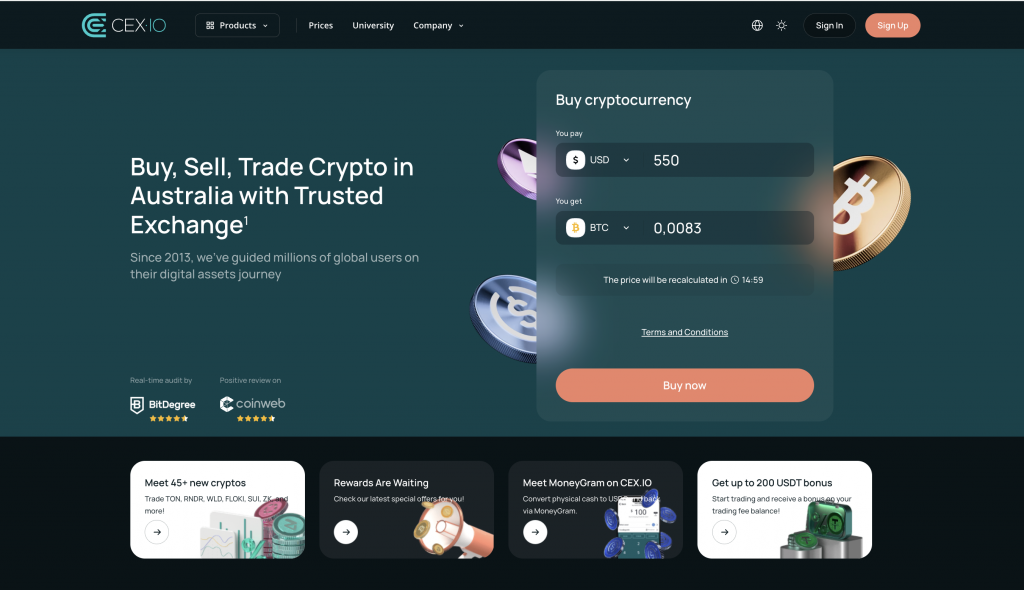
CEX.IO is a cryptocurrency exchange that started in 2013 and has more than 15 million registered users. It holds a FinCEN registration as a money services business. The exchange offers Spot Trading, a trading terminal with an order book, price charts, trade history and a list of pending orders. The availability of products, features and services on the CEX.IO platform is subject to jurisdictional limitations.
Order types and execution tools
Spot Trading on CEX.IO supports market, limit and stop limit orders. Limit orders accept time conditions such as Good Till Cancel, Good Till Date and Immediate or Cancel, which let a trader decide how long an order stays active. Market orders include a Max Slippage setting that limits the price deviation a trader accepts. The CEX.IO app lists more than 400 spot markets, and the markets a user sees depend on the user’s country.
Fees and verification
CEX.IO publishes its spot trading fees on the Limits and Commissions page. As of November 2026, the schedule starts at 0.25% for a 30-day trading volume of up to $10,000 and falls to 0.10% at the highest tier of $20 million. Users check the current figures before they trade, because tiers can change. CEX.IO requires identity verification before a user can trade, and new accounts can have lower limits during the first months after verification.
How to start trading on CEX.IO
The steps below describe how a verified user places a first spot order. They explain the process only and do not recommend any asset or strategy. Availability of markets and payment methods depends on the user’s country.
- Create a CEX.IO account and complete identity verification.
- Add funds with a payment method that CEX.IO supports in the user’s country.
- Open Spot Trading and pick a market with the pair selector.
- Choose an order type, enter the amount and, for limit and stop limit orders, the price.
- Check the fee shown for the order, confirm it and track it in the pending orders list.
A user can set a limit order at the planned entry and add a stop limit order at the planned exit, which turns the written trading plan into live orders. Prices can move quickly in crypto, so orders may fill at different prices than the user expects. The user decides the size and risk of every order.

Intraday trading FAQ
What is the 3-5-7 rule in day trading?
The 3-5-7 rule is a community risk guideline. No regulator publishes it. In its common version, a trader risks up to 3% of capital on one trade, keeps total open risk under 5% and aims for winners of about 7%. Sources describe the numbers a little differently, so traders adjust them to their own risk tolerance.
Can you make $1,000 a day with intraday trading?
No fixed daily income exists in intraday trading, and losses are common. A gain of $1,000 per day on a $10,000 account equals a 10% gain every day, which sits far above the 1% per-trade risk limits that traders commonly use. Results depend on capital, costs, market conditions and discipline.
Do you need $25,000 to day trade crypto?
No. The $25,000 minimum belonged to the Pattern Day Trader rule for US securities margin accounts, and spot crypto trading never fell under it. FINRA also removed that minimum from its rules in 2026. Exchanges can still set their own limits and verification requirements.
Risk notice
The value of digital and virtual currencies comes from supply and demand in the global marketplace, which can rise or fall independently of any fiat or government currency. Holding digital and virtual currencies carries exchange rate and other types of risk. Transactions in virtual currency are irrevocable, and losses from fraudulent or accidental transactions may result in the loss of your money with no recourse. Leveraged and short-term trading can increase losses. This article is educational and does not offer financial or tax advice. Please refer to the Terms of Use for more details.