
In 2026, selecting a cryptocurrency exchange involves evaluating more than the number of supported assets. Regulatory compliance, security infrastructure, and pricing transparency have become key considerations for many market participants. bitFlyer is one of the longer-standing platforms in the sector and operates under regulatory frameworks in Japan, the United States, and Europe.
This review provides an overview of bitFlyer’s services, pricing structure, and platform design as of 2026. It examines how the Lightning trading interface works, how spreads and trading fees are structured, and how the platform’s regulatory positioning influences its product offering.

Platform Overview and Positioning
bitFlyer is a cryptocurrency exchange headquartered in Tokyo, with regional entities including bitFlyer USA and bitFlyer Europe. Since its founding in 2014, the platform has expanded across several regulated jurisdictions while maintaining a relatively conservative listing strategy.
In 2026, bitFlyer continues to emphasize compliance processes and security controls. This approach has resulted in a smaller asset catalogue compared with some international exchanges, but it also aligns with the regulatory frameworks under which the platform operates. As a result, bitFlyer is often discussed in the context of exchanges that focus on operational history and regulatory oversight.
Key Features & Services
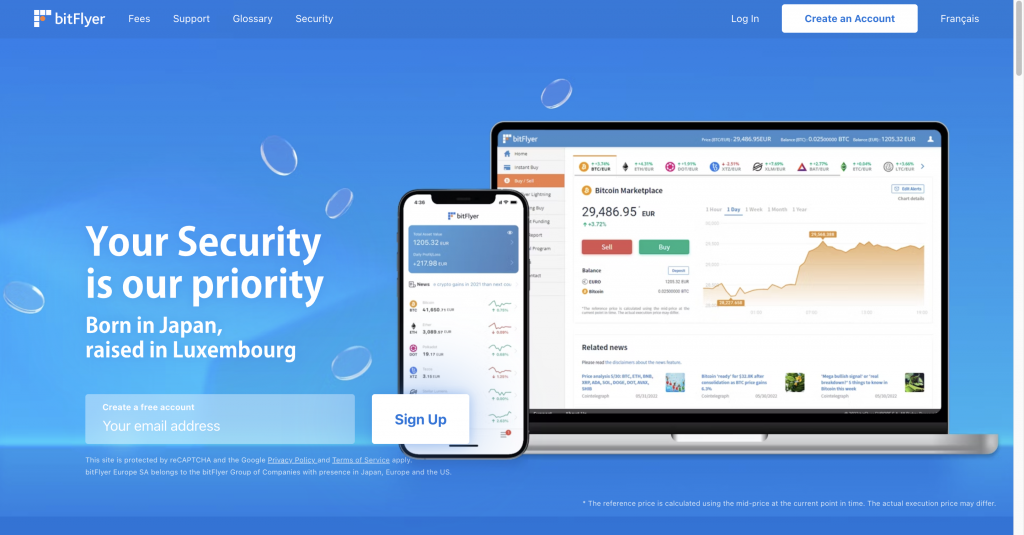
The current version of bitFlyer offers a streamlined set of products focused primarily on digital asset trading and basic crypto purchasing tools. Rather than offering a wide range of experimental products, the platform concentrates on a smaller group of services.
- Buy/Sell (Instant Buy): The Buy/Sell interface lets users buy Bitcoin and a limited selection of other cryptocurrencies directly on the platform. This interface simplifies the trading process by removing the need to interact with order books and presenting a single quoted price.
- bitFlyer Lightning: bitFlyer Lightning is the exchange’s advanced trading environment. It provides charting tools, order books, and multiple order types, including limit, stop-limit, and trailing stop orders. The interface is designed for users who prefer direct market interaction rather than simplified purchases.
- Recurring Purchases: The platform also offers tools for recurring purchases that let users schedule regular crypto purchases at set intervals, such as daily, weekly, or monthly.
- Crypto CFD & Margin Products: In some jurisdictions, bitFlyer provides derivative-style trading through its Crypto CFD products. Individual accounts may access margin trading ratios up to 2x, with funding payments applied periodically based on open positions.
User Interface
bitFlyer uses two distinct interface environments to accommodate traders at different levels of experience.
The standard Buy/Sell interface is designed for simplicity. It presents a quoted purchase price that includes a spread and removes the need to interact with order books.
The Lightning interface is structured for users who prefer direct trading tools. It allows customization of charts, order books, and trading panels. Because it provides more detailed market data, the Lightning interface typically requires greater familiarity with trading mechanics.
Fees and Pricing
bitFlyer applies different pricing structures depending on the interface used.
The Lightning Fee Schedule (2026)
The Lightning trading interface follows a volume-based fee model. As of March 2026, trading fees for lower-volume accounts begin at approximately 0.10%.
| 30-Day Trading Volume | Trading Fee (Maker/Taker) |
| Under $50,000 | 0.10% |
| $50,000 – $500,000 | 0.09% |
| $500,000 – $1M | 0.08% |
| Over $500M | 0.03% |
Crypto withdrawals also incur network or platform withdrawal fees that vary by asset. For example, Bitcoin withdrawals currently require a fee of approximately 0.0004 BTC, while Ethereum withdrawals may incur a fee of around 0.005 ETH.
Buy/Sell Spread
The Buy/Sell interface uses a spread instead of a separate trading commission. This spread generally ranges between 0.1% and 6.0%, depending on market conditions and asset liquidity. Because the quoted price already includes the spread, the fee component is not shown separately during the purchase process.
Payment Methods and Fiat Access
bitFlyer provides several fiat funding methods that vary by jurisdiction. Payment methods are more limited in some regions compared with certain global exchanges. In Europe, bitFlyer has also integrated PayPal deposits. This allows users to fund accounts through PayPal balances or linked payment methods, with transactions typically processed almost instantly.
Payment Methods for U.S.-based Customers (2026)
| Payment Method | Buy | Sell | Add Cash | Cash Out | Speed |
| Wire Transfer | ✔ | ✔ | ✔ | ✔ | 1-3 Business Days |
| ACH Transfer | ✘ | ✘ | ✘ | ✘ | N/A |
| Debit Card | ✔ | ✘ | ✘ | ✘ | Instant |
| Crypto Transfer | ✔ | ✔ | ✔ | ✔ | Network Dependent |
Note: European customers typically have access to SEPA transfers, while Japanese users can use local payment systems, including J-Debit.
Security and Compliance
Security infrastructure and regulatory oversight are central elements of bitFlyer’s platform design. The exchange operates under licensing regimes in Japan, the United States, and parts of Europe.
Key technical and operational controls include:
- Cold Storage: The platform reports that customer crypto assets are stored in offline wallets, which reduces exposure to online attacks.
- Multi-Sig Technology: Transactions from cold storage require multiple internal approvals before execution.
- Regulatory Licensing: bitFlyer operates under regulatory supervision in several jurisdictions, including the Japanese Financial Services Agency (FSA), the New York BitLicense framework in the United States, and European financial authorities.
- Encryption and Security Protocols: Secure communication protocols are used to protect connections between the platform and users.
Asset Availability and Regional Differences
bitFlyer maintains a limited asset catalogue compared with many international exchanges. Major assets such as Bitcoin (BTC), Ethereum (ETH), Litecoin (LTC), and Bitcoin Cash (BCH) are available, but the platform lists fewer smaller-cap tokens.
This reflects the exchange’s listing policy, which emphasizes liquidity and regulatory considerations.
Asset availability also varies by region due to licensing restrictions.
Mobile App
The bitFlyer mobile application provides access to both the simplified Buy/Sell interface and the Lightning trading interface.
- Mobile features include:
- biometric authentication
- real-time price alerts
- access to order books and charting tools through Lightning mode
Some users note that the Lightning interface can appear dense on smaller screens due to the amount of market data displayed
Customer Support and Reliability
bitFlyer offers customer support primarily through documentation resources and email-based contact channels. Response times have reportedly improved in recent years, though live chat support is not consistently available.
Some withdrawal processes include manual verification steps. While this may increase processing time in certain cases, the procedure is described as part of the platform’s security review process.
bitFlyer Pros & Cons
Pros
- Long operational history across regulated jurisdictions
- Strong focus on custody controls and security practices
- Active trading in major pairs such as BTC/JPY and BTC/USD
- Simplified purchasing interface for new users
Cons
- Limited number of supported assets
- Higher spreads on the simplified Buy/Sell interface
- Fewer fiat funding methods in the United States compared with some exchanges
CEX.IO As A bitFlyer Alternative

bitFlyer and CEX.IO operate under different platform models. While bitFlyer focuses on a narrower product set and conservative asset listings, CEX.IO offers a broader product set that includes spot trading, margin trading, Instant Buy functionality, and additional account features.
CEX.IO also supports several fiat funding methods, including cards, ACH transfers, PayPal for eligible U.S. users, Google Pay, and Apple Pay. These differences highlight how the two exchanges prioritize different aspects of platform design, such as product breadth and payment access.
Final Verdict
bitFlyer remains one of the longer-operating cryptocurrency exchanges and continues to maintain a presence across multiple regulated jurisdictions. Its focus on compliance and custody controls shapes the platform’s overall structure, including a limited asset catalogue and a simplified product set.
However, the spread-based pricing on the Buy/Sell interface and the narrower asset range may not align with every user’s preferences. Exchanges such as CEX.IO provide a different platform structure, including additional payment methods, a broader product ecosystem, and support for more digital assets. The distinction between the two platforms often depends on factors such as jurisdiction, payment access, and preferred trading tools.

FAQ
How trustworthy is bitFlyer?
bitFlyer is often discussed as a long-standing exchange due to its operational history and regulatory presence in multiple jurisdictions. The platform operates under licensing frameworks in Japan, the United States, and Europe, which require compliance with financial regulations and periodic oversight.
Is bitFlyer safe?
bitFlyer describes its security model as relying on multiple layers of technical and operational controls. These include cold storage custody, multi-signature approval processes for asset transfers, and account-level protections such as two-factor authentication.
Is bitFlyer free to use?
Creating and maintaining a bitFlyer account generally does not involve account maintenance fees. However, trading fees and spreads apply depending on how transactions are executed. The Lightning trading interface uses a trading fee schedule, while the Buy/Sell interface includes a spread within the quoted price.
Is CEX.IO better than bitFlyer?
The comparison between bitFlyer and CEX.IO depends on platform features, payment methods, and asset availability. bitFlyer emphasizes regulatory oversight and a smaller asset catalogue, while CEX.IO offers a broader product ecosystem and additional funding methods in several jurisdictions.
Is bitFlyer legal in the US?
Yes. bitFlyer USA operates as a registered Money Services Business and holds licenses in many U.S. states. It also holds a New York BitLicense, which allows the exchange to operate under the regulatory framework established by the New York State Department of Financial Services.
What is the difference between bitFlyer and bitFlyer Lightning?
bitFlyer refers to the exchange platform as a whole. The standard interface provides simplified tools for crypto purchasing. At the same time, bitFlyer Lightning is an advanced trading environment that allows users to place orders via an order book, with charting tools and additional order types.
Why is bitFlyer so popular in Japan?
bitFlyer has been active in Japan since 2014 and was among the early cryptocurrency exchanges to receive authorization from the Japanese Financial Services Agency (FSA). Operating under this regulatory framework has helped the platform maintain a stable presence in the Japanese market.
The exchange also supports significant trading activity in the BTC/JPY market, which contributes to its visibility among both individual users and professional trading firms. Its focus on regulatory compliance and its long-standing operations in Japan are frequently cited as factors influencing its adoption in the region.
Why is bitFlyer so popular in Japan?
bitFlyer is the dominant exchange in Japan because it was the first to receive a license from the Financial Services Agency (FSA). It has a long-standing reputation for compliance and security, which aligns perfectly with the conservative financial culture of Japanese investors. Furthermore, bitFlyer offers the deepest liquidity for the BTC/JPY trading pair in the world. This makes it the go-to destination for both retail Japanese investors and large institutional players looking to move significant amounts of capital between Bitcoin and the Japanese Yen efficiently.
Disclaimer: For information purposes only. Not investment or financial advice. Seek professional advice. Digital assets involve risk. Do your own research.