
In this CoinGecko review, we examine how one of the most widely used cryptocurrency data platforms operates in 2026. Founded in 2014, CoinGecko is an independent crypto data aggregator that tracks thousands of digital assets across centralized and decentralized exchanges. The platform provides market metrics, including price, trading volume, market capitalization, liquidity, and token supply.
CoinGecko does not support buying or selling cryptocurrencies directly. Instead, it functions as a research and analytics platform that helps users monitor market activity, compare assets, and explore the broader digital asset ecosystem before using a trading platform to execute transactions.
Platform Overview and Operational Structure
CoinGecko is a cryptocurrency market data platform founded in 2014 by TM Lee and Bobby Ong. Rather than operating as a trading venue, CoinGecko serves as an independent data aggregator, collecting and analyzing data from cryptocurrency exchanges and blockchain networks. The platform tracks thousands of digital assets and compiles metrics such as price, trading volume, liquidity, circulating supply, and market capitalization.
Because CoinGecko does not hold user funds or process transactions, it operates as a market data platform rather than a trading venue. Instead, it acts as a data provider, gathering information from integrated trading venues and applying internal algorithms to verify and aggregate market data.
The company operates through Gecko Labs Pte Ltd, a Singapore-registered entity. Its services include the public CoinGecko website, mobile applications, and a developer API that provides market data to businesses, analysts, and software platforms. Through this structure, CoinGecko focuses on market data aggregation and analytics rather than facilitating cryptocurrency transactions.
Core Features & Research Tools
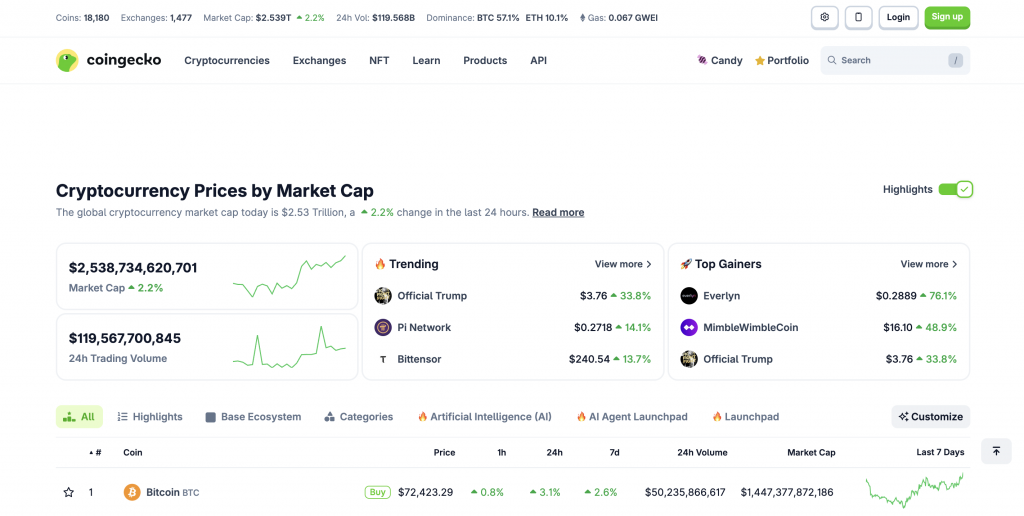
CoinGecko provides a collection of market-monitoring and analytics tools designed to help users explore cryptocurrency markets.
The platform aggregates data from exchanges and presents it through dashboards, rankings, and research tools that highlight price movements, liquidity trends, and sector activity across the digital asset ecosystem.
Cryptocurrency Market Data
At its core, the platform aggregates cryptocurrency market data from a wide range of centralized and decentralized exchanges. It tracks more than 18,000 digital assets and collects ticker data on price, trading volume, liquidity, and market capitalization. Exchange snapshots are processed frequently, allowing users to monitor market activity in near real time.
To generate a single market price for each asset, data from multiple trading pairs is combined while anomalous values are filtered using statistical outlier-detection methods. The final figure represents a volume-weighted average across active markets, providing a consolidated view of how an asset is trading globally.
Exchange Tracking
Beyond individual asset data, the platform also tracks trading activity across more than a thousand centralized and decentralized exchanges. Each exchange listing includes metrics such as 24-hour trading volume, supported trading pairs, liquidity depth, and available markets.
This allows users to identify where specific assets are actively traded and compare market activity between platforms. By bringing together exchange-level data in one place, the platform provides a broader view of the global trading infrastructure without functioning as a trading venue itself.
Trust Score System
To add context to exchange data, the platform uses an internal Trust Score system that evaluates exchanges using several indicators rather than relying solely on reported trading volume.
These indicators include liquidity depth, order-book spread, trading behavior, and web traffic patterns. The goal is to detect potential irregularities, such as inflated volume or artificial trading activity. Exchanges with stronger liquidity and more consistent market activity typically receive higher Trust Scores.
Market Analytics and Research Tools
In addition to raw market data, the platform provides several analytics tools for observing broader industry trends. These include sector-tracking dashboards, token-category rankings, and heatmaps that highlight short-term performance across different segments of the crypto market.
Users can follow narratives such as Layer 2 networks, decentralized finance protocols, or meme tokens through category-level market statistics. Tokenomics dashboards for selected assets also display token allocation structures and supply emission schedules. NFT market charts further track the overall capitalization and trading volume of ranked NFT collections.
Portfolio Tracking
For personal market monitoring, users can also create a portfolio within the platform. This feature allows assets to be added manually without connecting exchange accounts or transferring funds.
The portfolio dashboard displays real-time price updates, allocation breakdowns, and estimated performance changes based on recorded purchase prices. Because assets are stored elsewhere, the tool serves solely as a tracking interface. Portfolio tracking is available through both the website and mobile application.
CoinGecko API
For developers and businesses, the platform also provides a public and enterprise API that delivers cryptocurrency market data programmatically. The API offers access to price feeds, trading volume, market capitalization, historical datasets, NFT metrics, and on-chain data from decentralized exchanges.
The service supports a wide range of use cases, from portfolio applications and analytics dashboards to financial research platforms. CoinGecko also publishes detailed documentation of its data structure and price aggregation methodology, giving developers greater visibility into how market values are calculated.
User Interface: Desktop and Mobile Performance
CoinGecko’s interface is built primarily for market observation rather than trading execution, and this design philosophy is visible across both its desktop platform and mobile apps. The desktop website centers on large market tables that list assets by price, market capitalization, and trading volume. Filters allow users to sort assets by categories, sector narratives, or market metrics. At the same time, individual coin pages include detailed data panels covering historical price charts, market pairs, tokenomics, and exchange listings.
Compared with competing data platforms such as CoinMarketCap, CoinGecko’s desktop interface places greater emphasis on raw market data and exchange-level transparency. Tabs like Markets, Tokenomics, and Categories provide deeper views into liquidity sources and sector trends. However, the interface can feel dense, particularly for new users navigating large datasets.
The mobile app mirrors most desktop functionality. Users can monitor prices, set alerts, track portfolios, and explore token categories directly from the app. CoinGecko also includes Candy rewards, which users collect through daily check-ins and can redeem for platform perks.
Where the platform differs from trading apps is in its lack of integrated execution tools. Users cannot place orders, connect wallets, or perform swaps within the interface. While this keeps the platform focused on research and analytics, it also means users must switch to an exchange to execute transactions.
Data Methodology and Price Accuracy
CoinGecko places strong emphasis on transparency in how cryptocurrency prices are calculated. Rather than relying on a single exchange feed, the platform aggregates ticker data from a large number of centralized and decentralized exchanges. This data includes price, liquidity, and trading volume across multiple trading pairs.
To produce a single market price for each asset, CoinGecko first converts all ticker data into a common USD reference using internal indices such as the Stablecoin Price Index (USDI) and the Bitcoin Price Index (BPI). These indices help normalize prices across fiat pairs, stablecoins, and crypto-to-crypto trading pairs.
Once standardized, the platform applies statistical outlier detection using a modified Median Absolute Deviation (MAD) model. This method identifies ticker prices that fall outside a defined statistical range and excludes them from calculations. After removing anomalies, the remaining data is aggregated using a volume-weighted average price (VWAP) to generate the final market price displayed on the platform.
CoinGecko also filters suspicious exchange data, such as stale tickers or unusually large trading volumes, and its operations team can manually intervene if anomalies are detected. While no aggregation system can fully eliminate pricing discrepancies across exchanges, this multi-layer methodology is designed to reduce the impact of manipulated data and produce a more stable reference price across global markets.
CoinGecko Pros and Cons
While its extensive datasets and research tools make it a widely used reference for market information, the platform also has limitations depending on how users plan to interact with the crypto ecosystem.
The table below outlines some of the key strengths and potential drawbacks.
| Pros | Cons |
| Tracks a very large number of digital assets (18,000+), giving users broad market coverage. | Does not support buying, selling, or storing cryptocurrencies, since it is not a trading platform. |
| Aggregates data from both centralized and decentralized exchanges, providing a wider market view. | Interface can feel dense and data-heavy for new users unfamiliar with crypto metrics. |
| Transparent price aggregation methodology using VWAP and statistical outlier detection. | Market prices may still vary from individual exchanges due to differences in liquidity and trading pairs. |
| Offers extensive research tools, including tokenomics dashboards, sector analytics, and NFT market charts. | Some advanced features, such as deeper analytics or API limits, require paid tiers. |
| Provides a widely used developer API for integrating crypto market data into apps and analytics platforms. | Data accuracy still depends on exchange-reported volumes and liquidity conditions. |
CoinGecko vs CEX.IO: Research Platform vs Exchange
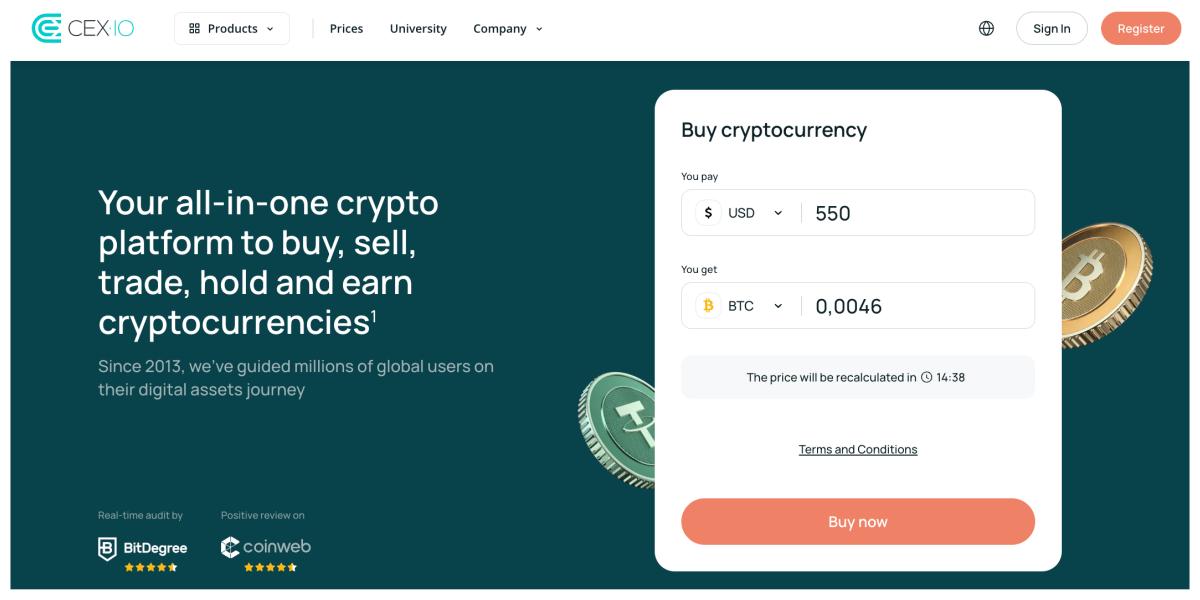
CoinGecko and CEX.IO serve different roles within the digital asset ecosystem. CoinGecko functions primarily as a market data and analytics platform, allowing users to track prices, liquidity, tokenomics, and exchange activity across thousands of assets. It is generally used for research, market monitoring, and comparing trading venues.
CEX.IO, by contrast, is a cryptocurrency platform that offers account-based services to eligible users for interacting with supported digital assets, subject to jurisdictional limitations. While CoinGecko helps users observe market trends and review asset data, CEX.IO offers account-based tools that may allow eligible users to interact with supported digital assets. Users who want to interact directly with digital assets typically rely on cryptocurrency exchanges rather than market data platforms.
When CoinGecko Can Be Useful
CoinGecko can be useful for users who want to analyze cryptocurrency markets without executing transactions. The platform aggregates data from a large number of centralized and decentralized exchanges, making it helpful for comparing prices, liquidity, and trading activity across markets.
Researchers, analysts, and traders often use the platform to observe sector trends, monitor token categories, review tokenomics data, and identify where assets are actively traded. Because most features do not require account registration, CoinGecko can also serve as a quick reference for checking market prices or tracking portfolio performance. In this role, it functions primarily as a cryptocurrency market data and research tool.
When a Crypto Exchange May Be More Suitable
A cryptocurrency exchange may be relevant for users who want to interact directly with digital assets rather than only monitor market data. Exchanges provide account-based environments where eligible users may access digital asset-related services.
Platforms like CEX.IO may support fiat payment methods for eligible users, including bank transfers and payment cards, subject to regional availability. In addition to market access, exchanges may provide account management tools and other platform features, depending on the jurisdiction and user eligibility. After reviewing market data on research platforms, some users choose to use exchanges to interact with supported digital assets.
Final Verdict
CoinGecko remains one of the most widely used cryptocurrency data platforms in 2026. Its extensive asset coverage, published price aggregation methodology, and broad set of analytics tools make it a useful reference point for monitoring market activity, comparing exchanges, and exploring sector trends across the digital asset ecosystem. For researchers, analysts, and traders seeking market insights, the platform provides a broad view of cryptocurrency markets without requiring an account.
However, because CoinGecko focuses on data rather than transactions, users who want to interact directly with digital assets typically use a cryptocurrency exchange. In such cases, platforms such as CEX.IO may offer account-based services to eligible users, subject to jurisdictional limitations.
FAQ
Can I withdraw the balance from CoinGecko?
No. CoinGecko does not hold user funds or provide wallet services. The platform functions as a cryptocurrency data aggregator, meaning it only displays market information. Because assets cannot be stored on CoinGecko, there is no balance to withdraw. Transactions must be performed through a cryptocurrency exchange or wallet service.
How does CoinGecko handle market data?
CoinGecko is widely used as a market data reference across the cryptocurrency industry. The platform aggregates data from multiple exchanges and applies filtering methods, including liquidity checks, statistical outlier detection, and volume-weighted price calculations. However, as with any data aggregator, the accuracy of information ultimately depends on the data reported by integrated exchanges.
How do Coingeckos receive rewards?
CoinGecko offers a feature called Candy Rewards within its mobile app and website. Users can collect “candies” by checking in daily or completing certain activities. These points can be redeemed for items such as research reports, discounts, or limited platform features. Candies do not represent cryptocurrency or monetary value.
Can I buy crypto through CoinGecko?
No. CoinGecko does not provide cryptocurrency trading or purchasing functionality. The platform is designed for market research and data tracking. Users who want to buy or sell cryptocurrencies typically use a trading platform or exchange that supports digital asset transactions. CEX.IO is one example of a platform that offers account-based services for eligible users, subject to jurisdictional limitations.
Who owns CoinGecko?
CoinGecko was founded in 2014 by TM Lee and Bobby Ong. The platform is operated by Gecko Labs Pte Ltd, a Singapore-registered company. Since its launch, CoinGecko has grown into one of the largest independent cryptocurrency data aggregators.
Is CoinGecko free to use?
Most CoinGecko features are available without charge. Users can access cryptocurrency price data, market charts, exchange listings, and research tools directly through the website or mobile application. However, some advanced services, such as higher-tier API access or specialized reports, may require a paid subscription.
Why use CoinGecko?
CoinGecko is primarily used to monitor cryptocurrency markets and compare asset activity across exchanges. The platform aggregates data such as price, trading volume, liquidity, tokenomics, and sector trends. For many users, it serves as a reference tool for researching assets and observing market conditions before interacting with trading platforms.
Which is better, CoinMarketCap or CoinGecko?
CoinMarketCap and CoinGecko both provide cryptocurrency market data and analytics tools. Each platform aggregates price information from exchanges and offers asset rankings, charts, and research dashboards. The choice between them often depends on user preference, interface design, and the specific analytics tools a user finds most useful for market observation. For a deeper breakdown of its features and methodology, see our CoinMarketCap review.
Disclaimer: For information purposes only. Not investment or financial advice. Seek professional advice. Digital assets involve risk. Do your own research.