Educational Notice: This article is provided purely for informational and educational purposes. It does not constitute financial, investment, or legal advice, nor does it represent an offer, solicitation, or recommendation to trade digital assets or register with CEX.IO.
Choosing a crypto exchange matters for German residents in 2026, because MiCA, the EU’s Markets in Crypto-Assets regulation, is reshaping which platforms can legally serve users across the European Union. Germany’s Federal Financial Supervisory Authority, BaFin (Bundesanstalt für Finanzdienstleistungsaufsicht), has historically supervised crypto service providers operating in Germany, and MiCA now adds a unified EU-wide licensing framework on top of national requirements. German users also benefit from a tax rule found nowhere else in the EU: crypto held for over one year is exempt from capital gains tax under the Haltefrist rule. Crypto is a high-risk, volatile investment, and no regulatory status removes that risk. This guide reviews three platforms serving German users: Kraken, Coinbase, and Bitpanda. It compares regulation, fees, SEPA payment options, and coin selection.
Kraken
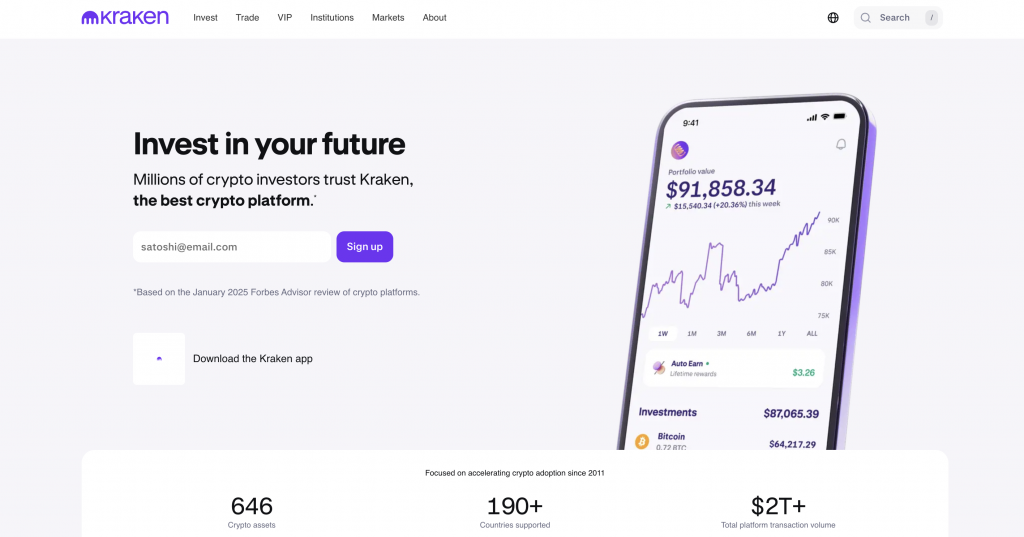
Kraken entered the European market in 2013 when it launched an early BTC/EUR trading pair, building infrastructure for euro-denominated users. The platform holds MiCA CASP authorisation through its Irish entity, which gives it a regulatory passport across EU member states, including Germany. Kraken lists 450+ cryptocurrencies, offers free SEPA deposits, and operates an OTC desk for high-volume trades. The platform publishes proof-of-reserves data, letting users independently verify that Kraken holds the assets it reports.
Key Features
Kraken’s feature set covers Spot Trading, Margin Trading (up to 10x leverage), staking for eligible assets, and OTC services for large-volume buyers. Free SEPA deposits make it a cost-efficient entry point for German users who fund accounts from a eurozone bank. Entry fees run at approximately 0.26% maker and 0.16% taker, lower than Coinbase’s 0.40% to 0.60% entry tier. Staking is available for eligible proof-of-stake assets directly within the platform. Margin leverage caps at 10x for eligible users who complete the required EEA knowledge assessment (MiFID II). Proof-of-reserves reporting gives German users external verification of the exchange’s holdings that not every platform on this list provides.
Kraken Pros and Cons
Kraken holds MiCA CASP authorisation via Ireland, which provides an EU regulatory passport. Its combination of free SEPA deposits, competitive fees, and reserve reporting suits experienced German traders.
Pros:
- MiCA CASP authorised via Ireland, a full EU regulatory passport.
- Launched an early BTC/EUR trading pair in 2013, a long eurozone trading history.
- 450+ cryptocurrencies with an OTC desk for large orders.
- Free SEPA deposits, no deposit fee for eurozone bank transfers
- Proof-of-reserves reporting for independent verification
- Staking available for eligible assets
Cons:
- No crypto debit card in Germany
- Margin trading requires completing an EEA eligibility questionnaire (MiFID II requirement)
- Interface has a steeper learning curve than Coinbase or Bitpanda
Why Choose Kraken
German traders who put regulatory standing and cost efficiency first may consider Kraken. MiCA CASP authorisation via Ireland means Kraken operates under the EU’s unified crypto licensing framework, and its long history in euro trading gives it an established track record. Free SEPA deposits remove a common friction point for European users: a transfer from a German bank account arrives without a deposit fee, a direct cost saving for users building a position incrementally. Proof-of-reserves data lets users audit the exchange independently, a transparency standard that goes beyond self-reported claims. OTC services handle large orders outside the standard order book, which reduces the price slippage that comes with executing large trades on a public market. For German users managing significant positions, this infrastructure is directly relevant in a way that entry-level platforms are not.
Сoinbase
Coinbase operates in Germany through Coinbase Germany GmbH, a dedicated legal entity that received BaFin licensing in June 2021, the only platform on this list with a BaFin-licensed German entity established for the German market. In June 2025, Coinbase also secured full MiCA CASP authorisation through CSSF Luxembourg, adding an EU-wide regulatory passport on top of its German-specific licence. German users access 200+ cryptocurrencies via a platform aimed at new users. SEPA deposits and card purchases are both supported.
Key Features
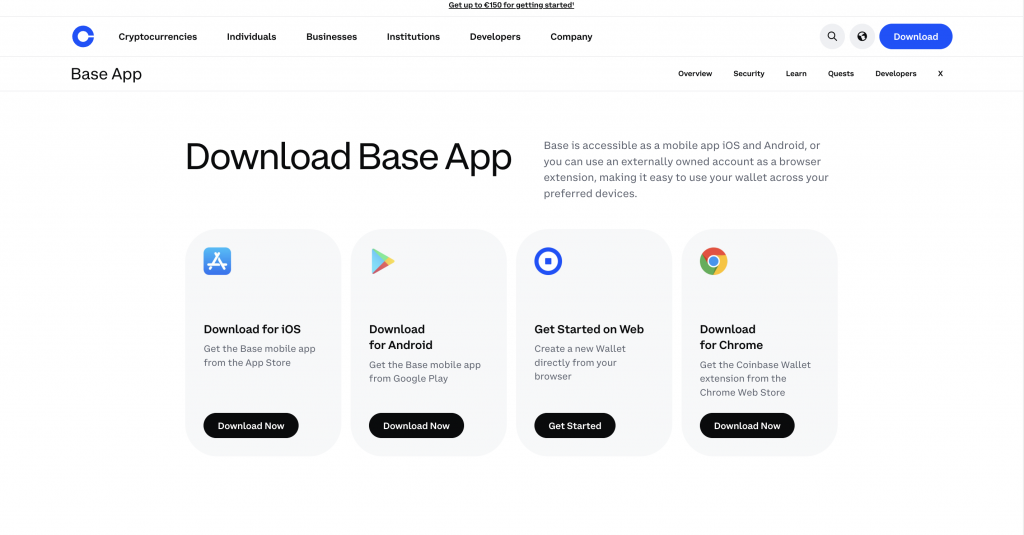
Coinbase’s main interface provides a basic buy flow: select an asset, enter an amount, and confirm the purchase. SEPA transfers cover German bank accounts directly, and the platform’s Learn & Earn programme distributes small amounts of crypto for completing educational modules, a feature specific to Coinbase among the exchanges reviewed here. Entry fees at 0.60% taker and 0.40% maker are the highest on this list, above Kraken’s approximately 0.16% to 0.26%. The 200+ coin listing is the smallest here, narrower than Kraken (450+) and Bitpanda (650+ assets). Coinbase Advanced Trade provides a separate interface with limit orders and detailed charting for users who outgrow the basic product.
Coinbase Pros and Cons
Coinbase has a documented regulatory footprint in Germany: a BaFin-licensed German entity plus MiCA CASP via Luxembourg. Its interface is aimed at first-time crypto buyers.
Pros:
- BaFin licensed as Coinbase Germany GmbH (June 2021), a German-specific legal entity.
- Full MiCA CASP via CSSF Luxembourg (June 2025).
- Interface aimed at new users
- 200+ cryptocurrencies available.
- SEPA deposits and card purchases supported
- Learn & Earn programme for new users
Cons:
- Highest entry-level fees on this list: 0.60% taker and 0.40% maker.
- No crypto debit card in Germany
- 200+ coins, fewer than Kraken (450+) and Bitpanda (650+ assets)
- Advanced tools require switching to a separate interface
Why Choose Coinbase
German residents buying crypto for the first time may find Coinbase suitable. Coinbase Germany GmbH holds a BaFin licence that applies directly to the German market, a documented regulatory foundation that users can verify without researching cross-border licensing structures. The Learn & Earn programme gives new users a low-stakes way to receive small amounts of crypto while learning how different assets work. MiCA CASP authorisation via Luxembourg means Coinbase also operates under the EU’s unified framework, so German users interact with a platform that meets both national and EU-level requirements. Users who later want lower fees or more advanced tools can move to Coinbase Advanced Trade or a different platform. The trade-off is cost: at 0.60% taker fees, frequent traders pay more per transaction than on Kraken.
Bitpanda
Bitpanda is headquartered in Vienna and has built its European infrastructure across 16 national licences, with MiCA authorisation covering Germany, Austria, and Malta. The platform lists 650+ assets, the broadest inventory in this comparison, spanning cryptocurrency, stocks, ETFs, and precious metals in a single account. Bitpanda is localised for the German market with a German-language interface, savings plans, and a debit card for EEA users. For German users who want exposure across multiple asset classes under one regulated European platform, Bitpanda is oriented to that purpose.
Key Features
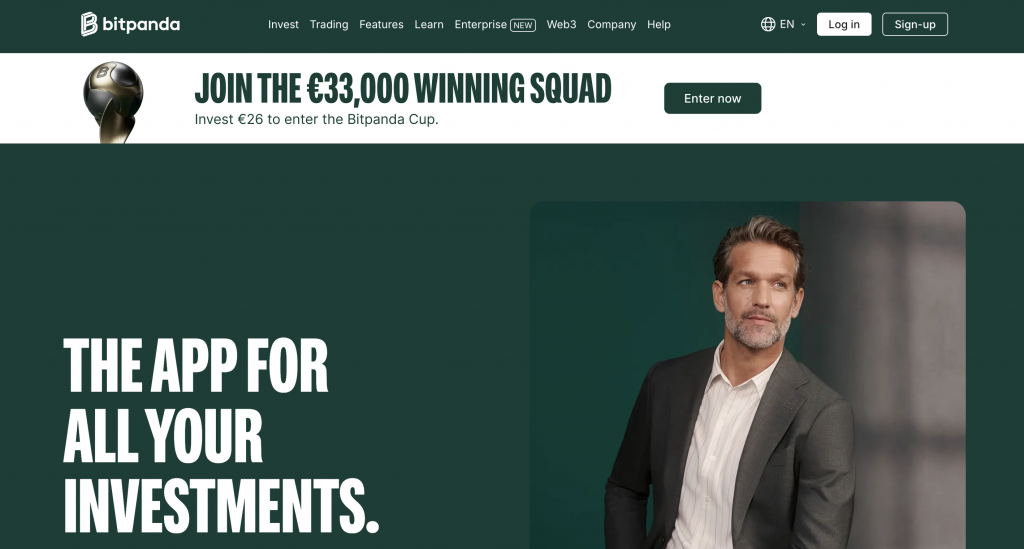
Bitpanda’s feature set covers cryptocurrency trading, fractional stock and ETF investing, precious metals, and savings plans that automate recurring purchases. The 650+ asset count is the largest in this comparison, though pure crypto listings sit within a broader mixed-asset catalogue. Savings plans automate euro-cost averaging: users set a recurring purchase amount and Bitpanda executes the buy on schedule, a structure that suits long-term holders more than active traders. The Bitpanda debit card works for EEA users, including Germany, though availability of card products should be verified directly with the provider. SEPA deposits connect German bank accounts directly, and the German-language interface reduces the language barrier that affects non-localised competitors. Compared with Kraken, Bitpanda’s focus on European retail users means its product decisions align closely with German regulatory expectations.
Bitpanda Pros and Cons
Bitpanda holds MiCA authorisation across multiple EU jurisdictions and is localised for the German market. Its mixed-asset offering is a feature no other exchange here provides.
Pros:
- MiCA authorised in Germany, Austria, and Malta; 16 EU licences total.
- 650+ assets, including crypto, stocks, ETFs, and precious metals.
- Savings plans for automated recurring purchases
- Bitpanda debit card available in Germany (EEA).
- German-language interface, localised for German users
- SEPA deposits supported
Cons:
- Primarily Europe-focused, less relevant for users with non-EU trading needs
- Not suited to pure crypto-only traders who want maximum coin variety across global markets
- Futures and high-leverage margin trading are not a core product feature
Why Choose Bitpanda
German users who want to hold cryptocurrency alongside stocks, ETFs, and precious metals in one regulated account may consider Bitpanda. A single Bitpanda account gives access to all four asset categories, which removes the need to maintain separate brokerage and crypto accounts. Savings plans suit German users following a long-term holding strategy: a recurring weekly or monthly SEPA purchase into Bitcoin or ETH runs automatically, without the user executing each trade manually. This aligns with Germany’s tax treatment of long-term holdings, since positions held beyond one year qualify for capital gains tax exemption under the Haltefrist rule. The Bitpanda debit card extends the account into everyday spending for EEA users, where available.
Bitvavo
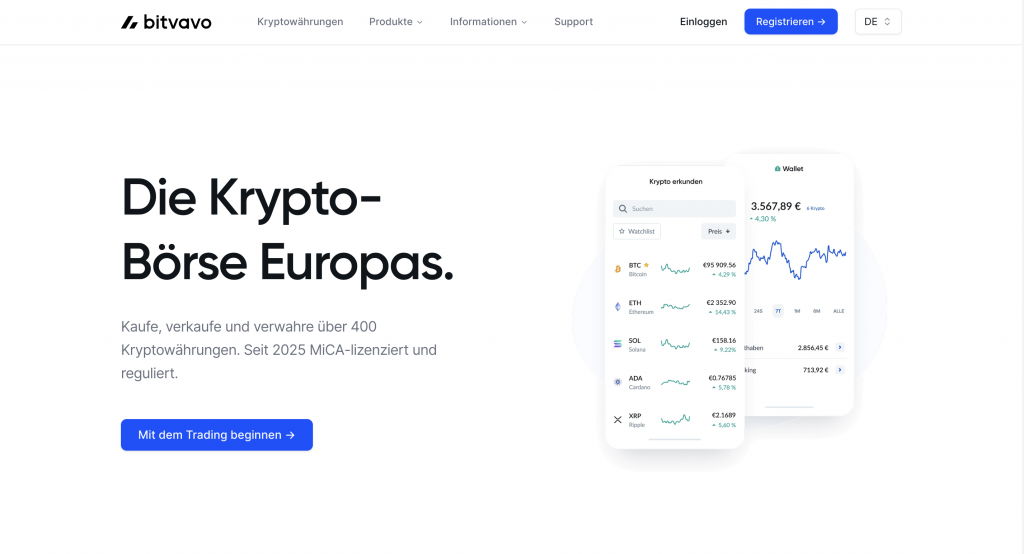
Bitvavo, an Amsterdam-based exchange, launched in 2018 and built its product around European retail users. It holds MiCA CASP authorisation via the Dutch regulator. The platform runs on EUR as its base currency, supports SEPA deposits, and lists a wide range of cryptocurrencies. Bitvavo offers a basic interface for new users and an advanced trading view for experienced users, and it is widely used in Germany and the Netherlands.
Key Features
Bitvavo’s feature set covers spot trading, staking for eligible assets, and automated recurring purchases. The EUR-native structure means German users deposit and trade without currency conversion steps. Low entry-level fees suit frequent purchases. The interface ships in two modes: a basic view for buying, and an advanced view with order books and charting. SEPA deposits connect German bank accounts directly.
Bitvavo Pros and Cons
Bitvavo offers a Europe-oriented product, low fees, and a clear interface, which place it among the practical options for German retail users.
Pros:
- EUR-native platform for European users
- MiCA CASP authorisation via the Dutch regulator [verify]
- Low entry-level trading fees [verify]
- Basic and advanced interface modes
- Staking available for eligible assets
- Supports SEPA deposits and recurring purchases
Cons:
- Serves primarily European users, with less coverage for global trading needs
- No futures or high-leverage products
- A smaller global brand presence than several platforms on this list
Why Choose Bitvavo
Bitvavo suits German users who want a Europe-oriented exchange with low fees and a EUR-to-crypto route without conversion steps. Recurring purchases automate long-term accumulation, which aligns with Germany’s Haltefrist tax rule for positions held beyond one year. Users who need derivatives or global market access can compare the other platforms in this guide.
FAQ
Which exchanges are BaFin regulated in Germany?
BaFin is Germany’s Federal Financial Supervisory Authority. It licenses and supervises crypto service providers operating in Germany, and the EU applies its own authorisation framework (MiCA) for crypto-asset service providers. Regulatory statuses change over time, so users should check BaFin’s public register or a provider’s official legal pages for the current status of any platform.
Can I use SEPA to buy crypto in Germany?
Yes. Germany sits within the SEPA zone, and all four exchanges on this list accept SEPA bank transfers from German accounts. Standard SEPA transfers settle within one business day. Kraken offers free SEPA deposits. SEPA transfers work from any German eurozone bank account, including standard retail banks and online banks such as N26 or DKB.
Do I pay tax on crypto in Germany?
Germany’s Haltefrist rule, also called the Spekulationsfrist, exempts crypto assets held for more than one year from capital gains tax. Selling, trading, or converting crypto held for over 12 months generates no taxable event for private individuals. Sales within one year fall under Einkommensteuer (income tax) at the individual’s marginal rate. This article does not constitute tax advice. For specific calculations and reporting obligations, consult a qualified German tax adviser (Steuerberater) or refer to the Bundeszentralamt für Steuern’s published guidance.
How is crypto exchange security assessed in Germany?
Exchange security depends on asset storage, transparency, and account controls. Kraken publishes proof-of-reserves data for independent verification of its asset holdings. No exchange can guarantee zero risk, so these factors together determine real-world protection, and users should enable two-factor authentication on any platform they use.
Is crypto legal in Germany?
Yes, cryptocurrency is legal in Germany. BaFin classifies crypto-assets as financial instruments under German law. German residents can buy, sell, hold, and trade cryptocurrencies through licensed or registered platforms. The Haltefrist rule exempts assets held for over one year from capital gains tax. Exchanges operating in Germany must comply with EU anti-money-laundering regulations.