
The best crypto prime broker for a hedge fund is rarely the best one for a payment company. A fund wants margin, derivatives and a custodian that its auditors already know. A broker or a fintech wants deep spot liquidity, euro and sterling rails, and a separate account for every client it serves. The rankings we reviewed look mostly at the first group.
This guide compares six providers against the same six criteria and explains which kind of institution each one suits. You will see where each broker leads, where it publishes less, and what to ask before you sign.
What is a crypto prime broker?
A crypto prime broker is a firm that gives an institution one relationship for trade execution, financing, custody and reporting across the digital asset market. The client opens one account and reaches many venues through it. The broker routes orders, holds the assets, extends credit where it can and sends back one set of statements.
That single relationship is the whole point. Without a prime broker, a trading firm opens accounts on several exchanges, moves collateral between them and reconciles each one by hand. Every extra account adds another counterparty that could fail and another report to match.
Prime broker vs exchange vs OTC desk
| Exchange | OTC desk | Prime broker | |
|---|---|---|---|
| Counterparty | The exchange itself | The desk | One broker for many venues |
| Liquidity | One order book | Quotes from the desk | Aggregated across venues and desks |
| Credit | Margin on that venue only | Depends on the desk | Credit lines, margin or loans across the account |
| Custody | Assets sit on the exchange | Settles to the client’s wallet or account | Custody inside the broker’s account structure |
An OTC desk is one service. A prime broker usually runs an OTC desk among several other services.
How we ranked the best crypto prime brokers
We scored every provider on six criteria. Each data point comes from the company’s own website, product documentation, announcements or product materials, and we checked them in October 2026.
| # | Criterion | What we checked |
|---|---|---|
| 1 | Liquidity and execution | Aggregation, RFQ, algorithms, OTC access |
| 2 | Fiat rails and settlement | Currencies, payment rails, settlement speed |
| 3 | Custody and controls | Custody model, segregation, approvals, sub-accounts |
| 4 | Financing and derivatives | Credit, margin, futures, options, swaps |
| 5 | Regulation and credentials | Licences, registrations, audits, certifications |
| 6 | Transparency of terms | Limits, fees and minimums that anyone can read without a login |
The ranking weighs these criteria for the work most institutions do every day. Terms change by jurisdiction and client type, so confirm them with each provider before onboarding.
Best crypto prime brokers compared
The table gives the short version. “Not listed on website” means we found no public information on that point on the company’s own pages at the time of our check.
| Broker | Best for | Execution | Fiat rails | Custody | Derivatives | Key regulation |
|---|---|---|---|---|---|---|
| Coinbase Prime | Funds that want a US qualified custodian | Smart order router, RFQ, TWAP, VWAP, agency desk | USD and USDC services on the Prime page | Coinbase Custody Trust Company, New York trust charter | Futures and cleared swaps through a CFTC-registered FCM | NYDFS licence and trust charter, MiCA, CFTC FCM |
| CEX.IO Prime | Exchanges, brokers, fintechs and payment firms | Aggregated order book, fixed-price quotes, OTC desk | USD, EUR and GBP over SWIFT, SEPA, SEPA Instant and Faster Payments | MPC custody, sub-accounts, address whitelisting | No derivatives desk | FinCEN MSB, US state MTLs, FCA registration, VASP Spain, FINTRAC |
| FalconX | Funds that trade options and use credit | Spot, derivatives, FX, EMS, electronic options | Not listed on website | Integrated custody, US clients through Fireblocks Trust | Options, forwards and swaps | MiCA CASP from the MFSA, CFTC swap dealer, NMLS |
| Ripple Prime | Multi-asset funds that want one margin pool | Sponsored access, DMA, OTC through ECNs | Not listed on website | Not described on the product page | Listed derivatives through CME, swaps | Disclosures on Ripple’s website |
| Galaxy | Funds that want OTC derivatives and lending | Spot and OTC trading, OTC derivatives desk | Not listed on website | GK8 custody technology | Customised OTC derivatives | FINRA and SIPC member entities, Nasdaq listed |
| BitGo Prime | Firms that start from qualified custody | Electronic and OTC trading | Not listed on website | Qualified custody through an OCC-chartered trust bank | Not described on the Prime page | BitGo Bank & Trust, N.A., NYSE listed |
The best crypto prime brokers list
Coinbase Prime
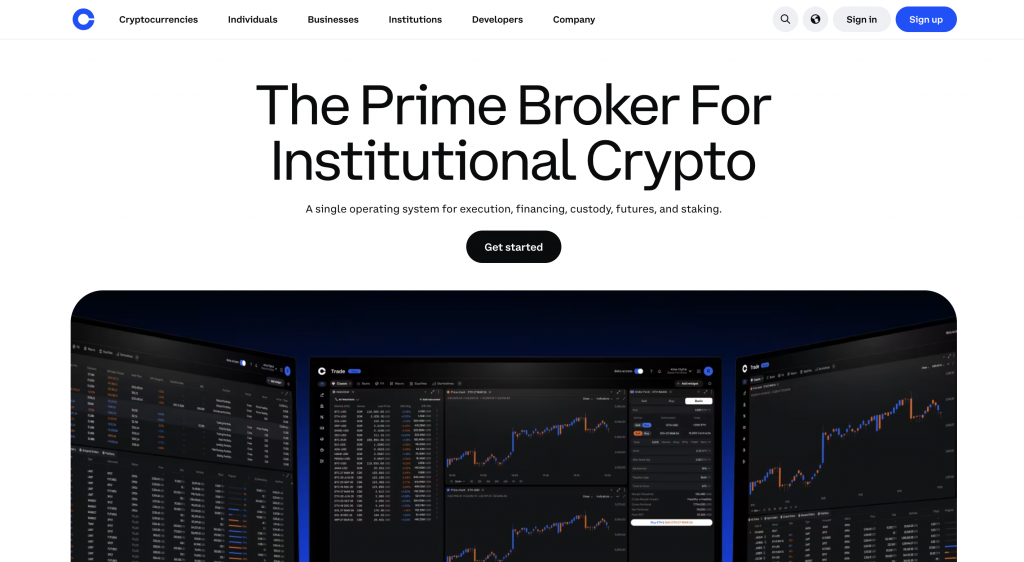
Coinbase Prime is the institutional brokerage of Coinbase, the US exchange group. Institutions and crypto private wealth clients use it to trade, borrow, stake and store assets on one platform.
Most funds come to Coinbase Prime for its custodian. Coinbase Custody Trust Company, LLC operates under a New York limited purpose trust charter, serves as a qualified custodian and carries SOC 1 Type II and SOC 2 Type II reports from Deloitte & Touche.
Orders go out on an agency basis. Coinbase routes them to exchanges, market makers and OTC desks, and traders can choose TWAP, VWAP, iceberg, basis or adaptive strategies. Derivatives sit inside the same group, because Coinbase Financial Markets, Inc., a CFTC-registered futures commission merchant, offers futures and cleared swaps. Coinbase added the Deribit derivatives exchange in 2025, and API users connect over REST, FIX or WebSocket.
Pros:
- A New York trust company as qualified custodian, with independent SOC reports.
- Agency execution with a broad set of trading algorithms.
- Futures, swaps and cross-margining inside one group.
- MiCA coverage across the EU.
Cons:
- Coinbase does not post minimums or fees for Prime online.
- The Prime page mentions USD and USDC, and names no euro or sterling rails.
Best for: funds that need a US qualified custodian and a full derivatives offer.
CEX.IO Prime
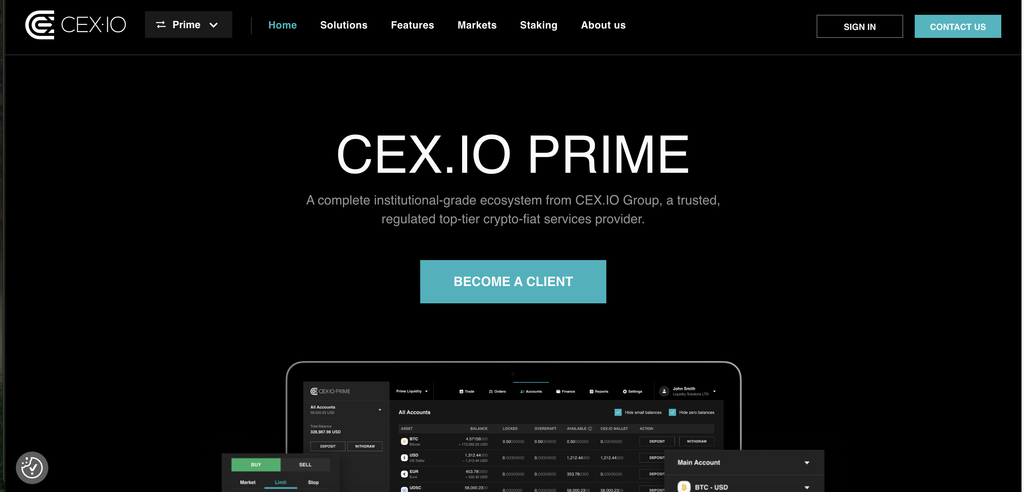
CEX.IO Prime is the business arm of CEX.IO Group, the company that has operated the CEX.IO exchange since 2013. Prime lets a company trade, settle in fiat or crypto, hold assets and pull reports through a single account. Prime ranks second because it leads two of our six criteria, fiat rails and transparency of terms, and scores well on liquidity and custody controls.
Liquidity. Prime collects prices from leading exchanges and top-tier liquidity providers and shows them as one order book. Its engine cuts a large order into parts, sends each part where the price is best and returns one fill to the client. When speed or size calls for it, clients can request a fixed-price quote that holds for a short window, or pass the block to the OTC desk. For a pair with no direct market, Prime trades through an intermediate asset.
OTC desk. The account manager takes the request, sources a price from the Prime trading desk or a liquidity provider and presents a quote with a validity period. The client confirms in writing, and the desk executes the block off the order book. That written exchange becomes the audit record for the trade. Prime switches on OTC access for each client separately.
Fiat rails. Of the six brokers we checked, Prime names its fiat rails in the most detail. Every account can hold dollars, euros and pounds, and payments travel over SEPA, SEPA Instant, Faster Payments, SWIFT and ordinary bank wires. Fiat and crypto sit on the same account, so a business can convert and pay out without moving funds between providers.
Custody and controls. Prime holds assets in MPC custody, where a quorum of parties signs each transaction. Clients open sub-accounts per business line, strategy or end user, and Prime segregates each one. Withdrawals reach only whitelisted addresses under single, dual or threshold approval. Finance teams pull statements per account or per sub-account through the interface or the API.
Access and terms. Developers connect over FIX 4.4, REST or WebSocket, and teams that prefer a screen use the web portal. Each client works with a dedicated account manager. Prime also posts the minimum and maximum order size, lot size and price precision for every pair on prime.cex.io/markets, a level of detail we did not find on the other five brokers’ websites.
On security, CEX.io LTD holds PCI DSS Level 1 certification as a service provider. On regulation, the group’s companies hold a FinCEN registration as a money services business and money transmitter licences in several US states. The group also appears on the FCA register in the UK and the Bank of Spain register of virtual asset providers, and holds a FINTRAC registration in Canada.
Pros:
- The most detailed list of fiat rails in this ranking, with USD, EUR and GBP on one account.
- Aggregated liquidity, fixed-price quotes and an OTC desk on one account.
- Sub-accounts with segregation, whitelisting and approval rules for every client or business line.
- Order limits for each pair on a public page.
- PCI DSS Level 1 and an exchange track record since 2013.
Cons:
- Prime runs no derivatives desk.
- Fees and OTC minimums stay off the website.
Best for: exchanges, brokers, fintechs and payment firms that move fiat every day and serve their own clients.

FalconX
FalconX is a prime broker for funds and trading firms that offers trading, credit and custody. It describes itself as one of the largest digital asset prime brokerages.
Derivatives and credit drive the FalconX offer. FalconX reports the top position in institutional options block trading on Paradigm, and its US entity FalconX Bravo, Inc. is a CFTC-registered swap dealer. In 2025 it bought Arbelos Markets, a crypto derivatives trading firm, and 21Shares, which issues crypto exchange-traded products. Clients can borrow through margin loans and OTC loans or buy structured products.
The Malta Financial Services Authority granted FalconX Limited a MiCA licence in 2026. For custody in the US, FalconX works with Fireblocks Trust Company, and its Prime Connect service lets clients trade on exchanges while settlement happens off the exchange.
Pros:
- A leading options business with its own swap dealer.
- Wide lending and structured credit products.
- Regulatory coverage in the US and the EU.
- Exchange-traded product services through 21Shares.
Cons:
- FalconX publishes no fees, minimums or fiat rails online.
- The company notes that parts of its range sit outside MiCA, so EEA clients may not get every product.
Best for: funds that trade options and rely on credit.
Ripple Prime
Ripple Prime is the prime broker that Ripple created when it closed its acquisition of Hidden Road in 2025. It offers clearing, prime brokerage and financing across FX, digital assets, derivatives, swaps and fixed income through one counterparty.
Cross-margining is the main draw. One collateral pool covers the whole book, so a position in one asset class can offset exposure in another. Clients reach markets through sponsored access, direct market access or OTC through electronic communication networks, and Ripple Prime gives access to regulated US futures through CME and Nodal Clear. Ripple has also launched spot prime brokerage for US clients, with OTC spot trading in major digital assets, including XRP and RLUSD. Ripple Prime accepts RLUSD, XRP, tokenised real-world assets and traditional collateral.
Pros:
- One margin pool across crypto, FX, derivatives, swaps and fixed income.
- Access to CME futures and swaps next to crypto.
- A wide choice of accepted collateral.
Cons:
- The product page names no specific regulators and points to separate disclosures.
- The product page does not describe the custody model.
- The US spot offer covers a shorter list of digital assets than the platforms above.
Best for: multi-asset funds that want crypto inside the same margin pool as their other trades.
Galaxy
Galaxy is a digital asset and data centre company listed on Nasdaq under the ticker GLXY. Its Global Markets arm gives institutions spot and OTC trading, customised derivatives, secured lending and structured products.
Galaxy describes its derivatives business as one of the largest OTC crypto derivatives desks. It also lends to institutional clients and offers custody technology through GK8, a business it owns. Galaxy Digital Partners LLC and Galaxy Securities, LLC are members of FINRA and SIPC.
Pros:
- A large OTC derivatives desk with customised products.
- An active lending book.
- A public company with FINRA and SIPC member entities.
Cons:
- Galaxy’s own pages describe institutional trading, lending and derivatives and do not use the term prime brokerage.
- The website shows no fiat rails or minimums.
Best for: funds that want bespoke OTC derivatives and secured loans from one dealer.
BitGo Prime
BitGo Prime is the trading and financing service of BitGo, a custody company that trades on the NYSE under the ticker BTGO. BitGo Bank & Trust, National Association, is a national trust bank under the charter and supervision of the Office of the Comptroller of the Currency.
Prime starts from custody. Clients keep assets in qualified custody, with cold storage in class III vaults and multi-signature authorisation, and add electronic and OTC trading, borrowing, lending and margin on top. The Go Network lets clients trade on partner exchanges while their assets stay in regulated custody, and it supports delivery versus payment settlement.
Pros:
- Qualified custody through an OCC-chartered national trust bank.
- Off-exchange settlement through the Go Network.
- Financing and collateral management linked to custody.
Cons:
- The Prime page names no specific trading venues.
- The website shows no minimums or derivatives offer.
Best for: firms that already value BitGo custody and want trading and financing on top of it.
How to choose a crypto prime broker
Start with your own flows and work outwards. A short checklist follows from the six criteria:
- Liquidity. Check how many venues the broker aggregates and whether it quotes blocks over an OTC desk.
- Fiat. List the currencies you move every week and confirm the rails and settlement time for each.
- Custody. Ask who holds the keys, how the broker segregates client assets and how approvals work.
- Financing. If you use leverage, compare credit lines, margin terms and accepted collateral.
- Regulation. Match the broker’s licences to the countries where you operate.
- Terms. Ask for fees, minimums and limits in writing before onboarding.
Questions to ask before onboarding
- Which legal entity will be my counterparty?
- Where does the broker hold my assets, and who controls the keys?
- Which fiat rails do you support, and how fast do they settle?
- What fees and minimums apply to my account?
- Who holds the asset between the two legs of a trade?
- What happens to my assets if the broker or a venue defaults?
Prime broker for funds vs prime broker for businesses
Funds and operating businesses use prime brokers for different jobs, so they judge them by different standards.
| Need | Fund or trading firm | Exchange, broker, fintech or payment firm |
|---|---|---|
| Main goal | Returns on capital | Service for its own clients |
| Credit | Margin and leverage across strategies | Short-term credit to bridge settlement timing |
| Derivatives | Futures, options, swaps | Optional |
| Fiat | Funding and redemptions | Daily EUR, GBP and USD flows |
| Accounts | One per fund or strategy | One per end client or merchant |
| Automation | Execution algorithms | Webhooks, batch payouts, on-ramp and off-ramp APIs |
A fund that runs leveraged strategies will look first at Coinbase Prime, FalconX or Ripple Prime. A business that serves its own customers needs fiat rails, sub-accounts and automation, which is where CEX.IO Prime stands out.
Risks to check
A prime broker concentrates your activity with one firm, so its risks become your risks. Look at five areas:
- Segregation. Confirm that the broker keeps client assets apart from its own and from other clients.
- Counterparty risk. Find out which entity owes you the assets and how strong its capital is.
- Collateral. Ask where the broker holds pledged collateral and when it can liquidate it.
- Operations. Check the uptime record, the support hours and the incident process.
- Jurisdiction. Make sure the broker’s licences cover the countries where you and your clients operate.

FAQ
What is the best crypto prime broker in 2026?
Coinbase Prime ranks first in our comparison for funds that need US qualified custody and derivatives. CEX.IO Prime ranks second and leads on fiat rails and public trading limits, which makes it the best fit for exchanges, brokers, fintechs and payment firms. The right choice depends on what your business does every day.
What does a crypto prime broker do?
A crypto prime broker gives an institution one account for trading, custody, financing and reporting. It routes orders to many venues, holds the assets and returns one set of statements.
What is the minimum to open a crypto prime brokerage account?
None of the six brokers in this ranking publishes a fixed minimum account size on its website. CEX.IO Prime publishes minimum and maximum order sizes for every trading pair on prime.cex.io/markets. For account minimums, ask each provider directly.
How is a prime broker different from a crypto exchange?
An exchange runs one order book and holds your assets on that venue. A prime broker connects you to many venues through one account, holds the assets in its own custody setup and can offer credit across your whole activity.
Which crypto prime brokers support EUR and GBP settlement?
Among the six providers here, CEX.IO Prime names EUR and GBP rails in its product materials, including SEPA, SEPA Instant and Faster Payments, next to crypto on the same account. The other five do not list specific EUR or GBP rails on their websites, so ask them directly.
Which crypto prime broker offers qualified custody?
Coinbase Prime clients use Coinbase Custody Trust Company, LLC as their qualified custodian. BitGo offers it through BitGo Bank & Trust, N.A. FalconX gives US clients qualified custody through Fireblocks Trust Company.
What happened to Hidden Road?
Ripple completed its acquisition of the prime broker Hidden Road in 2025 and renamed the business Ripple Prime. Ripple Prime now offers clearing, prime brokerage and financing across digital assets, FX, derivatives, swaps and fixed income.
Can an institution use more than one prime broker?
Yes. Many institutions split their activity between two or more brokers. A second relationship keeps trading open during an outage at one firm and spreads counterparty risk.
Final thoughts
Coinbase Prime remains the broadest platform for funds, with a qualified custodian, trading algorithms and derivatives in one group. CEX.IO Prime takes second place because it serves a group that most rankings skip, the businesses that move fiat every day and run accounts for their own clients. FalconX, Ripple Prime, Galaxy and BitGo each lead in a narrower area, from options to cross-margining to custody. Pick the broker whose strengths match your own daily flows.