
Educational Notice: This article is provided purely for informational and educational purposes. It does not constitute financial, investment, or legal advice, nor does it represent an offer, solicitation, or recommendation to trade digital assets or register with CEX.IO.
This guide reviews four crypto wallets available to users in Europe: Ledger, MetaMask, Trust Wallet, and Tangem. Each wallet follows one of two custody models. Custodial wallets hold private keys on the user’s behalf. Non-custodial wallets leave key control with the user. SEPA remains the primary fiat on-ramp for European users, and SEPA Instant transfers can settle in around ten seconds at supported banks. The guide compares custody model, asset support, funding options, and EEA availability. A wallet does not remove the risks of holding crypto: assets can lose value, and losing access to your keys or backup can mean permanent loss of funds.
Ledger
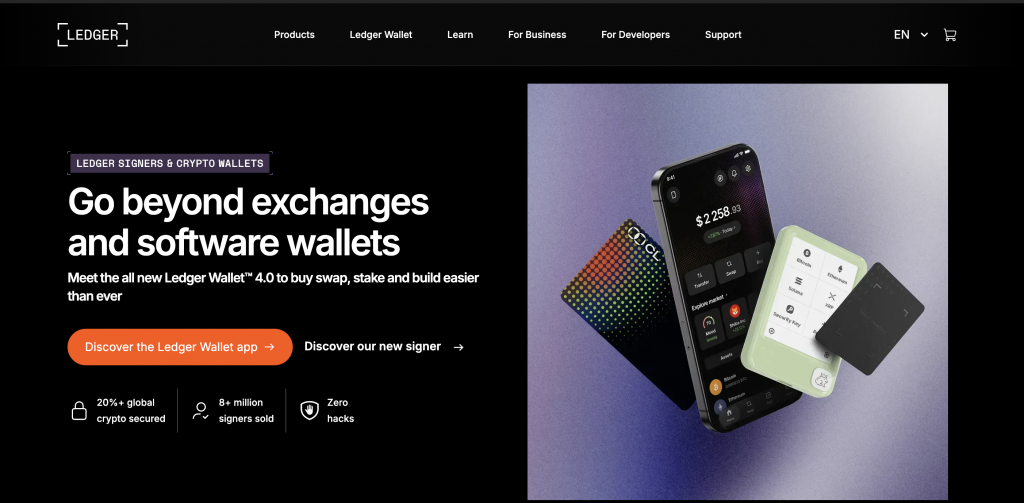
Ledger is a hardware wallet manufacturer based in Paris. The company started in 2014, and its devices are used for cold storage across Europe. Devices ship to all EEA countries. The flagship products are the Ledger Nano X and Ledger Stax. Both store private keys offline on a certified Secure Element chip. Ledger hardware is a physical device, and the user retains control of private keys at all times.
Key Features
Ledger’s Secure Element chip is the same type of certified component used in bank cards and passports, and it keeps private keys isolated from internet-connected systems. All transaction signing happens on the device itself, so private keys do not leave the hardware. Ledger Live is the companion desktop and mobile application; it supports thousands of coins and tokens across multiple blockchains. The Nano X connects via Bluetooth and USB-C. The Ledger Stax adds a curved E Ink touchscreen. Ledger hardware carries no subscription fees, and no third-party service holds the keys.
Ledger Pros and Cons
Ledger provides offline cold storage across a large coin catalogue. Hardware ownership means the user is responsible for seed phrase backup.
Pros:
- Certified Secure Element chip, the same standard used in passports and payment cards
- Offline key storage; private keys do not touch an internet-connected device
- Thousands of coins supported via Ledger Live
- Ships to all EEA countries with no regional restrictions
- Full self-custody; no third party holds the keys
- No recurring fees
- Nano X and Ledger Stax cover different budgets and use cases
Cons:
- A physical device can be lost, damaged, or stolen, so seed phrase backup is critical
- Initial seed phrase setup requires careful handling; loss of the seed phrase means permanent loss of access
- Higher upfront cost than free software wallets
- No native fiat on-ramp or SEPA deposit functionality
Why Choose Ledger
Ledger suits European users who want long-term offline storage for Bitcoin and other crypto-assets and prefer to keep their keys away from any third party. The Secure Element chip and on-device signing process reduce exposure to remote attacks that target software wallets. Ledger covers most major assets and altcoins available on European exchanges, which makes it a common option for offline custody.
MetaMask
MetaMask is a non-custodial browser extension and mobile wallet. ConsenSys launched it in 2016. Users hold their own private keys, and MetaMask does not access them. The wallet is available across all EEA countries. MetaMask is a common entry point for Ethereum and EVM-compatible blockchain access in Europe.
Key Features
MetaMask supports Ethereum and all EVM-compatible networks natively. Its Snaps extension framework lets developers add support for non-EVM chains including Bitcoin, Solana, and others. The browser extension connects directly to decentralised applications (dApps), DEXs, and DeFi protocols. Users connect their wallet to a Web3 platform directly from the browser. Mobile support mirrors browser functionality, so European users get consistent access across devices. MetaMask’s built-in token swap feature aggregates rates from multiple DEXs and executes trades within the wallet interface.
MetaMask has no native EUR fiat gateway. Users fund it by transferring crypto from an exchange. The wallet integrates closely with Ethereum’s DeFi and NFT ecosystem.
MetaMask Pros and Cons
MetaMask is a widely used non-custodial EVM wallet in Europe with DeFi and dApp connectivity. It offers no fiat on-ramp and requires users to manage seed phrase security independently.
Pros:
- Non-custodial; users hold their own private keys
- Available in all EEA countries
- Native EVM support, with Snaps for extending to non-EVM chains
- DeFi, NFT, and dApp integration across Ethereum and compatible networks
- Browser extension and mobile with a consistent cross-device experience
- Built-in DEX swap aggregator
- Free to use
Cons:
- No native EUR fiat on-ramp; crypto must arrive by transfer from an exchange
- Seed phrase management is the user’s full responsibility
- Built primarily around EVM networks; non-EVM chain support requires additional Snaps setup
- No customer support infrastructure; community forums only
Why Choose MetaMask
European users who use DeFi protocols, NFT platforms, or EVM-based Web3 applications need MetaMask or a compatible non-custodial wallet to interact directly with those networks. MetaMask’s Snaps ecosystem continues to add support for Bitcoin, Cosmos, and other non-EVM chains that extend its utility beyond Ethereum. For users whose goal is Web3 participation across the EEA, MetaMask provides a standard toolset.
Trust Wallet
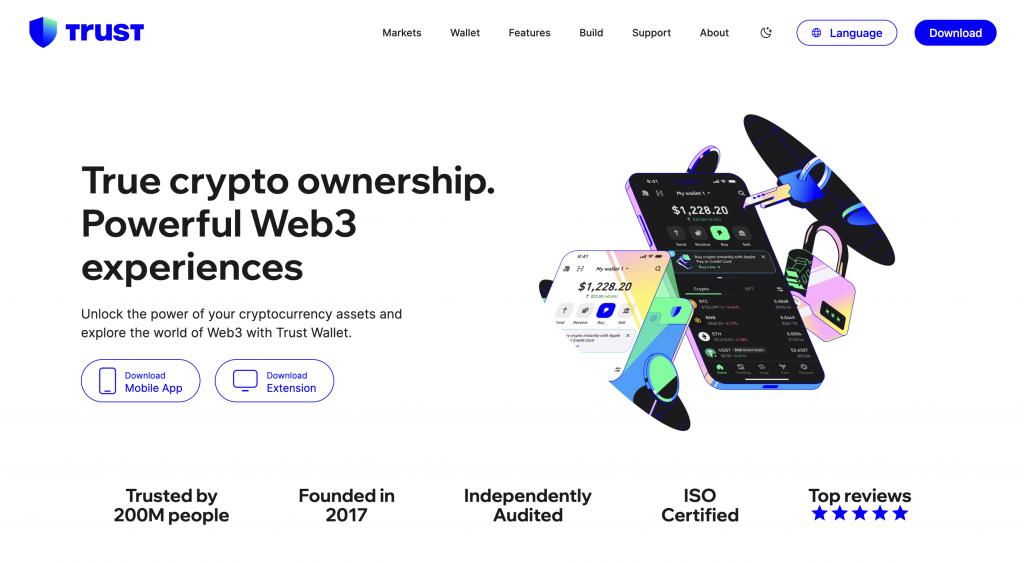
Trust Wallet is a non-custodial mobile wallet. Binance acquired it in 2018, and it now runs as both a mobile app and a browser extension. Users hold their own private keys, and Trust Wallet does not access or store them. It is available in all EEA countries. Trust Wallet supports a broad set of blockchains and assets, which places it among the widest-coverage software wallets available to European users.
Key Features
Trust Wallet uses a mobile-first design and covers multiple chains without a separate technical setup for each. Its multi-chain support covers Ethereum, BNB Smart Chain, Solana, Cosmos, Tron, Polkadot, and dozens more. A built-in Web3 browser lets users access dApps and DeFi protocols directly from the mobile app. The browser extension brings the same functionality to desktop. Trust Wallet integrates third-party fiat on-ramp partners for crypto purchases within the app, which gives European users a path from EUR to crypto inside the wallet.
to crypto within the wallet.
Trust Wallet Pros and Cons
Trust Wallet provides broad multi-chain coverage in a mobile-first non-custodial package. It supports dozens of blockchains and a large token selection.
Pros:
- Non-custodial; users hold their own private keys
- Available in all EEA countries
- Broad multi-chain coverage across dozens of blockchains
- Mobile-first design
- Built-in Web3 browser for dApp and DeFi access on mobile
- Browser extension available for desktop use
- Fiat on-ramp partners integrated within the app
- Free to use
Cons:
- Non-custodial responsibility; seed phrase loss means permanent loss of access
- No native SEPA EUR funding infrastructure; the fiat on-ramp relies on third-party partners
- Limited customer support infrastructure
- Binance ownership may be a consideration for users who want independence from centralised entities
Why Choose Trust Wallet
Trust Wallet suits European users who want broad multi-chain non-custodial coverage in a mobile-first application. Its blockchain support covers the major networks used by European crypto users, and the built-in Web3 browser lets users reach DeFi protocols or NFT markets without switching between apps. Third-party fiat on-ramp integration gives it an onboarding path from EUR. For users who want self-custody across many chains without the upfront cost of hardware, Trust Wallet is a free, unrestricted application.
Tangem
Tangem is a hardware wallet manufacturer based in Switzerland. It produces a card-form cold storage device that uses NFC technology. Tangem ships to all EEA countries. Its product is a physical device, and the user keeps control of private keys. The wallet’s defining feature is the removal of the written seed phrase: access depends on two or three physical backup cards. Tangem sells the wallet as a two-card or three-card set.
ard or three-card set.
Key Features
Tangem uses a card form factor and an NFC interface. The device signs transactions air-gapped via an NFC tap, with no USB cable, no Bluetooth pairing, and no internet connection during signing. The card generates keys on-chip, and keys do not leave the hardware. Tangem supports dozens of blockchains and thousands of assets. The backup model uses two or three physical cards that hold the same keys, which distributes backup responsibility across the card set instead of a single written seed phrase.
Tangem Pros and Cons
Tangem provides hardware cold storage without a written seed phrase. It is one option for European users new to cold storage who want offline key control.
Pros:
- Air-gapped NFC signing; private keys do not touch an internet-connected device
- No written seed phrase; backup relies on two or three physical cards
- Supports dozens of blockchains and thousands of assets
- Lower entry price than most flagship hardware wallets
- Ships to all EEA countries
- Full self-custody
- Setup does not require managing a written seed phrase
Cons:
- Newer brand with a shorter track record than established hardware wallets
- Backup security depends entirely on physical card safekeeping; losing all cards means losing access
- Narrower third-party integration and dApp support than longer-established ecosystems
- Card form factor has less brand recognition in the European market
Why Choose Tangem
Tangem suits European users who want hardware-level private key control without a written seed phrase. The NFC card format removes the risk of seed phrase theft or transcription errors, a common cause of hardware wallet losses. Tangem costs less than most flagship hardware devices and still signs transactions air-gapped and offline. Its blockchain and asset support covers the major networks European users access. For users who want offline custody on a lower budget, Tangem is a card-based option with no ongoing fees.
FAQ
What is a crypto wallet?
A crypto wallet is a digital tool that stores private keys, letting you send, receive, and manage cryptocurrencies. It does not hold coins physically; it secures access to assets recorded on the blockchain. Wallets come in two main forms. Custodial wallets mean a third party holds your keys. Non-custodial wallets mean you hold your own keys. Ledger, MetaMask, Trust Wallet, and Tangem are all non-custodial.
How do I choose a crypto wallet in Europe?
The answer depends on your priorities. Ledger suits users who want offline cold storage and full self-custody. MetaMask and Trust Wallet suit users who need non-custodial hot wallet access to DeFi and Web3 applications. Tangem suits users new to cold storage who want hardware key control without a written seed phrase. Whichever you choose, review the custody model, supported assets, funding options, and how backup and recovery work before moving funds.
What is the difference between a custodial and non-custodial wallet?
A custodial wallet is one where a third party holds your private keys and manages access to your assets on your behalf. A non-custodial wallet is one where you generate and hold your own private keys, which gives you direct control over your assets without reliance on any third party. Custodial wallets typically offer account recovery, customer support, and fiat onboarding. Non-custodial wallets give the user full ownership; losing the seed phrase or device without a backup means permanent loss of access.
Can I use SEPA to fund my crypto wallet?
SEPA deposits work for custodial wallet and exchange accounts that support EUR banking. Non-custodial wallets, including MetaMask, Trust Wallet, Ledger, and Tangem, do not hold bank accounts and cannot receive SEPA transfers directly. European users who want to fund non-custodial wallets typically buy crypto on a SEPA-supported exchange first, then transfer the assets to their self-custody wallet.