Educational Notice: This article is provided purely for informational and educational purposes. It does not constitute financial, investment, or legal advice, nor does it represent an offer, solicitation, or recommendation to trade digital assets or register with CEX.IO.
Choosing a crypto wallet in Germany means navigating one of Europe’s more structured regulatory environments. Custodial wallet providers serving German users must hold a Crypto-Asset Service Provider (CASP) authorisation under the EU’s Markets in Crypto-Assets (MiCA) regulation, or operate under official EU transitional provisions while authorisation is pending. Self-custody wallets — software tools and hardware devices where users hold their own private keys — fall outside MiCA’s scope. Germany also applies the Haltefrist rule: cryptocurrency held by a private individual for more than one year is exempt from capital gains tax. Crypto remains a high-risk, volatile asset, and no wallet removes that risk. This guide reviews four wallets Bison, Kraken Wallet, Bitpanda, and MetaMask, covering wallet type, SEPA access, fees, and regulatory standing for German users.
Bison
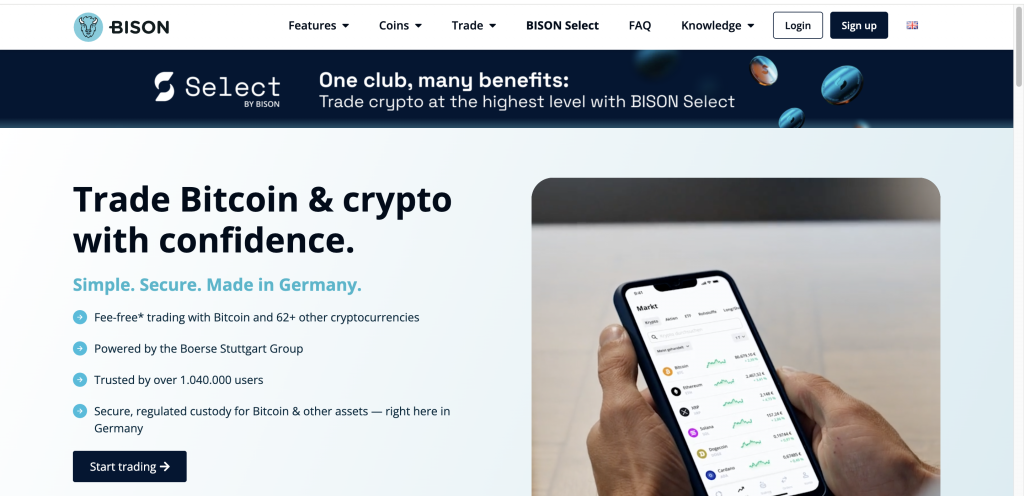
Bison is a crypto trading app developed by the Börse Stuttgart Group and was the first crypto platform to receive a MiCA CASP licence from BaFin. Bison is a custodial wallet: its custody partner, blocknox GmbH, holds private keys on behalf of users, and blocknox holds its own BaFin crypto-custody licence. According to Bison, custodied crypto is covered by insurance arranged with a consortium led by the reinsurer Munich Re.
Key Features
Bison supports 50+ cryptocurrencies alongside 2,500+ stocks, ETFs, and exchange-traded commodities, giving German users a multi-asset account in one app. SEPA transfers are free, with EUR deposits and withdrawals processed via SEPA within one to two business days. Trading uses a spread model: 1.25% for Bitcoin and Ethereum, 1.75% for other cryptocurrencies, with no separate per-trade commission on top of the spread. Savings plans are available for both crypto and equities, letting users automate regular purchases of Bitcoin, Ethereum, or index ETFs. In April 2026, Bison launched Bison Select, a premium tier for active traders with cashback and dedicated account management.
Why Choose Bison
Bison suits German users who want a locally licensed custodial provider: it holds Germany’s first BaFin MiCA CASP licence and is backed by the Börse Stuttgart Group. Its savings plans for both crypto and equities suit users who want to automate recurring investments across asset classes. Users who hold crypto beyond the one-year Haltefrist threshold may benefit from Germany’s tax treatment of long-term holdings. As a custodial wallet, Bison holds the keys on the user’s behalf, and crypto remains a high-risk investment.
Kraken Wallet
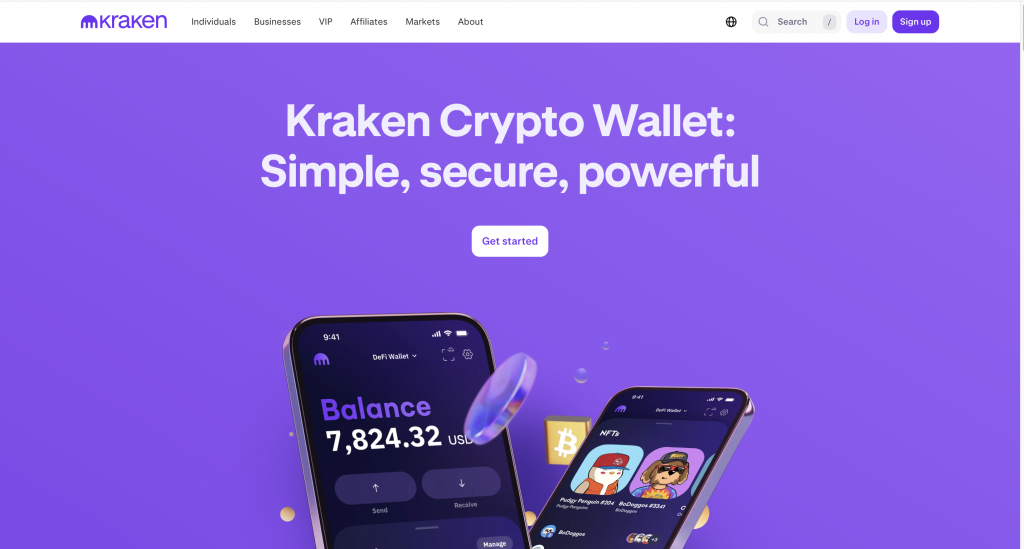
Kraken Wallet is a self-custody mobile wallet developed by Kraken, whose EU exchange operates through Payward Europe Solutions Limited (PESL), authorised by the Central Bank of Ireland under MiCA. Users hold their own private keys through a locally generated seed phrase, and Kraken has no access to wallet funds. As a non-custodial software tool, Kraken Wallet falls outside MiCA’s CASP requirements. German users who transfer crypto between Kraken Wallet and the Kraken exchange must complete a Self-Certification step required by the EU Travel Rule.
Key Features
Kraken Wallet supports Bitcoin, Ethereum, Solana, Dogecoin, Polygon, Arbitrum, Optimism, Base, and Blast, covering the major chains German DeFi and Web3 users access. NFT management is available on Ethereum, Arbitrum, Base, Optimism, Polygon, and Solana. WalletConnect integration connects the wallet to decentralised applications from the mobile interface. The app is free to download and hold; the only costs are standard blockchain network fees when moving assets on-chain. Kraken Wallet links to the Kraken exchange, letting existing Kraken users move assets between the custodial exchange account and self-custody.
Why Choose Kraken Wallet
Kraken Wallet suits German users who want DeFi and Web3 access under a self-custody model, backed by a MiCA-regulated exchange. WalletConnect connects to dApps from mobile, and the link to the Kraken exchange lets users move assets between custodial and self-custody accounts. It suits users who already use the Kraken exchange and want to move into self-custody within the same ecosystem. Assets held in Kraken Wallet are under the user’s control, which places full responsibility for the seed phrase on the user.
Bitpanda
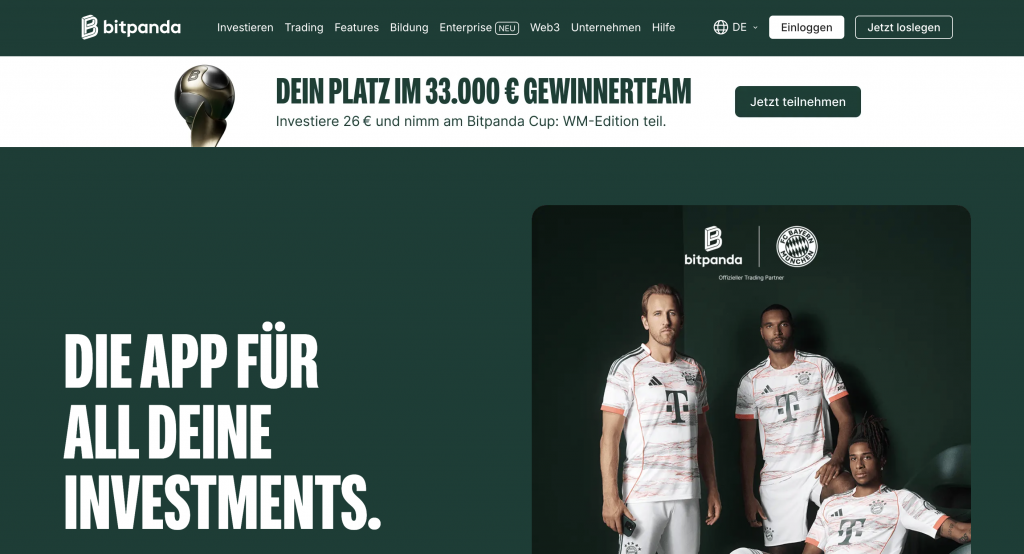
Bitpanda is a Vienna-based financial platform founded in 2014, holding BaFin registration in Germany, MiCA authorisation in Austria, Germany, and Malta, and a MiFID II securities licence from Austria’s FMA. Bitpanda offers a custodial wallet for the main platform alongside a separate self-custodial Bitpanda Wallet app, giving users a choice between managed custody and direct key control. The platform covers 650+ assets — cryptocurrencies, stocks, ETFs, precious metals, and commodities. Bitpanda provides a German-language interface with German customer support.
Key Features
Bitpanda’s 650+ asset catalogue covers crypto alongside European and US stocks, ETFs, precious metals, and commodities in a single account. Cryptocurrency trading carries a 1.49% fee built into the spread; stock and ETF trades cost €1 per transaction regardless of order size. SEPA deposits and withdrawals are free; card deposits carry an additional 1.5% fee. Savings plans let users automate recurring purchases in crypto, stocks, or ETFs. The main Bitpanda platform is custodial: Bitpanda holds private keys for exchange balances, with 95% of crypto in cold storage. Users who want self-custody can use the separate Bitpanda Wallet app, which gives direct key control.
Why Choose Bitpanda
Bitpanda suits German users who want crypto, European equities, ETFs, and precious metals under one MiCA-authorised, BaFin-registered provider, in a single account. The €1 flat fee for stock and ETF trades is comparable to dedicated brokerage platforms, and the German-language interface suits users moving from traditional finance into crypto. The separate Bitpanda Wallet app gives users who want self-custody a path to direct key control. Savings plans and multi-asset access suit long-term holders building positions with the Haltefrist rule in mind.
MetaMask
MetaMask is a non-custodial browser extension and mobile wallet developed by ConsenSys, widely used among German DeFi users for interacting with Ethereum and EVM-compatible blockchains. Users hold their own private keys through a locally generated seed phrase, and MetaMask does not hold or access user funds. As a self-custody software tool, MetaMask falls outside MiCA’s scope and is available to German users without a registration requirement on the provider’s side.
Key Features
MetaMask’s browser extension connects directly to Ethereum, Polygon, Arbitrum, Optimism, Base, BNB Chain, Avalanche, and other EVM-compatible networks, a common interface for DeFi protocols, NFT platforms, and Web3 applications German users access. The Snaps extension system lets developers add support for non-EVM chains including Bitcoin and Solana. A built-in token swap aggregates rates from multiple DEX protocols, and users add networks and tokens without creating additional accounts. MetaMask operates entirely through user-controlled keys: no MetaMask account is required and the provider holds nothing.
Why Choose MetaMask
German DeFi users who interact with Ethereum, Layer 2 networks, or EVM-compatible protocols need MetaMask or a compatible non-custodial wallet to engage directly with those systems. Custodial wallets do not provide the same direct dApp connectivity. The browser-extension workflow connects desktop users to web-based protocols, and the Snaps ecosystem extends coverage to non-Ethereum chains. MetaMask suits users whose goal is Web3 participation without any third-party access to their keys; those users take full responsibility for seed phrase security.
FAQ
What is a crypto wallet?
A crypto wallet is a tool that stores the private keys used to access cryptocurrency holdings on a blockchain. Custodial wallets, such as Bison and Bitpanda, hold private keys on behalf of users, with an account-based experience, customer support, and SEPA banking. Non-custodial wallets, such as Kraken Wallet and MetaMask, give users direct control of their own keys through a seed phrase. Users who hold their own keys carry full responsibility for key security and have no recovery option if those keys are lost.
How do I choose a crypto wallet in Germany?
There is no single wallet that fits everyone; the right choice depends on your priorities. Bison offers Germany’s first BaFin MiCA CASP licence and a multi-asset account from the Börse Stuttgart Group. Kraken Wallet offers self-custody backed by a MiCA-regulated exchange. Bitpanda offers crypto, stocks, ETFs, and metals in one MiCA-authorised, German-language platform. MetaMask offers full key ownership for DeFi and Web3 users. Review the custody model, supported assets, fees, funding options, and backup/recovery before moving funds.
Which crypto wallets are BaFin regulated in Germany?
BaFin supervision applies to custodial wallet providers operating in Germany. Bison holds Germany’s first MiCA CASP licence from BaFin. Bitpanda is BaFin registered and holds MiCA authorisation in Germany, Austria, and Malta. Kraken operates through Payward Europe Solutions Limited (PESL), authorised by the Central Bank of Ireland under MiCA and passported across EU member states, including Germany. Non-custodial wallets — Kraken Wallet and MetaMask — are software tools, not regulated services, and fall outside BaFin or MiCA scope.
Do I pay tax on crypto in Germany?
Germany applies the Haltefrist rule: cryptocurrency held for more than one year by a private individual is exempt from capital gains tax. Disposals within one year are subject to Einkommensteuer (income tax) at the individual’s marginal rate. Mining income and certain staking rewards may be treated as income in the year received. This article does not constitute tax advice; consult a qualified German tax adviser (Steuerberater) for your situation.
Can I use SEPA to fund my crypto wallet in Germany?
Yes, for custodial wallets with EUR banking support. Bison accepts SEPA transfers with free deposits and withdrawals. Bitpanda accepts SEPA with free deposits and withdrawals. Non-custodial wallets, like Kraken Wallet and MetaMask do not hold EUR balances and cannot receive SEPA transfers directly. German users who want to fund those wallets buy crypto on a SEPA-supported exchange and transfer the assets to their self-custody address.
How does wallet security differ across wallet types in Germany?
Security depends on the wallet type and the user’s own practices. Bison is a custodial wallet with a BaFin MiCA CASP licence, custody through BaFin-licensed blocknox, and insurance arranged with a consortium led by Munich Re. Bitpanda holds BaFin registration and MiCA authorisation and states that 95% of crypto is held in cold storage. For self-custody, Kraken Wallet and MetaMask keep private keys in the user’s control, so no third party can access or freeze assets, but the user carries full responsibility for seed phrase and device security. No wallet removes the investment risk of holding crypto.