
The digital asset market in 2026 is characterized by increased institutional participation and a rigorous regulatory framework. Following the market stabilization of 2024 and 2025, market participants have shifted their focus toward platforms that demonstrate structural transparency and verified security protocols.
Coinbase remains a central entity within the United States digital asset ecosystem. Since its initial public offering on the Nasdaq in 2021, the firm has operated as a primary interface between traditional financial systems and decentralized networks. As the sector matures, the platform maintains its market share while navigating competition from diversified international exchanges and emerging domestic service providers.
This analysis provides an objective assessment of Coinbase’s operational features, fee structure, and security infrastructure, outlining how the platform functions within the digital asset ecosystem.

Platform Overview and Positioning
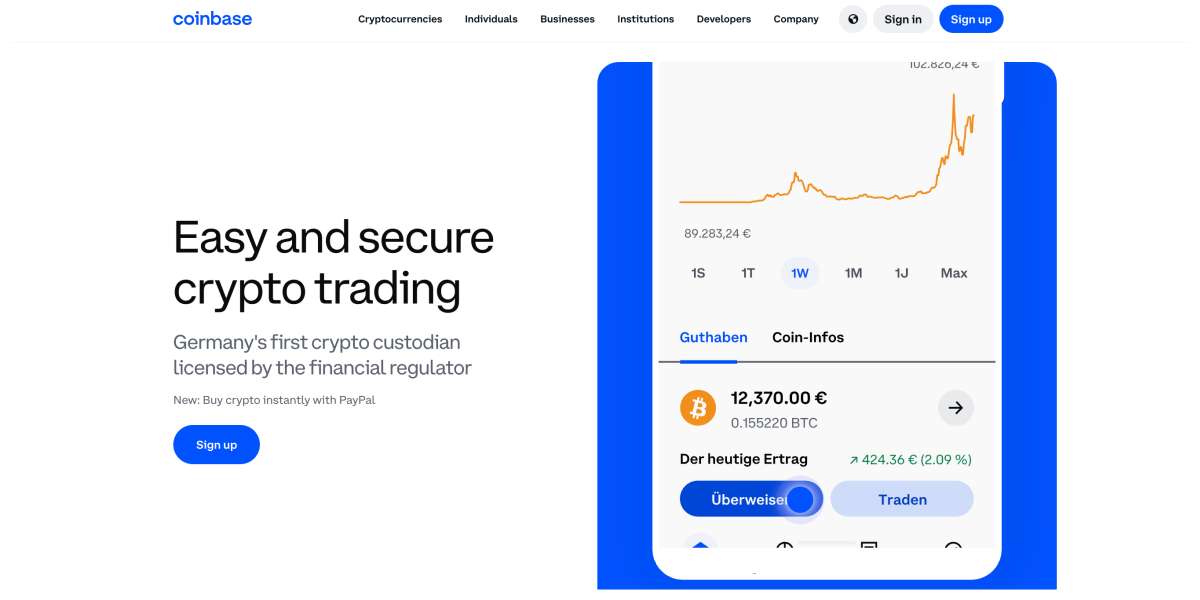
Coinbase functions as a regulated infrastructure provider for the digital economy. While historical market entrants often prioritized rapid expansion through offshore jurisdictions, Coinbase has adhered to a strategy centered on regulatory alignment.
This operational model has enabled Coinbase to secure a significant role among large financial market participants. The platform currently provides custodial services for approximately 80% of U.S. Spot Bitcoin and Ethereum ETFs, with total assets under custody exceeding $240 billion. For retail participants, the platform operates with the structural characteristics of a traditional brokerage.
Current Market Statistics (Q1 2026):
- User Base: 110+ million verified global accounts.
- Assets Under Custody: ~$245 billion.
- Legal Status: Publicly traded (COIN); registered as a Money Services Business (MSB) in the United States.
Key Features & Services
The Coinbase ecosystem has expanded from a basic transaction interface into a multifaceted financial infrastructure. The platform categorizes its services based on user requirements and technical expertise.
Standard Interface vs. Advanced Trade
The integration of professional-grade utilities into the primary Coinbase ecosystem was finalized following the retirement of the “Coinbase Pro” brand. These tools are now housed within the Advanced Trade module.
- Standard Interface: Utilizes a simplified UI designed for basic asset acquisition. This interface employs a specific fee structure and price spread.
- Advanced Trade: Provides real-time order books, technical analysis tools via TradingView integration, and multiple order types, including limit and stop-market orders. This interface is the primary tool for users seeking to reduce transaction costs.
Coinbase One Subscription
The service is designed for participants who engage frequently with the platform or require additional service features. Pricing currently ranges from $4.99/month for the Basic tier, $29.99/month for the Preferred tier, and $299.99/month for the Premium tier.
The service is designed for participants who trade frequently or want additional platform benefits. Depending on the tier, Coinbase One may include:
- Zero trading fees on simple buy and sell transactions, subject to monthly volume limits (a price spread still applies).
- Account protection coverage against verified unauthorized access incidents, ranging from $1,000 to $250,000, depending on the tier.
- Boosted staking rewards, with increases between 5% and 15% depending on the membership level.
- Priority support, including 24/7 support access and concierge support for Premium members.
- Additional perks, such as spot trading fee rebates on Advanced trades, free wire transfers on eligible tiers, and partner offers for on-chain services and tax tools.
Membership benefits and availability may vary by region.
Staking & Reward Programs
Coinbase provides staking services that allow participants to receive protocol-based rewards from Proof-of-Stake networks without running validator infrastructure themselves. Users can begin staking with relatively small balances, and rewards accrue automatically based on the protocol rate for each supported network.
As of early 2026, representative reward rates include:
- Ethereum (ETH): ~1.91% APY
- Cosmos (ATOM): ~14.22% APY
- Avalanche (AVAX): ~4.47% APY
Reward rates vary depending on network conditions and may change over time. Coinbase takes a commission on staking rewards, typically 35% of the rewards earned, though Coinbase One members may receive reduced commission rates depending on their subscription tier.
Participants can request to unstake assets at any time, though the time required to complete the process depends on each blockchain network’s rules. Coinbase also offers instant unstaking for a 1% fee where available.
Coinbase Wallet & Web3 Integration
While the primary Coinbase platform is a custodial service, the Coinbase Wallet is a distinct self-custody application. It provides a gateway to decentralized protocols:
- Decentralized Finance (DeFi): Direct interaction with protocols such as Uniswap.
- Base Layer-2: Transaction execution on the Coinbase-developed Ethereum scaling network.
- Digital Collectibles (NFTs): Management of assets across multiple blockchain networks.
User Interface Design
The Coinbase interface is structured for high accessibility and clarity. The design seeks to mitigate the visual density common in many global trading platforms.
- Identity Verification: The KYC (Know Your Customer) process is typically completed within a 10–15 minute window using standard government identification.
- Portfolio Management: The dashboard provides a summarized view of asset performance, market fluctuations, and customizable watchlists.
- Platform Accessibility: Both web and mobile versions include high-contrast viewing options and search-optimized navigation.
Fee Structure and Pricing Analysis
Coinbase employs a dual-tier fee model that varies by the user’s interface.
Simple Transaction Fees
Transactions executed through the standard Coinbase interface include two main cost components:
- Price Spread – Coinbase includes a spread in the quoted price of the asset when users buy, sell, or convert cryptocurrencies. This spread helps Coinbase temporarily lock in pricing while processing a transaction.
- Coinbase Transaction Fees – In addition to the spread, Coinbase charges a transaction fee that is calculated at the time an order is placed. The exact fee may depend on several factors, including the selected payment method, order size, asset type, market conditions, and jurisdiction.
Before confirming a trade, users can view the full breakdown of fees and spread in the order preview screen, where the total transaction cost is displayed.
Advanced Trade Fee Schedule
The Advanced Trade module utilizes a Maker-Taker model. These fees are determined by the user’s trailing 30-day trading volume.
| 30-Day Volume (USD) | Taker Fee | Maker Fee |
| $0 – $10,000 | 0.60% | 0.40% |
| $10,001 – $50,000 | 0.40% | 0.25% |
| $50,001 – $100,000 | 0.25% | 0.15% |
| $100,001 – $1,000,000 | 0.20% | 0.10% |
Payment Infrastructure and Fiat Connectivity
The platform provides several mechanisms for transferring traditional currency. The following table details availability for U.S. participants in 2026:
| Payment Method | Purchase | Liquidation | Deposit | Withdrawal | Processing Time |
| Bank Account (ACH) | ✔ | ✘ | ✔ | ✔ | 1-5 Business Days |
| Instant Bank Out | ✘ | ✘ | ✘ | ✔ | Immediate |
| Debit Card | ✔ | ✘ | ✔ | ✔ | Immediate |
| Wire Transfer | ✘ | ✘ | ✔ | ✔ | 1-3 Business Days |
| PayPal | ✔ | ✘ | ✔ | ✔ | Immediate |
| Apple / Google Pay | ✔ | ✘ | ✘ | ✘ | Immediate |
Security Framework and Compliance
Coinbase combines technical security infrastructure with regulatory oversight designed to help safeguard user assets. The majority of digital assets held by the platform are stored in offline cold storage environments, while a smaller portion remains online to facilitate daily liquidity.
The company is publicly traded on Nasdaq (COIN) and maintains registration as a Money Services Business (MSB) in the United States. It also holds Money Transmitter Licenses across multiple U.S. states and a New York Virtual Currency Business Activity License (BitLicense) issued by the New York State Department of Financial Services.
While digital assets held on the platform are not protected by FDIC or SIPC insurance, Coinbase maintains insurance policies designed to mitigate certain platform-level security risks.
Asset Availability and Regional Restrictions
The platform supports a catalog of over 200 digital assets for U.S. participants. However, local regulations cause variations in availability:
- State Regulations: Residents of New York and Hawaii are subject to a restricted asset list due to specific state licensing requirements.
- Staking Limitations: Specific jurisdictions (e.g., California) have imposed restrictions on staking new assets following 2023 and 2024 regulatory actions.
- International Operations: Coinbase has expanded its infrastructure in the European Union and Brazil, though operations in certain South American markets have temporarily paused.
Mobile Application Performance
The Coinbase mobile application (iOS and Android) mirrors the desktop environment. It includes the ability to switch between Simple and Advanced interfaces. Security features include biometric authentication and integrated 2FA prompts to ensure account integrity during mobile use.
Support Infrastructure and System Reliability
The support model has undergone several revisions to address historical user feedback regarding response times.
- Communication Channels: All users have access to Live Chat, which utilizes an initial AI-driven triage system.
- Premium Support: Direct telephonic support is reserved for Coinbase One subscribers.
- System Uptime: While the 2025 upgrades have increased platform stability, latency or delayed order processing still occur during periods of extreme market volatility.
Platform Comparison: Coinbase vs CEX.IO
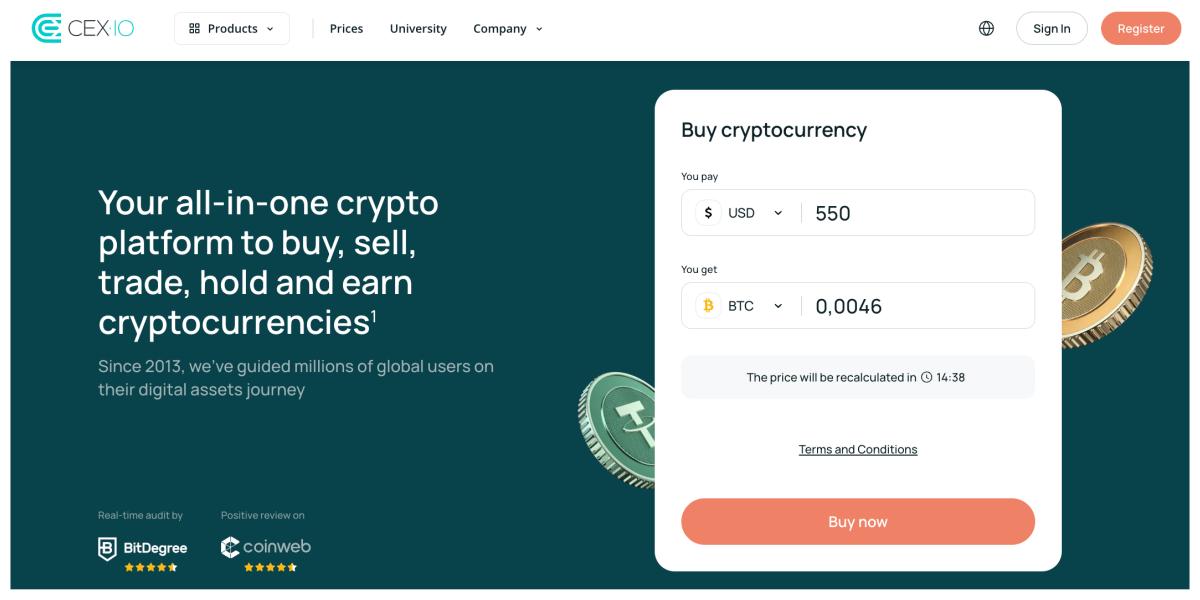
Coinbase operates primarily within a U.S.-centric brokerage model, while CEX.IO functions as a globally oriented exchange with broader payment connectivity. CEX.IO supports a larger set of fiat funding channels, including cards, ACH transfers, and PayPal (for U.S.-based users only), depending on region.
Trading costs can also start lower, with spot fees beginning at 0.25% based on 30-day volume tiers, compared with 0.60% taker fees at the entry level of Coinbase Advanced Trade. For participants who prioritize payment flexibility or lower initial trading fees, CEX.IO provides an alternative platform structure depending on jurisdiction.
Final Verdict
Coinbase remains one of the most established regulated digital asset platforms, particularly within the United States. Its public company status, institutional custody infrastructure, and integration with U.S. financial markets reinforce its role as a major gateway between traditional finance and blockchain networks.
At the same time, cost structure and payment availability differ across platforms. Entry-level trading fees on Coinbase Advanced Trade begin at 0.60%, and the number of supported fiat payment channels can be more limited in certain jurisdictions. Platforms such as CEX.IO operate under a comparable regulatory framework while providing additional funding methods and lower starting spot trading fees. As a result, platform selection often depends on whether a participant prioritizes institutional infrastructure, payment accessibility, or fee structure.
FAQ
How trustworthy is Coinbase?
The perceived trustworthiness of Coinbase is based on its operational history, its status as a Nasdaq-listed corporation, and its adherence to U.S. financial regulations. Unlike many unregulated offshore entities, Coinbase is subject to regular third-party audits and maintains transparent financial reporting. Furthermore, its role as a custodian for regulated financial products, such as Spot Bitcoin ETFs, indicates a high level of industry confidence. While all centralized platforms carry inherent counterparty risk, Coinbase’s commitment to 1:1 asset backing and legal transparency provides a measurable baseline for user trust.
Is Coinbase safe?
Coinbase utilizes a multi-layer technical security framework, including storing the majority of digital assets in offline cold storage and requiring multi-factor authentication. Most reported asset losses are attributable to user-level security issues, such as phishing or SIM swapping, rather than to system-wide vulnerabilities. Additional protective measures may include hardware security keys and address whitelisting. While a 2025 metadata incident occurred through a third-party vendor, the platform reported that no funds or private keys were compromised, highlighting the role of compartmentalized system architecture.
Is Coinbase free?
Account creation and the holding of digital assets on Coinbase do not incur fees. However, the platform generates revenue through transaction fees and price spreads. Transactions on the standard interface can incur total costs of 1.5% to 4.0%, depending on volume. Lower fee tiers are available through the Advanced Trade interface, where fees begin at 0.60%. The Coinbase One subscription ($29.99/month) removes transaction fees on simple trades up to $10,000 monthly, though the price spread remains part of the transaction cost.
Is Kraken better than Coinbase?
The comparison between Kraken and Coinbase depends on the user’s specific requirements. Kraken is often chosen by participants seeking lower initial fees and those who value the platform’s Proof of Reserves transparency model. Coinbase is commonly associated with a simplified user interface, integration with the U.S. banking system, and an ecosystem that includes Web3 and Layer-2 services. Both platforms operate within regulated environments and provide access to digital asset markets. The differences between them typically relate to interface design, fee structures, and product availability.
Is Coinbase legal in the US?
Yes, Coinbase is a legally operating and regulated entity within the United States. It maintains registration with FinCEN as a Money Services Business and holds Money Transmitter Licenses across various states. The resolution of historical regulatory inquiries in early 2025 has provided a clearer legal framework for its continued operations. It is important to note that, while the platform is legal, specific features—such as staking or access to certain assets—may vary by state due to local legislative environments in states like New York or California.
What is the difference between Coinbase and Coinbase Wallet?
The distinction lies in the custody of the digital assets. The primary Coinbase application is a custodial service, meaning the exchange manages the user’s private keys on their behalf. This offers convenience and account recovery options. The Coinbase Wallet is a self-custody application that allows users to maintain exclusive control over their private keys and recovery phrases. The Wallet allows for direct interaction with decentralized applications (dApps) and NFT marketplaces. However, in self-custody, if a user loses their recovery phrase, Coinbase has no technical means to restore access to the funds.
Disclaimer: For information purposes only. Not investment or financial advice. Seek professional advice. Digital assets involve risk. Do your own research.