
The cryptocurrency landscape in 2026 differs significantly from the market’s earlier periods of volatility. As broader market participation expands and decentralized finance (DeFi) ecosystems continue to develop, many market participants rely on precise, real-time data to monitor digital asset activity.
For many users, CoinMarketCap (CMC) serves as a widely used reference point for cryptocurrency market information. What began as a simple price-tracking website has gradually evolved into a broader ecosystem that combines market data monitoring with analytics, educational materials, and tools designed to help users navigate digital asset markets.
CoinMarketCap primarily operates as a non-custodial market data platform. Unlike a centralized exchange (CEX), it does not hold user funds or act as a direct counterparty to transactions. Instead, the platform compiles market data from hundreds of exchanges worldwide through API integrations and on-chain data sources, presenting pricing, liquidity, and trading metrics across a large number of digital assets tracked on the site.
Since its acquisition by Binance in 2020, the platform has occasionally faced public discussion regarding its independence. Nevertheless, as of 2026, CoinMarketCap continues to present itself as a neutral data provider, referencing transparent methodologies for price calculations, liquidity scoring, exchange rankings, and market-pair confidence indicators. Its core role is to translate complex market activity into standardized metrics that can help both retail users and professional analysts interpret cryptocurrency market conditions.
Core Features & Research Tools
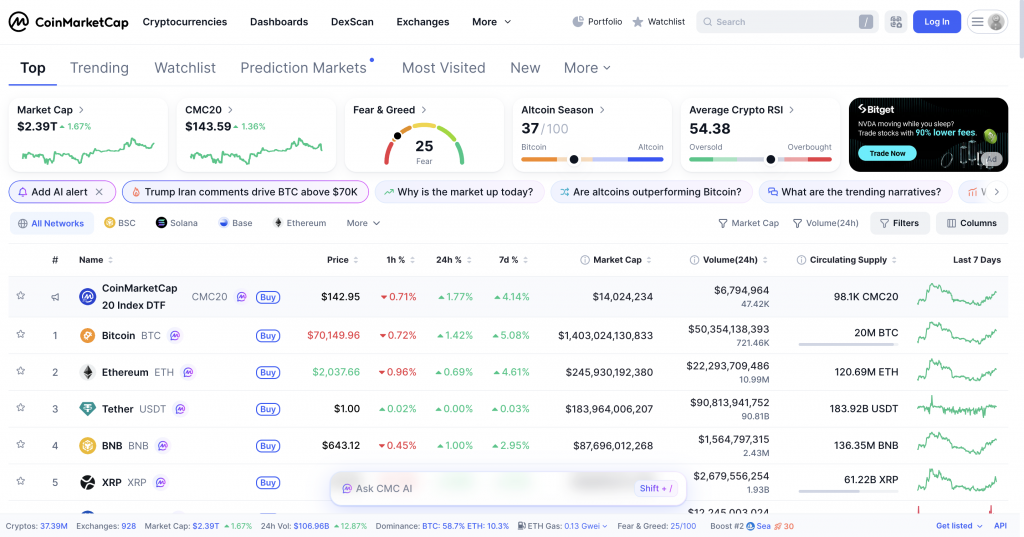
By 2026, CoinMarketCap expanded beyond static price charts, offering a range of interactive tools designed to help users interpret market data and monitor digital assets more efficiently.
CMC AI Insights
One of the newer additions to the platform is CMC AI, an integrated tool that summarizes market information and responds to user queries related to cryptocurrencies. Users can ask questions about specific assets, market activity, or ecosystem developments and receive AI-generated summaries based on publicly available data and CoinMarketCap content. The feature is intended to help users interpret market observations and navigate information across the platform.
CMC20 Index and Index Token
The CoinMarketCap 20 Index (CMC20) is a benchmark designed to track the performance of the 20 largest cryptocurrencies by market capitalization, excluding stablecoins, wrapped tokens, and certain assets with limited market accessibility. The index is market-cap-weighted and rebalanced monthly.
In addition to the benchmark itself, a CMC20 index-linked token is available on-chain via decentralized infrastructure. This structure allows market participants to reference the index’s performance through a single digital asset that reflects the weighted basket of underlying cryptocurrencies.
Portfolio Tracker & Watchlists
CoinMarketCap also provides a portfolio tracker that allows users to manually record transactions and monitor portfolio activity, including changes in valuation over time. The platform supports thousands of cryptocurrencies and displays real-time price updates sourced from exchanges.
Users can also create watchlists to follow selected assets more easily. These lists store preferences locally through cookies on the web platform, while the mobile application allows synchronization across devices through user accounts.
CMC Academy and Educational Content
CoinMarketCap Academy provides educational materials that explain cryptocurrency concepts, blockchain technology, and market developments. The section includes articles, research materials, and glossary entries designed to help users understand the digital asset ecosystem.
Data Methodology: How CMC Ranks the Market
Reliable data is an important component for any market data platform. CoinMarketCap uses a combination of quantitative metrics, algorithms, and review processes to evaluate market activity and reduce the potential influence of distorted trading data.
Exchange Score and Ranking Factors
CoinMarketCap ranks exchanges using a composite exchange score that incorporates indicators such as liquidity, reported trading volume, web traffic, and confidence indicators related to the reported volume. Additional elements such as exchange reputation, operational history, regulatory status, public audits, and user feedback may also be considered.
The final score ranges from 0 to 10, and exchanges are ranked accordingly. To preserve the structure of the ranking model, CoinMarketCap does not disclose the exact weighting applied to each factor.
Confidence Indicators and Market Pair Ranking
At the market level, CoinMarketCap evaluates trading pairs using multiple signals, including reported volume, liquidity score, and web traffic indicators. These inputs feed into a machine-learning model that ranks market pairs while indicating the platform’s confidence in the reliability of the reported trading activity.
This methodology is designed to reduce the influence of artificially inflated trading volumes, an issue that has occasionally been observed in parts of the cryptocurrency market.
Liquidity Score
Each market pair receives a Liquidity Score ranging from 0 to 1,000. This metric estimates how easily assets may be bought or sold without causing significant price movement. The score is calculated by simulating trades of different sizes against the order book and measuring the resulting price impact. Markets with deeper order books and lower price slippage generally receive higher scores.
Proof of Reserves Data
For some exchanges, CoinMarketCap also displays Proof of Reserves (PoR) information, which shows publicly verifiable wallet balances linked to exchanges. This data allows users to view certain on-chain assets associated with a platform. However, it should not be interpreted as a full audit of liabilities or as an overall assessment of solvency.
Listing Status Categories
CoinMarketCap categorizes cryptoasset pages based on verification level and available data. Listings may appear as unverified, preview (untracked), verified, or tracked, depending on factors such as exchange trading activity, data availability, and verification by the CoinMarketCap team.
Tracked listings generally include assets that trade on supported exchanges with sufficient liquidity and available market data. Verified listings indicate that project information has been reviewed and confirmed to originate from official project sources.
Transaction Facilitation: The CMC Swap & Third-Party Gateways
Although users cannot deposit funds into CoinMarketCap, the platform includes integrations that allow access to external services for token swaps or cryptocurrency purchases.
Token Swaps via External Protocols
CoinMarketCap provides access to token swap functionality through integrations with decentralized protocols. Users can connect a non-custodial Web3 wallet and initiate swaps through supported decentralized exchanges.
In these cases, CoinMarketCap functions primarily as an interface layer rather than a trading venue. Transactions are executed directly on-chain through the integrated protocol, and CoinMarketCap does not custody user funds or act as a counterparty to transactions.
Fiat-to-Crypto Gateways
CoinMarketCap also provides “Buy Crypto” links that connect users to third-party fiat-to-crypto providers. When users select a purchase pathway, they are redirected to an external payment partner that processes the transaction.
These providers determine the applicable fees, supported payment methods, and KYC requirements, while CoinMarketCap functions as a discovery interface linking users to these services.
User Interface and Accessibility
CoinMarketCap’s interface functions primarily as a centralized market data dashboard. The desktop version focuses on detailed analytics and allows filtering by metrics such as market capitalization, sector, network, and trading volume.
The platform also provides a mobile application that allows users to track prices, manage watchlists, and monitor portfolio activity. Features such as watchlists and portfolio tracking help users organize the assets they want to follow, although the platform itself does not execute trades.
Security, Privacy, and Regulatory Status
Because CoinMarketCap does not hold user assets, it has an operational profile different from that of custodial exchanges. Users do not deposit funds or provide private keys directly to the platform.
Instead, CoinMarketCap primarily functions as a market data platform, compiling information from exchange APIs and on-chain sources to display pricing, liquidity, and trading metrics across the cryptocurrency ecosystem.
CoinMarketCap Pros & Cons
| Pros | Cons |
| Comprehensive Database: Access to an extensive list of tokens and exchanges. | Non-Direct Trading: Users cannot store digital assets on the platform, as it functions primarily as a research and data tool. |
| Intuitive Tools: Features such as the AI Co-Pilot and Portfolio Tracker are available without additional cost. | Third-Party Reliance: Accessing swap or purchase services through partners may involve fee structures that differ from centralized exchanges. |
| Industry Transparency: Proof-of-Reserves dashboards and confidence indicators enable users to review exchange-related data. | Data Density: The amount of information displayed may feel complex for users who are new to cryptocurrency markets. |
Research vs. Execution: CEX.IO as a CoinMarketCap Alternative
CoinMarketCap primarily functions as a market data and analytics platform. It compiles price, trading volume, and market capitalization data from multiple exchanges, allowing users to observe market activity and compare digital assets across the broader cryptocurrency ecosystem.
However, CoinMarketCap does not provide transactional services or custodial functionality. Users cannot buy, sell, or store cryptocurrency directly on the platform.
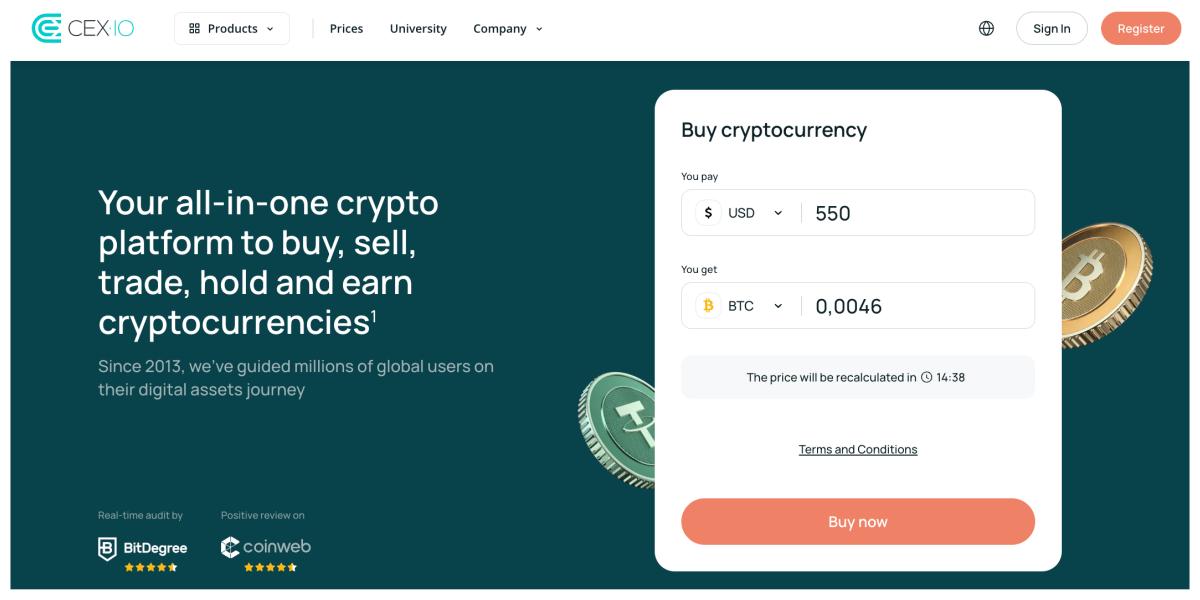
This is where exchanges like CEX.IO play a different role within the digital asset ecosystem. CEX.IO offers services that allow users to acquire digital assets, convert between cryptocurrencies, and manage holdings within a regulated exchange framework. The platform also supports several fiat payment pathways, including bank transfers and card payments.
As a result, the two platforms address different stages of the digital asset workflow. CoinMarketCap focuses on information and analytics, while exchanges such as CEX.IO provide services related to transactions, account management, and asset custody.
Final Verdict
CoinMarketCap remains one of the most widely referenced cryptocurrency data platforms. It compiles market information from numerous exchanges and provides tools for tracking prices, monitoring portfolio activity, and observing broader market trends. For many users, it serves as a common reference point for cryptocurrency research.
However, because CoinMarketCap functions as a data platform rather than an exchange, it does not support direct transactions or asset custody. Users who wish to acquire or manage digital assets typically rely on a separate exchange or wallet service.
In practice, this can involve combining research tools with an exchange environment. Platforms such as CEX.IO provide services related to acquiring digital assets, converting between cryptocurrencies, and managing holdings within a regulated framework. As a result, some users may use CoinMarketCap for market observations while relying on exchanges to access transactional services and account management tools.
FAQ
What is CoinMarketCap?
CoinMarketCap (CMC) is a cryptocurrency market data platform that tracks prices, trading volumes, and market capitalization for digital assets. It functions as a data aggregator, compiling information from multiple exchanges through APIs and on-chain data sources to display market metrics. CoinMarketCap does not sell cryptocurrencies directly or hold user funds in custody.
What is the CoinMarketCap app?
The CoinMarketCap app is the mobile version of the platform, allowing users to track cryptocurrency prices, monitor watchlists, and review portfolio activity from a smartphone. The app also includes features such as price alerts, portfolio tracking, and mobile-friendly market analytics tools.
How do I transfer Bitcoin from CoinMarketCap?
Bitcoin cannot be transferred from CoinMarketCap because the platform does not function as a wallet or exchange. It does not store cryptocurrencies. Digital assets are typically transferred from the exchange or wallet where they are held.
Does CoinMarketCap offer Learn & Earn programs?
CoinMarketCap periodically runs Learn & Earn campaigns where users watch educational content about blockchain projects and complete quizzes. Eligible participants may receive small promotional token distributions related to those projects, depending on campaign availability and program terms.
How do I list a new coin on CMC?
Projects can submit a listing request through CoinMarketCap’s official request form. The evaluation process considers factors such as trading activity, liquidity across supported exchanges, project development, and community engagement. Listings are reviewed individually, and approval timelines may vary.
How do I withdraw from CoinMarketCap?
CoinMarketCap does not provide custody or withdrawal services. Because the platform does not hold digital assets, withdrawals cannot be performed directly from it. Converting cryptocurrency to fiat currency generally requires using a cryptocurrency exchange or another service that supports withdrawals.
Disclaimer: For information purposes only. Not investment or financial advice. Seek professional advice. Digital assets involve risk. Do your own research.