
Navigating the cryptocurrency landscape in 2026 requires more than a passing awareness of market trends; it also requires careful attention to the platforms used to access digital assets. Among established exchanges, Gemini remains a visible market participant, particularly for users who prioritize regulatory compliance and account protections.
Founded by Cameron and Tyler Winklevoss in 2014, Gemini has spent over a decade building a reputation as a trust-focused exchange. However, in an era where lower-cost competitors like Kraken and feature-rich platforms like Coinbase continue to expand, Gemini’s premium-fee structure raises practical questions about overall value. This Gemini review provides an objective, data-driven analysis of its features, security architecture, and cost structure to help readers understand how the platform fits within the 2026 market landscape.
What Is Gemini Crypto Exchange?
Gemini is a New York-based digital asset exchange and custodian that operates as a limited-purpose trust company. Unlike many of its competitors that operate under standard Money Transmitter Licenses (MTLs), Gemini is regulated by the New York State Department of Financial Services (NYDFS). This distinction is critical: as a fiduciary, Gemini is legally required to put its clients’ interests first and maintain high capital reserves.
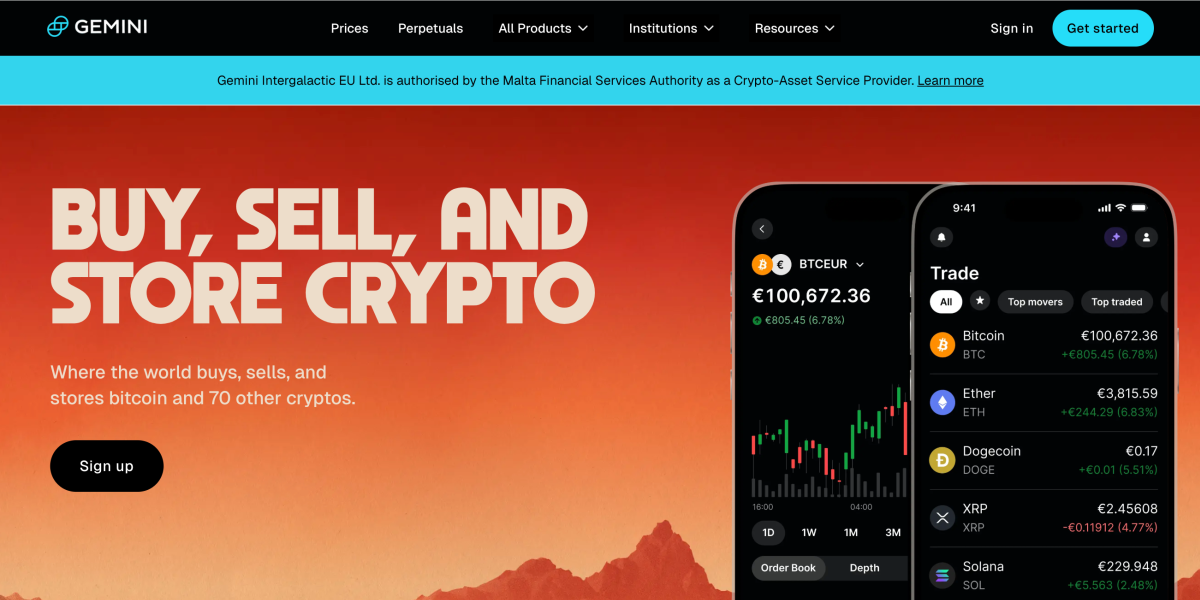
In 2026, the platform continues to cater to two primary audiences:
- Retail Users: Those looking for a simple, highly secure “on-ramp” to buy major assets like Bitcoin and Ethereum.
- Institutional Clients: Asset managers and corporations that require SOC-certified custody and deep liquidity through the eOTC desk.
While it does not list as many assets as Binance, Gemini applies a narrower listing approach focused on internal compliance and review standards.
Platform Positioning in 2026
The current market environment has seen a significant shift toward platforms with established compliance structures. Following the regulatory changes of the mid-2020s, Gemini has used its operating record to position itself as a link between traditional finance (TradFi) and decentralized finance (DeFi).
Its positioning is distinct: it does not aim to be the lowest-cost exchange or the broadest marketplace for token access. Instead, it presents a more selective platform model centered on transparency, oversight, and custody controls. This focus on accountability remains a defining part of its market identity in 2026.
Key Features & Services
Gemini has significantly expanded its ecosystem, moving beyond a simple buy/sell interface to a broader set of digital asset services.
Standard Interface vs. ActiveTrader
For most beginners, the default Gemini dashboard is the point of entry. It is intentionally minimalist, featuring “one-click” buying and selling. However, the convenience comes at a price. Standard orders are subject to a dual-fee structure that includes a transaction fee and a convenience fee (spread).
For those who want to minimize costs, Gemini ActiveTrader provides a more advanced interface. Integrated directly into the main platform, ActiveTrader provides:
- Advanced Charting: Full TradingView integration with depth charts and order books.
- Multiple Order Types: Includes limit, stop-limit, Fill-or-Kill (FOK), and Maker-or-Cancel (MOC).
- Lower Fees: Trading on ActiveTrader follows a maker-taker model, which may result in lower transaction costs (up to 80%) than the standard interface.
Gemini Credit Card
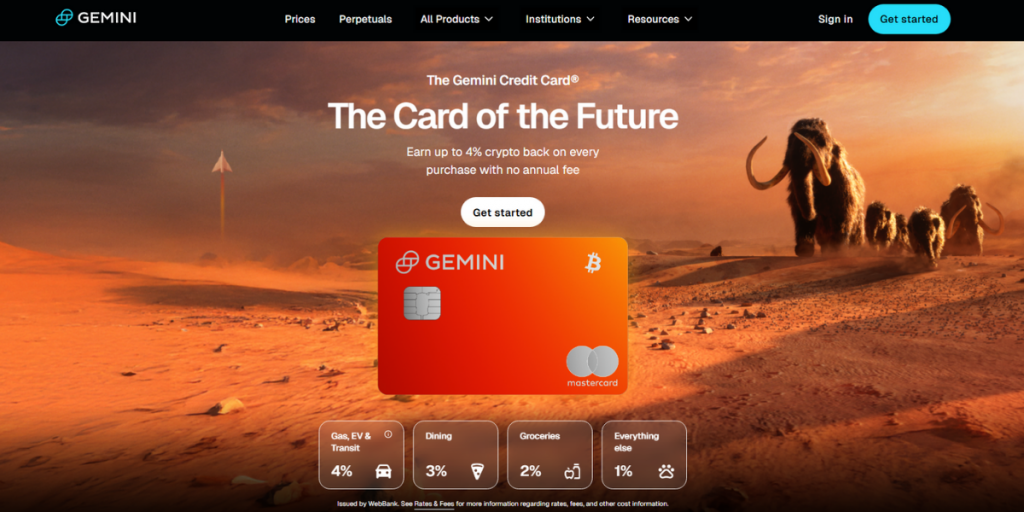
The Gemini Credit Card, issued by WebBank, remains part of the platform’s consumer product lineup. In 2026, the reward structure is aligned with everyday spending categories:
- 4% back on Gas, EV charging, and Transit on up to $300 in monthly spend, after which rewards drop to 1% for the remainder of the month.
- 3% back on Dining.
- 2% back on Groceries.
- 1% back on all other purchases.
Rewards are deposited instantly into a Gemini account in the selected cryptocurrency, such as BTC, ETH, or GUSD. This model connects routine card spending with crypto-denominated rewards, without requiring a separate purchase flow inside the platform.
Staking and Earning
Gemini handles the technical aspects of staking operations and distributes rewards directly to user accounts. The platform deducts a service fee from staking rewards, though the exact amount may vary by asset and network conditions.
As of early 2026, staking is available for several Proof-of-Stake assets, including:
- Ethereum (ETH): ~3.00% APY
- Solana (SOL): ~6.00% APY
- Monad (MON): ~12.00% APY
Reward rates may fluctuate based on network conditions.
Gemini Custody & Institutional Solutions
One of Gemini’s more established business segments is its institutional division. In 2025 and 2026, Gemini served as custodian for several notable financial products, including the VanEck Solana ETF. The custody platform is SOC 1 Type 2 and SOC 2 Type 2 certified, reflecting audited controls related to financial reporting and data security.
User Interface & Experience
The user experience (UX) on Gemini is designed to be approachable. The web interface uses white space effectively, avoiding the cluttered layout often associated with some larger exchanges. Navigation is straightforward: the Portfolio tab provides a breakdown of holdings, while Discovery allows users to track market activity.
The transition between the standard interface and ActiveTrader occurs in the settings menu. This structure allows users to move between simplified and advanced tools within the same ecosystem. For beginners, the simplified layout may reduce the sense of complexity often associated with more feature-dense exchanges.
Gemini Fees and Pricing
Understanding the Gemini fee structure involves distinguishing between the two primary interfaces, each designed for a different transaction volume and user experience. The platform uses a tiered pricing model that correlates with the level of execution control and 30-day trading volume.
Standard Interface Fees
For orders exceeding $200, the transaction fee is set at 1.49%. In addition to this fee, a convenience fee, or spread, typically around 0.50% to 1.00%, is factored into the quoted price. This spread is part of the quoted execution price during the Instant Buy process and may vary based on market conditions.
For orders up to $200, Gemini applies a flat transaction fee based on the order size:
| Order Amount | Transaction Fee |
| $\leq$ $10.00 | $0.99 |
| $10.01 – $25.00 | $1.49 |
| $25.01 – $50.00 | $1.99 |
| $50.01 – $200.00 | $2.99 |
For orders exceeding $200, the transaction fee is set at 1.49%. In addition to this fee, a convenience fee (spread)—typically around 0.50% to 1.00%—is factored into the quoted price. This spread helps secure the user’s price during the “Instant Buy” process, regardless of immediate market fluctuations.
ActiveTrader Fee Schedule
The Gemini ActiveTrader platform utilizes a standard maker-taker model, which is common across advanced trading interfaces. This interface is designed for users who require deeper access to the order book and lower per-trade costs.
For accounts with minimal trading volume, fees begin at:
- Maker fee: 0.60%
- Taker fee: 1.20%
As trading volume increases, fees decrease across multiple tiers. For example, users with at least $75,000 in trading volume may see fees reduced to approximately:
- Maker fee: 0.125%
- Taker fee: 0.25%
High-volume tiers can significantly further reduce taker fees.
Stablecoin pairs may have reduced or zero fees depending on the pair. Certain pairs, such as RLUSD/USD, USDC/GUSD, and GUSD/USD, have zero maker and taker fees.
Ancillary Costs: Deposits and Staking
While ACH and Wire transfers are processed without a Gemini-side fee, users utilizing Debit Cards or Digital Wallets (Apple/Google Pay) should account for a 3.49% to 3.99% processing fee. For those utilizing Gemini Staking, the platform retains a service fee of 15% to 25% of earned protocol rewards to cover operational costs for validator maintenance and security.
Payment Methods and Fiat Access
Gemini offers several ways to fund an account, each with different speed and cost implications.
Payment Methods for U.S. Customers (2026)
| Method | Buy | Sell | Add Cash | Cash Out | Speed | Fee |
| Bank Account (ACH) | ✔ | ✔ | ✔ | ✔ | 1-5 Days | Free |
| Instant Cashout | ✘ | ✘ | ✘ | ✔ | Instant | 1.75% |
| Debit Card | ✔ | ✘ | ✘ | ✘ | Instant | 3.49% |
| Wire Transfer | ✔ | ✔ | ✔ | ✔ | 1-3 Days | Free (Bank may charge) |
| PayPal/Apple/Google Pay | ✔ | ✘ | ✘ | ✘ | Instant | 3.49% |
Note: While ACH deposits are available for immediate trading, they usually require a 4-5 day “settlement period” before the purchased crypto can be withdrawn to an external wallet.
Security and Compliance
Security is a central part of Gemini’s platform positioning. In a market where exchange breaches remain a recurring risk, Gemini describes its model as relying on multiple layers of technical and operational controls.
- Cold Storage: The vast majority of user assets are held in geographically distributed, air-gapped cold storage. These facilities utilize Hardware Security Modules (HSMs) that have achieved the highest U.S. government security ratings.
- Insurance: Gemini maintains $125 million in insurance coverage for its hot wallet. This protects against exchange-level breaches, but it does not cover individual account hacks caused by poor user password hygiene.
- Regulatory Status: As a New York Trust Company, Gemini is subject to regular audits and must meet strict capital reserve requirements. It publishes periodic Proof of Reserves (PoR) to demonstrate that all customer funds are held 1:1.
- SOC Certifications: It was the first exchange to complete SOC 1 Type 2 and SOC 2 Type 2 examinations. These audits verify that Gemini’s internal controls over financial reporting and data security are functioning correctly over a sustained period.
Users seeking additional account protections may consider hardware-based authentication tools, such as a YubiKey. More information is available on Gemini’s official security support resources.
Asset Availability and Regional Differences
Gemini supports approximately 70-80 cryptocurrencies. While this includes much of the market capitalization represented by BTC, ETH, SOL, XRP, and several stablecoins, it remains below the asset counts offered by Kraken or Binance.
This narrower selection appears to reflect Gemini’s listing approach. The platform states that assets are added following legal and technical review. For some users, this may simplify asset selection, while others seeking broader access to altcoins may find the platform more restrictive.
Regional Availability: Gemini is available in all 50 U.S. states and over 60 countries. However, due to differing local regulations, features like derivatives trading are only available in specific jurisdictions outside the U.S. (e.g., under its Maltese MiFID II license).
Mobile App Review
The Gemini mobile app has received strong ratings on the App Store and Google Play. In 2026, the app serves as a close mobile extension of the web experience.
- Usability: The interface is clean and responsive. Placing an “Instant Buy” takes fewer than three taps.
- Price Alerts: Users can set custom alerts for price movements or percentage changes, which are delivered via push notifications.
- Security on Mobile: The app supports biometric authentication (Face ID/Touch ID) and requires 2FA for all withdrawals.
The main drawback of the app is that it defaults to the high-fee standard interface. To use ActiveTrader on mobile, users typically need to use a mobile browser, as the dedicated ActiveTrader features are not yet fully natively integrated into the standard retail app experience.
Customer Support and Reliability
If Gemini has a “heel,” it is customer support. While the platform provides an extensive help center (Gemini Cryptopedia), reaching a human remains a challenge for many.
- Support Channels: Primarily email and ticket-based. There is no 24/7 live phone support for retail users in 2026.
- Response Times: During periods of high market volatility, users often report delays in response times, with account verification or withdrawal holds, sometimes taking several days to resolve
- Trustpilot Sentiment: User reviews are often polarized. Positive reviews praise the security and ease of use, while negative reviews often cite frustration with the automated support system.
Gemini Alternatives: How CEX.IO Compares
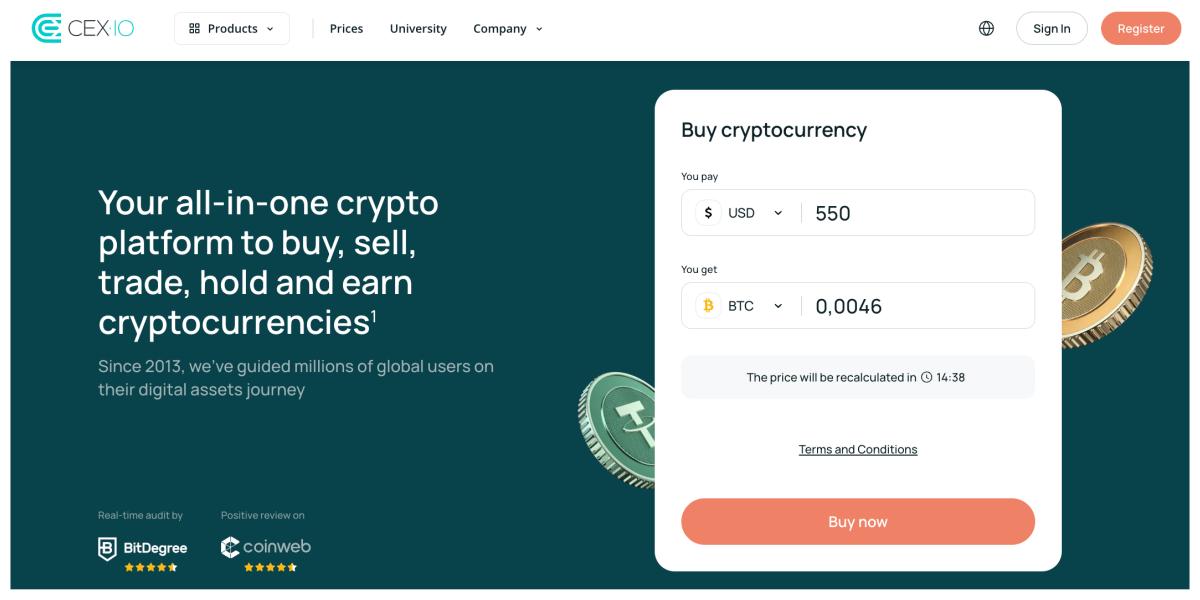
Gemini emphasizes regulatory oversight and a tightly controlled asset listing process, while other exchanges place greater emphasis on payment flexibility and fiat access. CEX.IO is one such platform. For U.S. users, it supports several funding methods, including ACH transfers, debit and credit cards, PayPal for eligible U.S.-based users, Google Pay, and Apple Pay, depending on availability and jurisdiction.
Trading costs can also begin lower, with spot trading fees starting at 0.25%, compared with 0.60% maker and 1.20% taker fees at the entry tier of Gemini ActiveTrader. This creates a different cost and payment profile for users, allowing comparison of access methods and fee structures across exchanges.
Final Verdict: Is Gemini Right for You?
Gemini remains one of the more compliance-focused exchanges in the industry, supported by New York Trust regulation and audited custody infrastructure. For users who prioritize regulatory oversight and audited storage controls, the platform continues to occupy a distinct position in the digital asset market.
However, higher entry trading fees and fewer fiat payment channels may not suit every user. Platforms such as CEX.IO offer a different combination of funding methods and lower starting spot trading fees for eligible U.S. participants, while operating within a regulated framework.
FAQ
How trustworthy is Gemini?
Gemini is often viewed as one of the more established exchanges in the global market. It operates as a New York Limited Purpose Trust Company and is a fiduciary under New York Banking Law. This requires it to maintain capital standards, internal audits, and consumer protection measures under its regulatory framework. Furthermore, its SOC 1 and SOC 2 certifications indicate that its security and financial processes are audited by independent third parties. While no platform is risk-free, Gemini’s emphasis on regulatory compliance and its operating record contribute to its reputation in the market.
Is Gemini safe?
Gemini describes its platform as using multiple security controls. The majority of customer funds are stored in offline cold wallets, distributed geographically and protected by hardware security modules (HSMs). For funds kept online in hot wallets, Gemini maintains a $125 million insurance policy for certain exchange-level incidents. It also requires two-factor authentication (2FA) for accounts and offers Address Allowlisting, which can help reduce the risk of transfers to unapproved destinations. These measures form part of the platform’s broader security architecture, although no exchange is free from risk.
Is Gemini free?
Gemini is not a free platform, as it generates revenue through trading fees and spreads. There is no fee to create an account or maintain a balance, but buying, selling, or converting crypto usually involves transaction costs. Standard orders carry a flat fee for smaller amounts and a percentage fee, typically 1.49%, plus a spread for larger orders. The ActiveTrader interface has a different maker-taker fee structure, with lower fees at some volume tiers. ACH and wire deposits are generally free, while debit card purchases carry a 3.49% convenience fee.
Is Kraken better than Gemini?
The answer depends on the features being compared. Kraken is often associated with lower trading costs on certain services and broader asset availability. Gemini is often associated with New York Trust regulation and a narrower asset listing framework. Both platforms operate within regulated environments and offer different combinations of fees, product availability, and support channels. The distinction between them usually comes down to cost structure, asset access, and platform design.
Is Gemini legal in the US?
Yes, Gemini operates legally in the United States. It is available in all 50 states, including New York, where crypto regulations are among the strictest in the country. Gemini follows Anti-Money Laundering (AML) and Know Your Customer (KYC) requirements, so users are typically required to provide government-issued identification during sign-up. Feature availability may vary by jurisdiction and product type.
What is the difference between Gemini and Gemini Wallet?
Gemini is the centralized exchange where users buy and sell assets, while Gemini Wallet refers to the custodial storage environment used for assets held on the platform after purchase. When funds remain on Gemini, they are held in a custodial wallet, meaning Gemini manages the private keys on the user’s behalf. This structure supports functions such as instant trading and account recovery processes. Users who prefer direct control over their assets can also withdraw funds to self-custody hardware or software wallets, where they control their own private keys.
Disclaimer: For information purposes only. Not investment or financial advice. Seek professional advice. Digital assets involve risk. Do your own research.