Most regulated cryptocurrency exchanges require users to be at least 18 years old. A few regions set the limit higher — South Korea uses 19 for crypto trading, and some financial services start at 21. The rule comes from two places: contract law, which generally prevents a minor from entering a binding contract, and Know Your Customer rules, which require exchanges to verify every user’s identity, including age.
This guide explains the reasons behind the age requirement, covers the rules in major regions, walks through what teens and parents can actually do before 18, and outlines a clean starting point once the birthday arrives.
Why 18 is the standard
Two legal concepts set the age limit. The first is contract law. In most countries, a person under the age of majority cannot enter a legally binding contract. Signing up for a crypto exchange is a contract. The exchange’s terms of service bind the user to rules about fees, dispute resolution, and trading conduct. If those terms cannot be enforced against a minor, the exchange has no legal protection.
The second is Know Your Customer (KYC) and Anti-Money Laundering (AML) regulation. Regulated crypto exchanges are required to verify the identity of every user before allowing deposits or trades. That verification includes confirming age. An exchange that knowingly serves a minor can face regulatory penalties and lose its operating license.
A third, less legal reason is consumer protection. Regulators view minors as a vulnerable group and limit their access to volatile financial products. This is the same reason most jurisdictions prevent minors from trading stocks or opening standard brokerage accounts.
Age limits by region
Specific limits vary. Rules change — check the platform’s current terms before signing up.
- United States: 18+ is the standard. Some states set specific rules for different financial products.
- European Union and EEA: 18+ in most countries. A few EEA countries set the age of majority at 19 (a small number of regions) or 21 (Liechtenstein and a few others).
- United Kingdom: 18+.
- South Korea: 19+ for crypto trading, enforced through strict KYC and banking link requirements.
- Japan: 18+. Japan lowered the general age of adulthood from 20 to 18 in 2022.
- Australia: 18+.
- Canada: 18 or 19 depending on the province. Alberta, Manitoba, Ontario, Prince Edward Island, Quebec, and Saskatchewan use 18. The rest use 19.
- Singapore: 18+.
- India: 18+ where exchanges operate, with strict PAN card and bank verification requirements.
Decentralized exchanges have no built-in age check. Smart contracts respond to any wallet. That does not make underage use legal in every jurisdiction — regulators argue that securities and financial services rules still apply regardless of whether a human gatekeeper is in the loop.
Teens and crypto — what is actually possible before 18
The 18 rule applies to opening an account in your own name on a regulated exchange. Several legitimate paths still let younger people engage with crypto:
Receiving crypto as a gift
A parent, relative, or family friend can send crypto to a wallet the teen controls. The sender handles any gift tax reporting obligations above annual exclusion limits. The teen can hold the coins and learn how self-custody works. A hardware wallet or a reputable non-custodial wallet makes this practical and safe when set up correctly.
Custodial investing accounts opened by a parent
In the US, parents can open UGMA (Uniform Gifts to Minors Act) or UTMA (Uniform Transfers to Minors Act) custodial investment accounts for a minor. Some brokerages now support spot Bitcoin and Ethereum ETFs inside UTMA accounts. The parent manages the account until the child reaches the age of majority, at which point ownership transfers.
Dedicated teen-focused investing apps like Greenlight and UNest let parents and minors learn together under parental oversight. Coverage of crypto-specific products varies.
Mining and earning
Mining crypto or receiving it as payment for digital work does not usually require KYC. A minor who earns crypto through a paid project can hold it in a self-custody wallet. Tax reporting obligations apply based on local rules.
Paper trading and simulators
TradingView, Investopedia Simulator, and several free apps let users paper-trade crypto with simulated money. Tracking simulated performance over weeks and months teaches discipline without risking real capital.
The Consequences of Lying About Your Age
Attempting to bypass age restrictions by entering a false birth date to open an exchange account is a risky move that usually ends in one of three ways. First, you might face an immediate rejection at verification. An exchange’s KYC (Know Your Customer) process is designed to catch these discrepancies, and it will simply close the account before any trading even happens. Second, you could experience a later freeze. Sometimes, the exchange catches the issue during a subsequent identity audit. When this happens, your funds get stuck until you can definitively prove your identity and age—or worse, you could lose access permanently. Finally, repeated violations can result in a compliance ban. This is a permanent ban that often gets shared across compliance networks utilized by multiple exchanges.
Additionally, using a parent’s account without their explicit knowledge is a direct violation of any platform’s terms of service. If detected, the account will likely be frozen. Practically speaking, if your parents find out first, that family conversation tends to be far worse than a simple account rejection.
Productive Paths for Teen Crypto Learning
If you are a teen who wants to understand the cryptocurrency space before turning 18, there are several highly productive, risk-free paths you can take. First, you need to focus on building knowledge and practical skills rather than risking real capital.
- Paper Trading: Platforms like TradingView offer simulators where you can place trades with virtual money. Tracking your simulated performance over several months is an excellent way to reveal whether your trading strategies actually work in practice.
- Education: Take advantage of free educational resources. Platforms like CEX.IO University, Binance Academy, 99Bitcoins, and various free MOOC courses cover blockchain technology and the markets in depth, completely at no cost.
- Open-Source Contributions: If you have an interest in coding, GitHub projects welcome contributors of any age. Building something technical provides a much deeper understanding of the industry than simply watching token prices fluctuate.
- Hackathons: Many blockchain hackathons actively accept student teams. Winning a prize or successfully deploying a project on a testnet creates real, impressive portfolio material for your future.
Alongside these activities, make it a habit to have open conversations with your parents about financial risk, market volatility, and the eventual tax implications of investing.
Making a Clean Start When You Turn 18
On your 18th birthday (or whenever you reach the local age of majority), you can finally enter the market legally. To ensure a safe and proper start, first, you need to pick a regulated platform that boasts a strong compliance history and public proof-of-reserves disclosures. Once you have chosen your exchange, follow these steps to get set up properly:
- Step 1: Sign up using an email address that you personally control, and secure your new account with a strong, unique password managed through a dedicated password manager.
- Step 2: Complete the KYC verification using your own government-issued ID. Do not try to take any shortcuts here.
- Step 3: Immediately enable two-factor authentication (2FA). As always, rely on an authenticator app rather than standard SMS verification.
- Step 4: When you are ready to fund your account, start with a small amount that easily fits your budget for potential loss. A few hundred dollars is more than enough to help you learn the mechanics of the market.
Before placing your very first trade, take the time to read the platform’s education section and at least one beginner guide. Moving forward, make sure to keep meticulous records of every purchase you make—including the date, amount, cost basis, and any fees. Tax authorities will expect this exact data from you when you eventually decide to sell your assets.
About CEX.IO
CEX.IO launched in 2013 with a mission to support global financial inclusion through the adoption of cryptocurrency and blockchain technology. As one of the most tenured market participants, CEX.IO runs an intuitive ecosystem of solutions built with user safety at the core. Customers can trade, store, transfer, and earn digital assets on the platform. More than 15 million registered users globally use CEX.IO every day across retail, enterprise, and institutional needs.
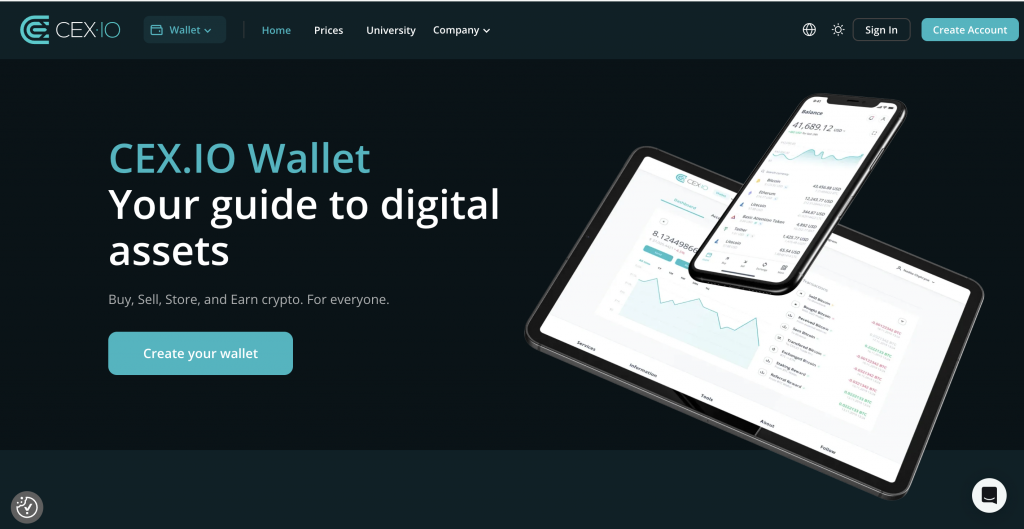
CEX.IO is registered with FinCEN in jurisdictions where it holds a license to operate as a Money Service Business. The company follows local regulations in the U.S., Europe, and other countries where it operates.
CEX.IO age requirements and account verification
CEX.IO requires every user to be at least 18 years old, or the local age of majority if that age is higher. Identity verification is part of every sign-up. Verification unlocks full access to the CEX.IO wallet, Instant Buy, Spot Trading, Convert, and fiat deposits and withdrawals.
The verification flow:
- Submit a government-issued ID — passport, driver’s license, or national ID card.
- Complete a selfie or short video check that confirms you match the ID.
- Provide basic personal details — full legal name, date of birth, address.
- Wait for the automated check. Most verifications complete within minutes; complex cases can take a few hours.
CEX.IO verification levels unlock progressively higher limits. Additional documents (proof of address, source of funds) may be required for larger volumes. For teens and parents who want to learn before turning 18, CEX.IO University covers wallets, transfers, trading basics, and risk topics at no cost.
The availability of the product, feature, or asset on the CEX.IO platform is subject to jurisdictional limitations.
FAQ
What is the minimum age to buy Bitcoin?
Most regulated centralized exchanges require users to be at least 18. South Korea uses 19 for crypto trading. A few services in specific regions set the limit at 21. Decentralized exchanges have no built-in age check, but underage use may still break financial services rules in the user’s country.
Can minors trade crypto?
Not through regulated centralized exchanges in most countries. Minors can receive crypto as a gift, earn it through mining or paid digital work, and use parent-managed custodial investment accounts that hold spot Bitcoin ETFs in the US.
Why do crypto exchanges require users to be 18?
Contract law in most countries holds that a minor cannot enter a legally binding contract. KYC and AML rules also require exchanges to verify every user’s identity, including age. Regulators view minors as a vulnerable group and limit their access to volatile financial products.
Can I use my parent’s account to trade crypto?
Doing so violates the platform’s terms. Exchanges can detect the violation through identity audits and freeze or close the account. Funds can become stuck until the identity mismatch is resolved.
How can teens get crypto legally?
Accept crypto as a gift into a self-custody wallet. Earn crypto through mining or paid digital work. Use a parent-managed custodial investment account that holds spot Bitcoin ETFs. Learn through paper trading and free courses.
Does the age limit depend on the country?
Yes. 18 is the standard in most Western countries. South Korea uses 19 for crypto. A few regions use 21 for specific financial products. Canada’s age of majority varies by province. Always check the platform’s terms and the local rules.
Risk disclaimer
The value of digital and virtual currencies is derived from supply and demand in the global marketplace, which can rise or fall independently of any fiat or government currency. Holding digital and virtual currencies carries exchange rate and other types of risk. Transactions in virtual currency are irrevocable, and losses from fraudulent or accidental transactions may result in the loss of your money with no recourse. Please refer to the Terms of Use for more details.