
Tangem Wallet takes a different route from typical hardware wallets. Instead of USB devices or seed phrases, it uses NFC-enabled cards that store private keys inside a secure chip. Setup takes a few minutes, and transactions require a simple tap against a smartphone.
The wallet supports over 16,000 assets across more than 80 blockchains, while keeping keys offline at all times. Backup relies on additional cards rather than written phrases.
In this review, we break down how Tangem works, its fees, security design, and where it fits compared to other wallets.
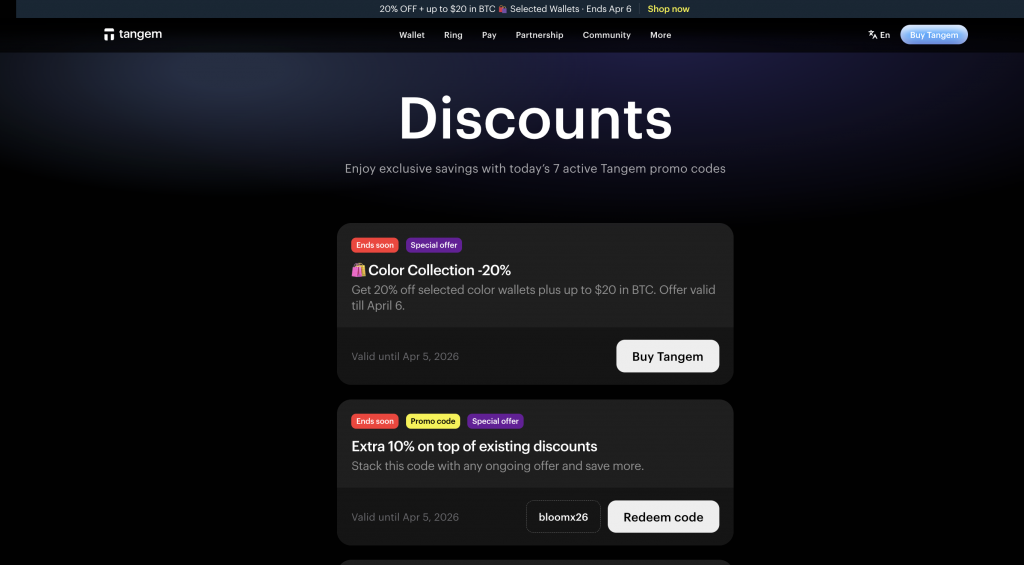
Tangem Wallet at a Glance
Tangem Wallet focuses on physical key storage through NFC cards, removing cables, batteries, and traditional recovery phrases. The table below highlights the core details.
| Feature | Details |
| Wallet Type | Hardware wallet (card-based, NFC) |
| Custody | Self-custody, keys stored in a secure chip |
| Supported Assets | 16,000+ tokens |
| Supported Networks | 80+ blockchains |
| Backup Method | 2–3 physical backup cards (no seed phrase required) |
| Setup Time | ~2 minutes via mobile app |
What Is Tangem Wallet?
Tangem Wallet is a self-custody hardware wallet that stores private keys inside a secure microchip embedded in a physical card. The device connects to a mobile app through NFC, so users approve transactions by tapping the card against their phone.
Unlike traditional hardware wallets, Tangem does not require cables, batteries, or a written recovery phrase by default. It supports more than 16,000 assets across 80+ blockchain networks, allowing users to manage a wide range of tokens in one place. The wallet operates entirely offline when signing transactions, keeping private keys isolated from internet exposure.
How Tangem Wallet Works
Tangem generates a private key inside the card’s secure element during activation, using a hardware random number generator. The key never leaves the chip. To send funds, users initiate a transaction in the app, then tap the card to sign it via NFC.
Backup works differently from standard wallets. Instead of a seed phrase, users link two or three cards that store identical keys. The cards exchange encrypted data during setup, so the key does not appear in readable form at any stage. If one card is lost, another restores access.

Key Features of Tangem Wallet
Tangem introduces a card-based approach to self-custody, with features designed around physical security and mobile access.
Card-based hardware design
Tangem replaces traditional hardware devices with NFC cards that contain a secure chip. The card has no battery, no ports, and no firmware updates required through external connections, which potentially reduces physical attack surfaces.
Seedless backup system
Users can create backups by linking multiple cards. Each card stores the same private key, removing the need to write down and store a recovery phrase. A seed phrase remains available as an optional feature.
Broad asset and network support
The wallet supports over 16,000 cryptocurrencies across more than 80 blockchains. This includes major networks like Bitcoin, Ethereum, and Solana, along with token standards such as ERC-20, BEP-20, and SPL.
Tangem Wallet Fees Explained
Tangem Wallet does not add its own commission when sending crypto. Users pay only the blockchain network fee, which goes to validators or miners. The exact cost depends on the network; for example, Ethereum fees differ from Bitcoin or Polygon, and fluctuate based on demand.
The app displays the fee before confirmation and allows three preset levels, Slow, Market, and Fast, or manual adjustment. Higher fees increase transaction priority.
Tangem also supports paying fees in USDT or USDC on selected networks. The app converts the required amount at a 1:1 rate with no markup, deducting the equivalent value automatically.
Security and Safety
Tangem Wallet stores private keys inside a certified EAL6+ secure element, designed to resist both physical tampering and software attacks. The key generates on the card during activation and never leaves the chip.
Backup uses multiple cards instead of exposing a recovery phrase. Each card receives the key through encrypted communication, so no readable copy appears during transfer.
The device has no battery, Bluetooth, or USB interface. Transactions require physical card access and NFC confirmation, which reduces remote attack vectors and keeps signing isolated from internet-connected environments.
How to Use Tangem Wallet
Tangem Wallet works through a mobile app and an NFC card, ring, or mobile wallet. Setup is quick, but the wallet still follows a true self-custody model, so access, backups, and transaction approvals remain tied to the device you control. The steps below show how to start using it.
1. Install the Tangem app
Download the Tangem app on an NFC-enabled smartphone. Tangem also offers a mobile wallet mode inside the app for users who want to start without a card right away.
2. Create or import a wallet
Open the app and choose whether to create a new wallet or import an existing one. If you use Tangem hardware, scan the card to begin activation. If you use the mobile wallet, the app creates the wallet directly on your phone.
3. Set up backup access
For the hardware wallet, link two or three Tangem cards, or a ring and cards, during setup. Each backup device stores the same private key through encrypted transfer. For the mobile wallet, complete the recovery phrase backup before storing funds.
4. Add crypto to the wallet
Select an asset, open the receive screen, and copy the wallet address or scan the QR code. Tangem supports more than 16,000 assets across 87+ networks, so the correct network matters when receiving funds.
5. Send crypto
Open the asset you want to send, enter the destination address and amount, review the network fee, then tap your Tangem card or ring to sign the transaction. Tangem does not add its own sending commission, so the fee shown is the blockchain fee.
6. Choose the network fee
Before confirming, review the fee settings. Tangem provides Slow, Market, and Fast presets, as well as manual adjustment in some cases. On supported networks, you may also pay the fee with USDT or USDC instead of the native coin.
7. Use built-in app services
Inside the app, users can buy, swap, stake, and manage supported assets through integrated providers. Tangem also includes Tangem Pay in selected regions, which issues a virtual Visa card after identity verification through external partners.
8. Restore access if needed
If one card is lost, another linked card or ring can still access the wallet. Mobile wallet users restore access with their recovery phrase. Tangem hardware users do not need a seed phrase unless they choose to generate one manually.
Supported Cryptocurrencies and Networks
Tangem Wallet supports a broad range of digital assets, with over 16,000 tokens available across more than 87 blockchain networks. This includes major networks such as Bitcoin, Ethereum, Solana, XRP Ledger, and Polygon, alongside a wide selection of emerging chains.
The wallet also supports common token standards such as ERC-20, BEP-20, SPL, and TRC-20, allowing users to manage multiple asset types in a single interface.
Network compatibility plays a key role. Each asset must match its correct blockchain when sending or receiving, since transactions execute directly on-chain rather than within a platform environment.
Pros and Cons of Tangem Wallet
Tangem Wallet introduces a different approach to self-custody through card-based hardware and mobile interaction. The points below highlight where it performs well and where limitations appear.
Pros
- Private keys stored in an EAL6+ secure chip
- No seed phrase required, backup via multiple cards
- No cables, batteries, or USB connections needed
- Supports 16,000+ assets across 80+ networks
- No additional fees for sending crypto, only network costs
Cons
- Requires a physical card for every transaction
- Limited direct fiat withdrawal functionality
- Some features depend on third-party providers
Tangem Wallet vs Other Wallets
Tangem, CEX.IO, and Atomic Wallet approach crypto management from different angles. One relies on physical hardware, another integrates regulated services with fiat access, while the third delivers software-based self-custody. Comparing them highlights where each setup fits specific use cases.
Tangem Wallet vs CEX.IO
Tangem Wallet stores private keys on a physical card with an EAL6+ secure chip. Transactions require tapping the card via NFC, which means access always depends on having the hardware nearby. It supports over 16,000 assets across 80+ networks, but buying, swapping, or selling often runs through third-party providers, where fees and rates vary.
CEX.IO uses a custodial model with account-based access. Identity verification unlocks fiat rails, including ACH deposits ($20 minimum, $5 fee) and card payments (0.49%–4.99% plus service charge). Spot trading fees start at 0.25% and drop to 0.10% based on 30-day volume. Transactions show a final price before confirmation, which removes rate uncertainty.
Tangem suits users who want offline key storage and direct asset control. CEX.IO requires identity verification, which enables ACH deposits, card payments, and bank withdrawals, features not available natively in Tangem.
Tangem Wallet vs Atomic Wallet
Tangem relies on hardware cards and NFC interaction, while Atomic Wallet runs as a software application with a locally stored encrypted wallet. Tangem removes seed phrases by using backup cards, while Atomic uses a 12-word recovery phrase.
Atomic Wallet includes built-in swaps and staking, though rates come from integrated partners and vary by transaction. Tangem connects to external providers for similar services. Tangem supports more networks, while Atomic works across major blockchains and tokens.
Tangem requires physical access for every action. Atomic allows immediate access through the app, which may suit users who prefer software-only interaction.
Wallet Comparison Overview
The table below outlines how these wallets differ across core functionality.
| Feature | Tangem Wallet | CEX.IO Wallet | Atomic Wallet |
| Wallet Type | Hardware, card-based | Custodial | Software, non-custodial |
| Key Control | Stored on a secure chip | Platform manages access | User-controlled (encrypted locally) |
| Ease of Use | Tap-to-sign via NFC card | High, guided flows and clear prompts | App-based, requires seed phrase management |
| Transaction Flow | Card + mobile confirmation | Platform-based execution | On-chain, manual confirmations |
| Fee Visibility | Depends on the provider | Final price shown upfront | Depends on partner services |
| Recovery Access | Backup cards | Account recovery via verification | Seed phrase required |
| Fiat Access | Limited, via partners | Built-in buy, sell, and withdrawal | Requires external service |
Which Wallet Is Better for Beginners?
CEX.IO provides a more structured starting point. New users complete verification, fund their accounts via bank transfers or cards, and review final transaction amounts before confirming. Fees follow a defined structure, for example, 0.25% spot trading at lower volumes, with clear deposit costs.
Tangem removes seed phrases, but requires understanding hardware handling and third-party services for transactions. Atomic Wallet introduces seed phrase responsibility and manual network selection.
For beginners who want direct fiat access, clear pricing, and account recovery through verification, CEX.IO presents a more straightforward path.
FAQs
Can I put XRP on Tangem Wallet?
Tangem Wallet supports XRP through the XRP Ledger, alongside thousands of other assets. You can store, send, and receive XRP by pairing your Tangem card with the mobile app. Transactions require tapping the card via NFC, which signs the transfer using the secure chip embedded in the card.
Is Tangem a safe wallet?
Tangem stores private keys inside a certified EAL6+ secure element chip, similar to those used in banking cards. The key never leaves the card, and transactions require physical confirmation. There is no seed phrase exposure. Security depends on keeping backup cards safe and preventing unauthorized physical access.
Is Tangem a Russian company?
Tangem AG operates from Zug, Switzerland. The company develops hardware wallets and related software for managing digital assets. It does not operate as a cryptocurrency exchange or financial institution and does not hold or control user funds, as all assets remain under user-managed private keys.
Does Tangem have a monthly fee?
Tangem Wallet does not charge subscription or monthly fees. You pay once for the hardware cards. Sending crypto only requires covering blockchain network fees. If you use integrated third-party services for swaps or purchases, those providers apply their own rates and charges.
Can I lose my crypto on Tangem Wallet?
Loss of access can occur if all backup cards are lost or damaged, since recovery depends on those cards. Tangem does not store keys or provide account recovery, as regulated exchanges such as CEX.IO do. Anyone with access to your card can approve transactions, so physical security remains critical to protecting your funds.
What are the disadvantages of Tangem?
Tangem requires a physical card for every transaction, which limits remote access. Fiat withdrawals and purchases are handled by third-party providers. There is no account-based recovery process. Some advanced features, such as staking or swaps, rely on external integrations with variable fees and availability.
Can you cash out on Tangem Wallet?
Tangem does not provide direct bank withdrawals. To convert crypto to fiat, you can use third-party services integrated into the app or transfer funds to a platform that supports withdrawals. The final rate and fees depend on the selected provider and transaction method.
How long will a Tangem wallet last?
Tangem cards do not contain batteries or moving parts, which reduces wear over time. The manufacturer estimates a lifespan of up to 25 years under normal conditions. Durability depends on physical handling, as damage to the card or chip can prevent access to stored private keys.