
Banks accept fiat currency — dollars, euros, pounds — not cryptocurrency. Moving crypto into a bank account requires converting it to fiat on a platform that supports both sides and then withdrawing. Three clean steps: deposit crypto to a platform, sell for fiat, withdraw to the bank.
This guide walks through the full process, covers the main withdrawal rails available in each major region, explains the name-matching rules that trip up first-time users, and lists the common problems and their fixes. The active work takes about 30 minutes. Bank settlement adds anywhere from minutes to five business days depending on the method.
Why crypto cannot go directly to a bank account
A bank account operates on the traditional banking rails — SWIFT for international wires, SEPA for euro transfers in Europe, ACH for US domestic transfers, Faster Payments for GBP in the UK. These rails move fiat currency between bank accounts. They do not understand or accept cryptocurrency.
Converting crypto to fiat requires a platform that bridges both worlds. The platform accepts a crypto deposit from a blockchain, holds a fiat balance, and can push that fiat out through the traditional rails. Regulated centralized exchanges are the most common bridge. Peer-to-peer marketplaces work too, with more payment methods but more counterparty risk.
How to transfer crypto to a bank account
Step 1 — Prepare your exchange account
- Pick a regulated exchange that supports your country and offers fiat withdrawals in a currency your bank holds.
- Create the account. Use a strong, unique password managed through a password manager.
- Turn on two-factor authentication with an authenticator app like Google Authenticator or Authy (stronger than SMS).
- Complete identity verification. Most platforms require an ID document, a selfie, and basic personal details. Higher withdrawal limits often require proof of address or source of funds.
- Link your bank account or payment method in the withdrawal settings.
The name on the bank account must match the name on the exchange account. Platforms reject third-party transfers and may return funds with a fee deducted. Verification can take minutes for a basic check or up to a few days for higher tiers.
Step 2 — Deposit crypto to the exchange
- In the exchange wallet, pick the coin you plan to deposit.
- Click Deposit. Select the correct network for multi-chain assets — USDT exists on Ethereum, Tron, Solana, and other chains; USDC has similar multi-chain support.
- Copy the deposit address. Some coins (XRP, XLM, EOS) also need a memo — copy that too.
- Send a small test transfer first — $5 to $20 depending on the coin. Wait for the test to credit. The test confirms the network, address, and memo are all correct.
- Send the full amount. Wait for the required number of confirmations. Bitcoin needs 3 confirmations on most platforms, Ethereum 12 to 35, Solana 32.
Step 3 — Sell crypto for fiat
Three paths cover almost every sale:
- Instant Sell — one-click conversion at the current market rate. Simplest option for users who just want to move to fiat.
- Convert — swaps one asset for another (crypto to fiat or crypto to crypto) in a single step.
- Spot Trading — full order book view. Market orders fill at the current best price. Limit orders wait for your target price. Stop-loss orders protect against downside moves.
Pick a fiat currency your bank supports. USD bank account → sell for USD. EUR bank account → sell for EUR. Converting to a currency your bank does not hold forces a second conversion at the bank, usually at a poor rate.
Step 4 — Withdraw fiat to your bank
Withdrawal method depends on country and currency:
SEPA
Euro transfers inside the Single Euro Payments Area — 36+ countries. Standard SEPA: 1 business day. SEPA Instant: seconds on banks that support it. Typical fee: free or a small flat fee (€0.50–€5). Requires an IBAN.
SWIFT
International wires through the SWIFT network. Two to five business days. Higher fees — $15 to $40 plus intermediary bank charges that the receiving bank may deduct. Used when SEPA is not available (non-SEPA countries, non-EUR currencies).
ACH
USD transfers inside the US. One to three business days. Often free or low-cost at the exchange. Uses routing and account numbers.
Domestic Wire
USD inside the US, same-day for business-hour transfers. Typical fee: $15 to $30 at the exchange. Used for larger amounts where speed is critical. Requires ABA routing number.
Faster Payments
GBP inside the UK. Seconds to minutes. Usually free. Requires UK sort code and account number.
Card withdrawal
Pushes fiat directly to a Visa or Mastercard. Minutes where supported. Fee is typically 1% to 3% of the amount. Useful for users without fast bank rails but comes with the highest cost.
Fees and processing times at a glance
- SEPA: often free or low, 1 business day (seconds on SEPA Instant).
- SWIFT: $15–$40 plus intermediary fees, 2–5 business days.
- ACH: often free or low, 1–3 business days.
- Domestic Wire: $15–$30, same day.
- Faster Payments: often free, minutes.
- Card withdrawal: 1–3% of amount, minutes.
Banks often charge a separate processing fee on top of the exchange fee. Weekends and public holidays delay most rails except SEPA Instant and Faster Payments.
Name matching and compliance
Exchanges apply strict name-matching rules on fiat withdrawals to satisfy anti-money-laundering obligations:
- The bank account holder must match the exchange account holder.
- Joint bank accounts may be rejected if only one name matches.
- Third-party transfers (payment processors, friends’ accounts, parent’s accounts) are rejected.
- Business accounts require business-verified exchange accounts with additional documentation.
If a withdrawal fails for name mismatch, the exchange usually returns the funds after a fee and a verification delay. The returned amount is smaller than the original, and the delay can run days to weeks.
Alternatives to a direct bank withdrawal
- Crypto debit or prepaid card — loads fiat onto a Visa or Mastercard you can spend anywhere the card is accepted. No bank transfer needed. CEX.IO Card is one example.
- PayPal — eligible US users can withdraw USD directly into a PayPal balance on some exchanges, including CEX.IO.
- Bitcoin ATM — convert and collect cash in person. Higher fees (8%–15%) but useful when bank access is limited.
- Peer-to-peer marketplace — match with a buyer, pick a payment method (bank transfer, mobile payment, cash), and settle directly. Platform holds crypto in escrow until both sides confirm.
- Stablecoin off-ramp — send USDT or USDC to a service that converts and pays out to your bank. Useful for users whose exchange does not serve their country.
Common problems and fixes
- Withdrawal “under review” — the exchange needs extra proof of source of funds. Submit the requested documents to release the transfer. First-time large withdrawals often trigger this.
- Bank returns the SEPA transfer — usually a name mismatch. Contact support with confirmation of account details. Expect a fee deduction on the returned amount.
- Missing reference number — always include the reference the exchange shows on screen. Without it, matching on the exchange side can fail and funds get stuck in a clearing pool.
- Currency mismatch — a USD wire to a EUR account triggers a bank-side conversion at a typically poor rate. Pick the currency the bank holds.
- Daily limit reached — most exchanges cap daily and monthly fiat withdrawals. Higher verification tiers lift the caps.
About CEX.IO
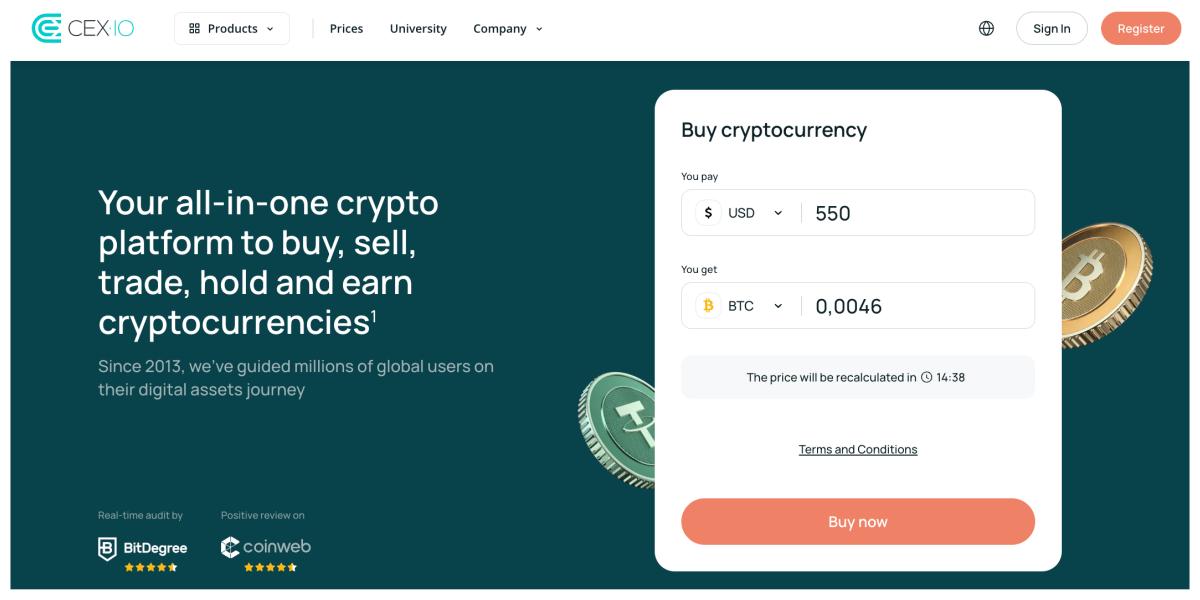
CEX.IO launched in 2013 with a mission to support global financial inclusion through the adoption of cryptocurrency and blockchain technology. As one of the most tenured market participants, CEX.IO runs an intuitive ecosystem of solutions built with user safety at the core. Customers can trade, store, transfer, and earn digital assets on the platform. More than 15 million registered users globally use CEX.IO every day across retail, enterprise, and institutional needs.
CEX.IO is registered with FinCEN in jurisdictions where it holds a license to operate as a Money Service Business. The company follows local regulations in the U.S., Europe, and other countries where it operates.
How to withdraw to your bank account with CEX.IO
The CEX.IO withdrawal flow:
- Sign in to CEX.IO and open the Wallet.
- Click Withdraw on the fiat balance (EUR, USD, or GBP depending on country).
- Pick the method — SEPA (EEA), Faster Payments or Online Banking (UK), Domestic Wire (US), card withdrawal where supported, or PayPal for eligible US users.
- Enter the amount. Review the fee.
- Confirm with two-factor authentication.
Available methods by country:
- EEA users: SEPA for euro transfers.
- UK users: Faster Payments and Online Banking for pound transfers.
- US users: Domestic Wire for USD, and PayPal for USD (eligible users only).
- Card withdrawals: available in most countries where CEX.IO operates. Check the restricted countries list at cex.io/limits-commissions.
SWIFT availability varies by country. Check the live list on the fees page before relying on it.
The availability of the product, feature, or asset on the CEX.IO platform is subject to jurisdictional limitations.

FAQ
How do I cash out crypto to my bank account?
Deposit crypto to a regulated exchange, sell it for the fiat currency your bank holds, then withdraw the fiat through SEPA, SWIFT, ACH, a domestic wire, Faster Payments, or a card withdrawal. The full process typically takes minutes of active work plus a settlement window of minutes to five business days.
How long does a crypto to bank transfer take?
The crypto deposit and sale take minutes. The bank transfer takes minutes (Faster Payments, Domestic Wire) to five business days (SWIFT) depending on the method and country.
What are the fees for withdrawing crypto to a bank?
Exchange fees range from zero (SEPA, ACH on many platforms) to 1–3% for card withdrawals. Banks may charge separately. SWIFT carries the highest total cost. Always check the platform’s fees page for current numbers.
Can I transfer Bitcoin directly to my bank?
No. Banks do not accept Bitcoin. You must convert to fiat on an exchange first, then withdraw the fiat through a standard banking rail.
Which exchanges let me withdraw to a bank account?
Major regulated exchanges support bank withdrawals for verified users. Methods depend on country — SEPA in the EEA, ACH and Domestic Wire in the US, Faster Payments in the UK.
Do I pay tax when I transfer crypto to a bank?
The bank transfer itself is not taxable. The sale that converted crypto to fiat is taxable in most countries. Keep records of the sale price, cost basis, and fees. A local tax professional can confirm the rules for your jurisdiction.
Risk disclaimer
The value of digital and virtual currencies is derived from supply and demand in the global marketplace, which can rise or fall independently of any fiat or government currency. Holding digital and virtual currencies carries exchange rate and other types of risk. Transactions in virtual currency are irrevocable, and losses from fraudulent or accidental transactions may result in the loss of your money with no recourse. Please refer to the Terms of Use for more details.