
The difference between a crypto wallet and an exchange comes down to one job each. A crypto exchange is a marketplace where you buy, sell and trade crypto. A crypto wallet is a tool that stores the keys to your coins and lets you send and receive them.
Most people meet both on the same day. You sign up on an exchange, buy your first bitcoin, and the exchange shows the coins in a wallet inside your account. That wallet runs on the exchange’s system, so the exchange holds the keys.
The short answer: use an exchange to turn dollars into crypto and back, and use a wallet to hold crypto and move it where you want. The sections below explain how each one works, compare them side by side and show how to move coins between them.
What is a crypto exchange?
A crypto exchange is a platform where people buy, sell and trade cryptocurrencies. It matches buyers with sellers and sets a market price for each coin. Most exchanges also accept dollars, euros or other fiat money, so they work as the entry point into crypto.
To use a typical exchange, you open an account, verify your identity and add money with a card or bank transfer. You then buy coins at the current price or place an order at the price you choose. When you sell, the exchange credits fiat to your account, and you withdraw it to your bank.
Centralized vs decentralized exchanges
A centralized exchange is a company that runs the trading platform and holds customer funds. It checks your identity, keeps your coins in its own wallets and sends withdrawals when you request them. CEX.IO, Coinbase and Kraken are centralized exchanges.
A decentralized exchange, often called a DEX, is a set of smart contracts on a blockchain. You connect your own wallet, swap tokens straight from it and keep the keys the whole time. Most decentralized exchanges do not ask for identity checks. They also have no fiat deposits and no support team to contact.

What is a crypto wallet?
A crypto wallet is software or a device that stores the private keys for your crypto. The coins themselves live on the blockchain. The wallet holds the keys that prove you own them and signs every transaction you send.
Each wallet also gives you public addresses. You share an address when someone needs to send you crypto, the same way you share a bank account number. The private key stays secret, because anyone who has it can move the coins.
Custodial vs non-custodial wallets
A custodial wallet is a wallet where a provider holds the private keys for you. You log in with an email, a password and two-factor authentication. If you forget the password, the provider restores access after it checks your identity.
A non-custodial wallet is a wallet where only you hold the keys. The app shows you a recovery phrase of 12 or 24 words when you create the wallet. That phrase is the only way back in, so a lost phrase means lost coins.
Hot wallets vs cold wallets
A hot wallet is a wallet that stays online: a phone app, a browser extension or a desktop program. Hot wallets let you send and receive coins in seconds. Their constant connection also exposes them to malware and phishing.
A cold wallet keeps the keys offline, usually on a hardware device such as Ledger or Trezor. The device signs transactions inside itself, so the keys never reach your computer. Cold wallets suit long-term savings that you move rarely.
How is a cryptocurrency exchange different from a cryptocurrency wallet?
A cryptocurrency exchange trades coins, and a cryptocurrency wallet holds the keys to them. The table compares a centralized exchange with a non-custodial wallet, the two ends of the scale.
| Factor | Crypto exchange (centralized) | Crypto wallet (non-custodial) |
|---|---|---|
| Main job | Buy, sell and trade crypto | Store keys, send and receive crypto |
| Private keys | The exchange holds them | You hold them |
| Fiat money | Deposits and withdrawals in USD, EUR and more | None in most wallets |
| Identity check | Required | Not required |
| Main fees | Trading fees, spreads, withdrawal fees | Network fees on each transfer |
| Lost access | Support restores the account | Only the recovery phrase restores it |
| Main risk | Hacks, frozen withdrawals, company failure | Lost phrase, phishing, user mistakes |
| Best for | Buying with fiat, trading, selling | Long-term holding, Web3 apps |
Who controls the private keys
Key control is the core difference. On an exchange, the company signs every withdrawal, so your access depends on its rules and its solvency. In a non-custodial wallet, you sign every transaction, so nobody can freeze or move the coins without your key.
What you can do with each
An exchange connects crypto to the banking system. You turn dollars into bitcoin, swap one coin for another and cash out to your bank. A non-custodial wallet connects you to blockchains: you receive coins from anyone, send them anywhere and use decentralized apps.
Fees
Exchanges earn money on trades. They charge a trading fee or a spread on each purchase and a fixed fee on many withdrawals. A non-custodial wallet charges nothing for holding coins. You pay the blockchain’s network fee each time you send, and some wallets add a fee on built-in swaps.
Security and recovery
An exchange protects accounts with passwords, two-factor authentication and cold storage for most customer funds. If you lose your password, support verifies your identity and restores access. A non-custodial wallet puts all of this on you. A stolen phrase gives the thief your coins, and a lost phrase locks you out for good.
What is an exchange wallet?
An exchange wallet is a custodial wallet that an exchange opens for each customer inside the account. It blurs the line between the two products. You buy, store, send and receive crypto in one place, and the exchange holds the keys.
Several exchange companies now run a second, self-custody wallet next to the exchange. So a question like “is Coinbase an exchange or a wallet” has more than one answer. The examples below show three common setups.
CEX.IO Wallet
CEX.IO Wallet is the wallet inside every CEX.IO account. It works on the web and in the CEX.IO App for iOS and Android. You buy crypto with a card or bank transfer, convert one coin to another, sell for fiat and send coins to any external address. CEX.IO stores 98% of digital funds in offline cold wallets and confirms logins and transfers with two-factor authentication and email.
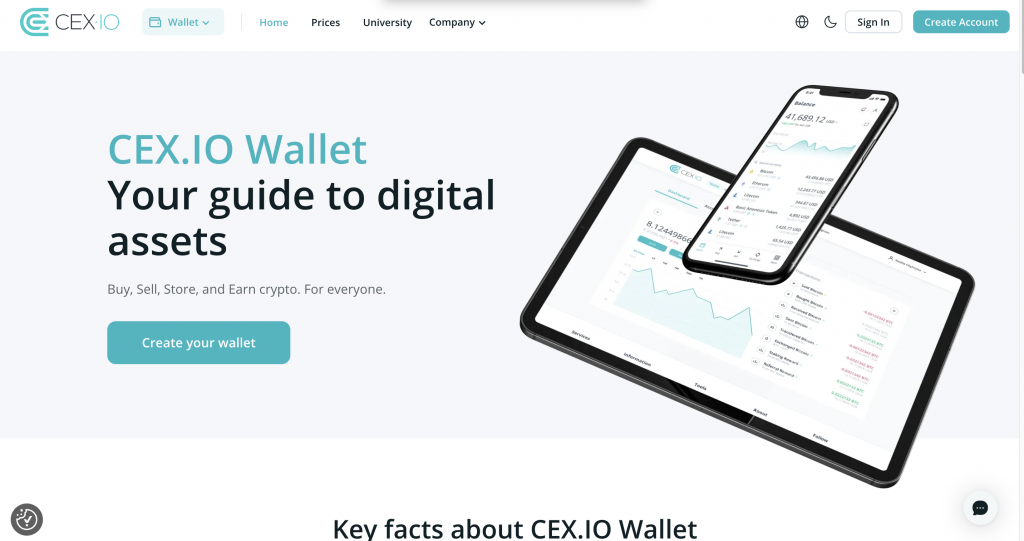
CEX.IO users can also pay each other through CEX.IO Pay. Transfers between CEX.IO accounts arrive instantly, and CEX.IO charges no commission on them. CEX.IO holds the keys, so the wallet follows the custodial model from the table above. The availability of CEX.IO products and assets is subject to jurisdictional limitations.
Kraken: exchange and Kraken Wallet
Kraken runs two separate products. The Kraken exchange keeps client funds in its corporate wallets while users trade or stake. Kraken Wallet is a self-custody app where the user manages the keys and connects to decentralized apps, as Kraken’s help center explains. So yes, Kraken has a wallet, and it works apart from the exchange account.
Coinbase: exchange and Coinbase Wallet
Coinbase follows the same pattern. The Coinbase app is an exchange that holds customer funds. Coinbase Wallet is a separate self-custody app, which Coinbase ran under the Base App name for about a year before it brought back the Coinbase Wallet name in September 2026. Coinbase is both an exchange and a wallet provider, and each app follows its own custody model.
Is it better to keep crypto in a wallet or on an exchange?
The better place to keep crypto depends on how often you use it. Coins you trade or plan to sell soon belong where you can trade them. Coins you plan to hold for years belong where only you control the keys.
An exchange wallet suits active buyers and sellers. You avoid network fees on every round trip, you see live prices and you can cash out in a few taps. The cost is trust: your access depends on the exchange staying secure and solvent.
A hardware wallet suits long-term holders. The keys stay offline, and no company can freeze the coins. The cost is responsibility: you guard the recovery phrase and pay a network fee each time you move coins.
A self-custody app suits people who use Web3. Decentralized exchanges, NFT markets and lending apps connect to your own wallet, and an exchange account cannot sign those transactions.
Many users keep both. They keep a small amount for trading on an exchange and move savings to a hardware wallet once the sum grows.
How to transfer crypto from an exchange to a wallet
To move crypto from an exchange to a wallet, you copy a receive address from the wallet and send the coins to it from the exchange. The steps below follow the CEX.IO guide to crypto withdrawals.
- Open your wallet, choose the coin and copy its receive address. On a hardware wallet, check the address on the device screen.
- In the CEX.IO App, open the Wallet tab and tap Send.
- Choose the coin and tap Crypto address.
- Tap Add Address, pick the network and paste the wallet address. Add a memo or tag if the coin uses one.
- Enter a small test amount and confirm the withdrawal.
- Wait for the test to arrive in the wallet, then send the rest.
The network in step 4 has to match the network your wallet uses for that coin. A mismatch can cause high fees or a full loss of the funds. CEX.IO also blocks withdrawals for 48 hours after you open an account or reset two-factor authentication, so plan the first transfer with that delay in mind.
The same flow moves coins from an exchange to a cold wallet. The only difference sits in step 1: you take the address from the hardware wallet’s companion app and confirm it on the device.
How to move crypto from a wallet back to an exchange
To sell coins that sit in a wallet, you send them to your exchange deposit address first. In the CEX.IO App, tap Add Funds, pick the coin and network, and copy the deposit address. Paste it into the send screen of your wallet, confirm the transfer and wait for the network confirmations. The coins then appear in your CEX.IO account, ready to sell or convert.
Common mistakes to avoid
Transfers go wrong for a handful of repeat reasons. Each one has a simple fix.
Picking the wrong network sends coins where the receiver cannot read them. USDT, USDC and ETH exist on several networks, and each network uses its own address format. Check that both sides show the same network name before you confirm.
Skipping the memo or tag leaves the deposit without an owner. Exchanges use one shared address for some coins and tell users apart by the memo. Copy both fields when the deposit screen shows them.
Storing the recovery phrase online hands it to anyone who breaks into your email or cloud account. Write the phrase on paper or metal and keep it in a safe place at home.
Trusting messages that ask for your phrase or password leads straight to theft. No exchange or wallet support team asks for a recovery phrase. Treat every such request as phishing.
Leaving two-factor authentication off makes a stolen password enough to empty an exchange account. Turn on an authenticator app on day one.
Sending the full amount on the first transfer leaves no room for error. A small test transfer costs one extra network fee and confirms that the address and network work.
FAQ
Is a crypto wallet the same as an exchange?
No. An exchange is a marketplace for buying and selling crypto, and a wallet stores the keys to your coins. Many exchanges include a custodial wallet in each account, which is why the two get mixed up.
Do you need a crypto wallet if you use an exchange?
You most likely have one already. Most exchange accounts come with a custodial wallet that holds your coins. You need a separate non-custodial wallet only if you want to hold the keys yourself or use Web3 apps.
Is Coinbase an exchange or a wallet?
Coinbase is both. The Coinbase app is a centralized exchange that holds customer funds. Coinbase Wallet is a separate self-custody app where you keep your own keys.
Does Kraken have a wallet?
Yes. Kraken Wallet is a self-custody app that Kraken runs alongside its exchange. Funds on the Kraken exchange stay in Kraken’s custody, and funds in Kraken Wallet stay under your keys.
Are crypto exchanges safe?
Large regulated exchanges protect accounts with identity checks, two-factor authentication and cold storage. They still carry risks that a self-custody wallet avoids: hacks, frozen withdrawals and company failure. Many users check where an exchange holds licenses and keep long-term savings in a wallet they control.
Is moving crypto from an exchange to a wallet taxable?
In the US, no. The IRS calls a transfer between wallets or accounts you own a non-taxable event. Any crypto you spend on the transfer fee can count as a disposal, so keep records of each fee.
Is crypto on an exchange insured?
No, US deposit insurance does not cover crypto. The FDIC does not insure crypto assets, and its coverage does not apply when a crypto company fails. Your protection depends on how the exchange stores assets and on your own account security.
Crypto is not insured by the FDIC or SIPC. Transactions in virtual currency are irrevocable, and, accordingly, losses due to fraudulent or accidental transactions may result in the loss of your money with no recourse. The availability of CEX.IO products and assets is subject to jurisdictional limitations.