
Zonda, also known as zondacrypto, is a European-based cryptocurrency exchange that focuses on fiat-to-crypto access, local payment methods, and regulatory alignment in select regions. It supports a mix of major digital assets, stablecoins, and fiat currencies, including EUR, USD, and PLN. The platform combines spot trading with additional services, such as payment processing and loyalty-based fee reductions.
While its feature set is narrower than that of global exchanges, Zonda positions itself around compliance, account-level security controls, and structured fee tiers. In this review, we break down how it works, what it costs, and where it fits for different users.
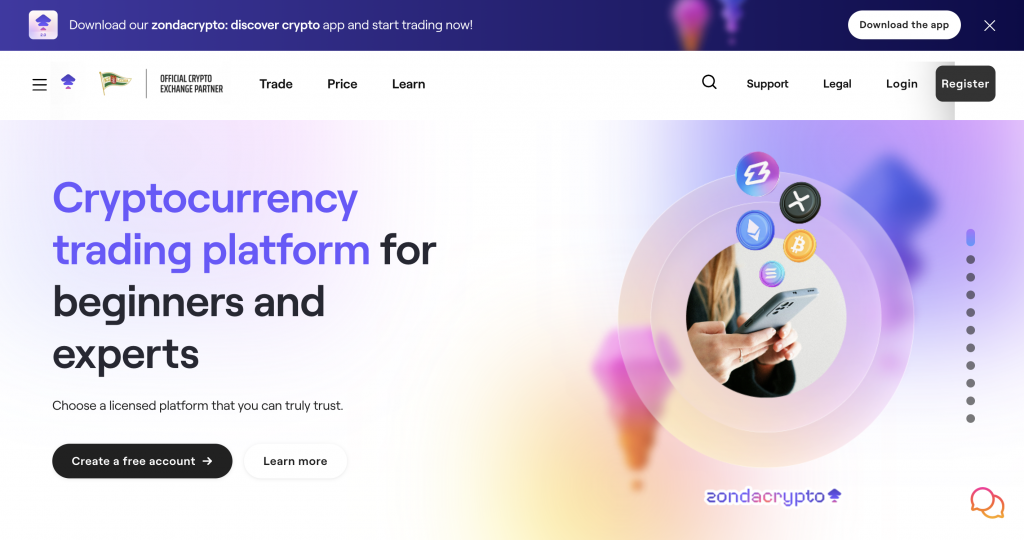
Zonda Exchange at a Glance
Zonda positions itself as a fiat-friendly crypto exchange with regional payment rails and a structured fee system. It supports both individual users and businesses, with separate services like trading and crypto payment processing. Below is a quick snapshot of its core setup:
| Feature | Details |
| Founded | 2014 (operating as zondacrypto) |
| Core Offering | Spot crypto trading and a crypto payment gateway |
| Supported Fiat | EUR, USD, PLN |
| Deposit Methods | Bank transfers (SEPA, Elixir), cards, BLIK, ZEN |
| Trading Fees | Tiered, starting from ~0.25% (lower with loyalty tiers) |
| Crypto Withdrawal Fees | Network-based (e.g. BTC ~0.0005 BTC, ETH ~0.005 ETH) |
| Security Measures | Cold storage, 2FA, encrypted infrastructure |
At a high level, Zonda focuses on structured access to crypto using traditional payment methods, with clear minimum transaction thresholds starting from €5 or $5, depending on the trading pair.
What Is Zonda?
Zonda, operating as zondacrypto, is a European cryptocurrency exchange that provides spot trading and fiat on-ramp services. It supports digital assets such as BTC, ETH, and USDT, as well as fiat currencies such as EUR, USD, and PLN. The platform is structured around account-based trading, where users deposit funds through bank transfers, cards, or local payment methods before executing trades.
Zonda also offers a payment gateway (Zondacrypto Pay) for businesses to accept crypto payments with optional conversion to fiat. Its model centres on regulated access, identity verification, and defined fee tiers rather than advanced trading infrastructure.

How Zonda Exchange Works
Zonda operates as a custodial exchange. After registering and completing identity verification, users can fund their accounts using supported payment methods, including SEPA transfers, cards, and local options such as BLIK and ZEN. Once funds are available, users can place buy or sell orders on supported trading pairs. Transactions are subject to a minimum value threshold of €5 or $5, depending on the market.
Fees apply at different stages, including deposits (e.g., card payments at 2.99%), trading commissions based on tier levels, and withdrawals that follow either percentage-based or fixed structures. The platform also integrates loyalty tiers that reduce trading fees based on activity.
Key Features of Zonda Exchange
Zonda focuses on practical access to crypto through fiat integration, structured fees, and account-level controls. Its feature set is narrower than that of global exchanges but is built around defined use cases.
Fiat Payment Integration
Zonda supports multiple fiat rails, including SEPA bank transfers, card payments, and regional methods such as BLIK and ZEN. Deposits can be free via bank transfer, while card funding carries a 2.99% fee. This setup allows users to move between fiat and crypto without relying on external platforms.
Tiered Trading Fees with Loyalty Program
Trading fees follow a tiered structure, starting at around 0.25% and decreasing as activity levels increase. Users can access lower fees through the ZND Loyalty Program, with top tiers reaching as low as 0.05% maker and 0.10% taker. This creates a measurable cost difference depending on usage.
Built-In Crypto Payment Gateway
Zonda includes a separate payment solution that allows merchants to accept crypto and settle in crypto or convert to EUR or PLN. Fees range from 0.5% for crypto-to-crypto payments to 1.1% when automatic fiat conversion is applied. This extends the platform beyond trading into payment processing.
Zonda Exchange Fees Explained
Zonda applies fees across deposits, trading, and withdrawals, with clear percentage-based structures. Bank transfers in EUR or PLN can be free, while card deposits typically carry a 2.99% fee.
Trading fees follow a tiered model, starting around 0.25% and decreasing through the ZND Loyalty Program, with top tiers reaching 0.05% maker and 0.10% taker. Withdrawals vary by method; for example, SEPA transfers are at 0.08% with minimum and maximum caps, while crypto withdrawals depend on network fees, such as 0.0005 BTC or 0.005 ETH. Overall costs depend on funding method and activity level.
How to Use Zonda Exchange
Zonda follows a standard custodial exchange flow, where you fund an account first, then execute trades.
Step 1: Create an account
Register using your email and complete identity verification (KYC) to unlock deposits and withdrawals.
Step 2: Deposit funds
Choose a funding method such as SEPA bank transfer, card payment, BLIK, or ZEN. Bank transfers are free, while card payments incur a percentage fee.
Step 3: Choose a trading pair
Select a market such as BTC/EUR or ETH/USDT based on the funds you deposited.
Step 4: Place an order
Enter the amount and confirm the transaction. Minimum trade values start from €5, $5, or 5 PLN, depending on the pair.
Step 5: Withdraw or store funds
You can keep assets in your account or withdraw to a bank account or external wallet, depending on your needs.
Supported Cryptocurrencies and Networks
Zonda supports a broad but curated list of cryptocurrencies, covering major assets, stablecoins, and selected tokens. Core assets include Bitcoin (BTC), Ethereum (ETH), Solana (SOL), and XRP, alongside stablecoins such as USDT and USDC. It also lists a mix of DeFi tokens, fan tokens, and ecosystem assets like Chainlink (LINK), Polygon (POL), and The Graph (GRT).
On the network side, Zonda supports multiple blockchains, including Ethereum (ERC-20), Tron (TRC20), Polygon, Arbitrum, Optimism, and Solana. Each asset follows specific deposit and withdrawal requirements, including minimum thresholds and fixed network fees.
Pros and Cons of Zonda Exchange
Zonda focuses on fiat access, structured fees, and regional payment integration. That makes it straightforward in some areas, but more limited in others. Here’s how it breaks down based on its actual setup and fee model.
Pros
- Multiple fiat deposit methods, including SEPA, cards, BLIK, and ZEN
- Bank transfers available with 0 EUR deposit fees in many cases
- Tiered trading fees starting around 0.25%, reduced to 0.05% maker at higher tiers
- Low minimum trade size starting from €5, $5, or 5 PLN
- Integrated crypto payment gateway for merchants with 0.5%–1.1% fees
Cons
- Card deposits carry a 2.99% fee, increasing the total transaction cost
- Limited advanced trading features compared to larger exchanges
- Geographic restrictions, including stated exclusion of UK users in official communications
Zonda Exchange vs CEX.IO
Zonda and CEX.IO both provide fiat-to-crypto access, but their structures differ in payment flexibility, fee models, and product scope.
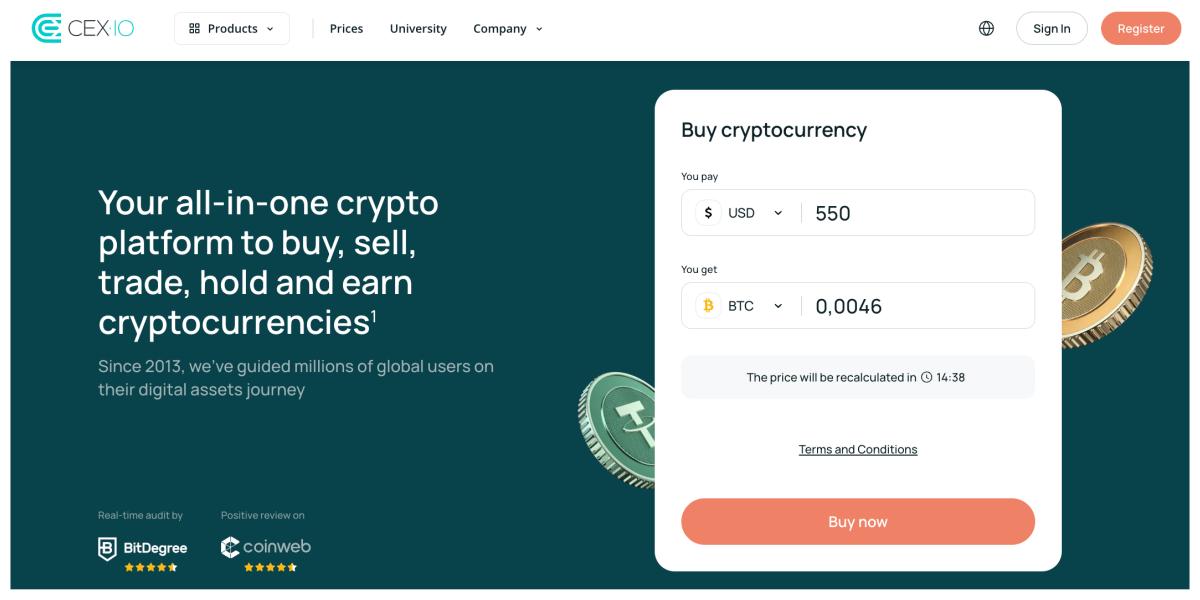
CEX.IO supports card deposits with fees ranging from 0.49% to 4.99% plus service charge, depending on transaction parameters, while Zonda applies a fixed 2.99% card fee. This creates variability on CEX.IO, where lower-cost card transactions are possible under certain conditions, while Zonda maintains a flat rate. Zonda does offer 0 EUR SEPA deposits, but CEX.IO also supports multiple fiat rails, including ACH (U.S.), cards, and digital wallets, expanding regional access.
Trading fees follow different structures. Zonda starts at 0.25% and reduces to 0.05% maker / 0.10% taker through its loyalty program. CEX.IO begins at 0.25% and scales down to 0.10% based on 30-day volume, without requiring a platform token or tier participation.
Asset access on CEX.IO is broader in terms of functionality. Zonda focuses on spot trading and payments, while CEX.IO offers spot trading, Instant Buy, and a Crypto Converter, all within a single account. This removes the need to switch between separate services for different transaction types.
Minimum transaction thresholds also differ. Zonda sets a minimum trade size of € 5, while CEX.IO supports card purchases starting at $20, aligned with its payment infrastructure.
From a regulatory and operational perspective, CEX.IO operates under FinCEN registration in the U.S. and multiple state-level licences, alongside compliance in other jurisdictions. Zonda highlights licensing under the Estonian FIU, but also explicitly restricts access for certain regions, including the United Kingdom.
Overall, Zonda provides structured fiat access and predictable fees, while CEX.IO offers broader functionality, more flexible payment routing, and a wider regulatory footprint.

Exchange Comparison Overview
The table below highlights key differences, focusing on measurable factors such as fees, payment access, and product availability:
| Feature | Zonda Exchange | CEX.IO Exchange |
| Card Deposit Fees | 2.99% fixed | 0.49%–4.99% + service charge |
| Bank Transfers | 0 EUR (SEPA) | Supported (ACH, SEPA, wires) |
| Trading Fees (Entry Level) | ~0.25% | 0.25% |
| Fee Reduction Model | Loyalty tiers (token-based) | Volume-based tiers |
| Core Products | Spot trading, payments | Spot, margin, Instant Buy, converter |
| Regulatory Coverage | Estonia (FIU), regional limits | U.S. (FinCEN + state licences), multi-region compliance |
Which Exchange Is Better for Beginners?
Both Zonda and CEX.IO allow new users to access crypto through fiat payments, but the onboarding path and transaction flow differ in measurable ways.
Zonda requires users to deposit funds first, then manually select a trading pair and place an order. While minimum trades start from €5, the process still follows a traditional exchange structure with order placement and pair selection.
CEX.IO supports a more direct purchase flow through Instant Buy, where users select an asset, enter an amount, and confirm the final price before completing the transaction. This removes the need to interact with trading pairs during the first purchase. Card transactions start from $20, and the total cost is displayed upfront before confirmation.
Funding flexibility also differs. Zonda supports SEPA, cards, and regional methods like BLIK and ZEN. CEX.IO expands this with ACH (U.S.), cards, and digital wallet integrations, allowing users to choose between lower-cost bank transfers and faster card payments depending on availability.
From a structure perspective, CEX.IO keeps buy, sell, and conversion tools within a single interface, while Zonda separates funding and trading into distinct steps.
For beginners who want a defined purchase flow with upfront pricing and fewer steps, CEX.IO provides a more direct path. Zonda may suit users who are comfortable placing trades manually from the start.
FAQs
Is Zonda crypto safe?
Zonda applies several account-level security measures, including two-factor authentication (2FA), withdrawal confirmations, and encrypted infrastructure. It also states that crypto funds are stored in cold wallets. In addition, the platform follows AML and KYC procedures. However, like any custodial exchange, users rely on the platform’s internal controls to access and manage funds.
What is the CEO of Zonda crypto?
Zonda, operating as zondacrypto, has undergone multiple structural and branding changes over time, and public-facing information about executive leadership is not consistently highlighted across its platform materials. As a result, the CEO is not always clearly stated in standard user documentation, and users typically interact with the platform rather than its leadership team.
How does Zonda crypto work?
Zonda works as a custodial exchange. Users register, complete identity verification, and deposit funds using methods such as bank transfers or cards. Once funded, they can trade crypto pairs starting from €5 or equivalent. Transactions include trading fees, and withdrawals can be made to bank accounts or external wallets.
Is Zonda a real company?
Yes, Zonda is a real cryptocurrency exchange operating under the zondacrypto brand. It has been active since 2014 and provides trading services, fiat deposits, and crypto payment processing. The platform operates within regulatory frameworks in certain jurisdictions and publishes legal documents, fee tables, and operational policies for users.
Is Zonda a Chinese company?
No, Zonda is not a Chinese company. It operates as a European-based crypto exchange and positions itself around regional compliance, including licensing under Estonia’s Financial Intelligence Unit framework. Its services, payment methods, and supported currencies reflect a focus on European markets rather than China.
Who bought Zonda?
Zonda has evolved from earlier branding and ownership structures, including its transition from BitBay to zondacrypto. Rather than a single high-profile acquisition, the platform has undergone rebranding and internal restructuring over time. Public documentation focuses more on its services and regulatory positioning than on ownership changes.
Where is Zonda based?
Zonda operates in Europe and highlights regulatory alignment with Estonia’s Financial Intelligence Unit (FIU). Its services support European fiat currencies such as EUR and PLN, along with regional payment methods like SEPA and BLIK. This positioning indicates a primary operational focus on European markets.
Why is it called Zonda?
The name “Zonda” reflects the platform’s rebranding from BitBay to zondacrypto. While the company has not provided a detailed public explanation of the name choice in standard materials, the rebrand aligns with its broader shift toward a more global identity and expanded product ecosystem, including payments and loyalty programs.
Is Zonda available in the U.S.?
Zonda’s availability is limited by jurisdiction, with its services primarily focused on European markets. Access for U.S. users may be restricted depending on regulatory requirements and internal policies. In comparison, CEX.IO operates in the United States under FinCEN registration and state-level licences, allowing eligible users to buy, sell, and trade crypto within a defined regulatory framework.